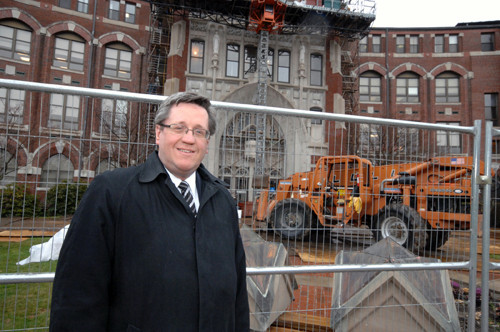
When John Sweeney worked at Eastern Connecticut State University, he saw enrollment shoot up by 60 percent over a decade and administrators attribute much of the boost to an ambitious project that built new residence halls and renovated other campus buildings. Now at Providence College, Sweeney hopes the same formula works at the private, Catholic school.
Sweeney, the school’s senior vice president of finance and business, is coordinating a seven-year, roughly $35 million project to overhaul all 15 of the college’s residence halls.
“How your dorms look are not going to get you students but they may persuade them to go elsewhere,” Sweeney said. “If a college is not maintaining their facilities why would you think they’re going to maintain their academic programs?”
With one exception, the renovations will not change the style of the dorms, but rather renovate everything from the ceilings to shower stalls. New furniture will arrive too. The one exception is Dore Hall, which the college hopes to transform into a school of business. To replace the lost beds, it will build a new residence hall.
The college’s 15 dorms represent a mix of styles, with some with rooms in a traditional railroad-track design and others with apartment-like suites. The college acquired some when it purchased the former Charles V. Chapin Hospital in 1974.
Sweeney said the college has always maintained its stock of residence halls that house about 3,100 students, or about 80 percent of its undergraduate students. But the college historically has undertaken work at its residence halls in a piecemeal fashion, for example replacing floors one year and doors the next.
Sweeney saw two problems with such a strategy. One, it lessened the impact of renovations because aging furniture or the nonrenovated parts of buildings overshadowed the recent work. And two, it just wasn’t efficient. Workers would clear the furniture to replace the floor, put it back and then come in a few months later to remove it for the painters.
Hired in March 2010, Sweeney sought to instead put the college on a regular cycle, modeling the timeframe after the hospitality industry. Under the plan backed by the school’s president and board of trustees, the college each year will aim to renovate about 120,000 square feet, representing about 442 beds.
“There were a lot of great things going on” before his arrival, Sweeney said. The dorm plan, he said, “Was just saying, ‘let’s look a little further out and see how everything fits together.’ ”
Work started last year with renovations to two dorms – Brown and DiTraglia halls – at a cost of about $900,000.
Up this summer is a complete renovation of 328-bed Davis Hall that Sweeney expects to cost between $2 million and $3 million, including new furniture. Also this summer, the college will renovate half the bathrooms in Raymond Hall, with the remainder refurbished in the summer of 2012 for a total project cost of $500,000. This summer, workers will also aim to complete a $700,000 bathroom renovation at Guzman Hall.
The annual $4 million to $5 million in investments in residence halls represents about one-third of the overall money Providence College sets aside each year for capital building projects. (Other money will go toward finishing the renovation of an administrative and academic building, among other projects.)
Sweeney said the college would not raise student housing fees to pay for the projects. Instead, the school has been identifying operational efficiencies that reduce costs, such as putting its natural gas purchases out to bid, switching waste haulers and revamping its copy machine systems.
The buildings may also eventually pay for themselves. Sweeney said the overhauls allow the school to put in new energy-efficient heating and ventilation systems, better insulation, low-flow plumbing and, in apartment-style buildings, energy-efficient kitchen appliances. •