When Chuck Wexler, executive director of a national organization of police chiefs called the Police Executive Research Forum, came to Providence to see the force led by Col. Dean M. Esserman, he saw two things he liked – community organizations partnering with police and officers that enjoy their jobs.
“Providence has always been known for one thing or another, but it’s known today for turning itself around,” Wexler said last week at the 2nd Annual New England Police Summit, held June 3 at Roger Williams University. “I look out and I see the Providence police officers and when I look in their eyes, I say, ‘They like this place, they like what they’re doing.’ ”
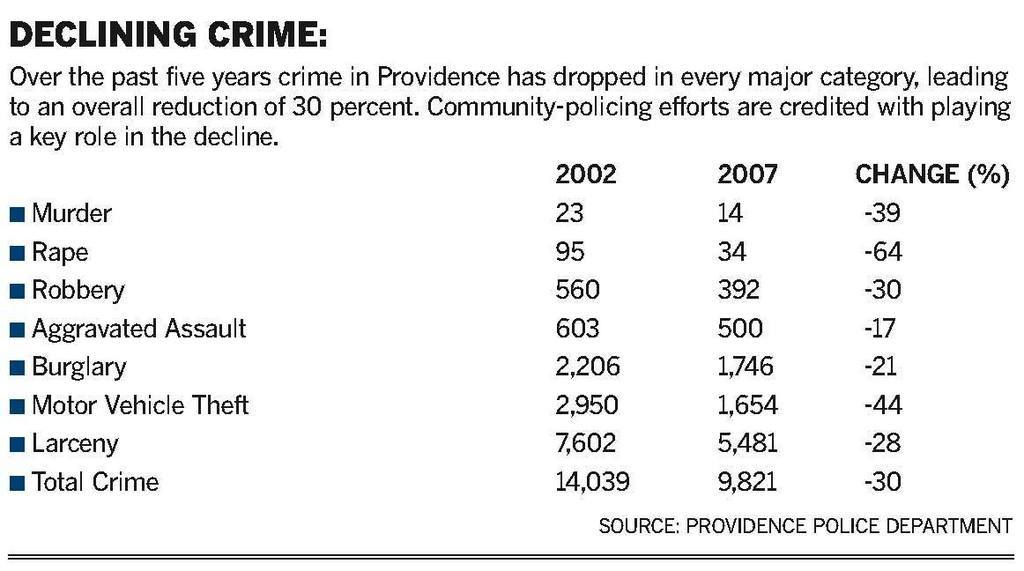
The department’s statistics show that crime in the city dropped by 30 percent between 2002 and 2007 – the number of incidents declined each year, from 14,039 during 2002 to 9,821 during last year.
At least some of that “historic” decline can be attributed to setting up community policing stations throughout the city, but the partnerships between community organizations and businesses are also important, Mayor David N. Cicilline said. “The most powerful tool throughout all of this is the restoration of trust,” he said.
Some of that trust is the result of programs that Esserman has ushered into the city over the last five years.
One of those programs is David M. Kennedy’s “High Point” approach to attacking the drug market. Kennedy, the director of the Center for Crime Prevention and Control at John Jay College of Criminal Justice, worked with the city for about two years. Instead of arresting the mid-level drug dealers in the Lockwood neighborhood, the program instead holds a community intervention at which they’re given a chance to stop.
“In every single city that has done this, at the moment of the meeting the drug market has evaporated and hasn’t come back,” Kennedy said.
Lt. George Stamatakos, one of four officers that led the Lockwood investigation, said 104 dealers were arrested and seven – the “lucky seven” – were given a chance to stop dealing drugs.
And there’s another benefit to the program: police aren’t seen only as enforcers, but as community members, he said. “The community sees you in a different light.”
The reduced crime rate and the availability and quick response of community police officers have helped attract business to the city, said Daniel Baudouin, executive director of The Providence Foundation, in an interview last week. “People can see that there’s order to this place, that people value this place, that it’s not a place were they can generally come down and create problems. There are some issues still, at 2 a.m., that create their own problems. … [but] people feel pretty comfortable downtown.”
Bob Herbert, a New York Times columnist, has written extensively about the long-term efforts of police departments around the country to “improve, refine, modernize and humanize their approach to crime.” At last week’s summit, he said Esserman has been at the forefront of that movement.
But community policing is only part of the equation. The community itself is playing an increasingly important role, said Kennedy.
In Providence, one of those community groups is Community Mediation Center of Rhode Island.
That nonprofit, a four-employee operation on Broad Street, this year received a grant from the Rhode Island Foundation to boost a “juvenile restorative justice” project that helps perpetrators of low-level crimes to connect with their victims, said Pam Humphrey.
“The idea is really to get [the offenders] when they’re young and to reconnect them with the person against whom they’ve offended,” Humphrey said. They’ll then “realize that their actions not only affect that victim, but also their community, the victim’s family and everyone around them.”
The program, in its “early stages,” is being used for crimes like “property offenses and maybe a simple assault. We’re not yet dealing with heavy violence, murder or sexual offenders,” she said. •