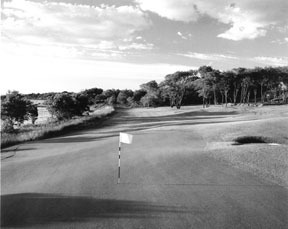
things, a Scottish links-style golf course.
At a quarter-billion dollars, it’s one of the most expensive private investment projects ever embarked on in Rhode Island.
Yet few people have seen – or ever will see – the spectacle of serene elegance unfolding on the shore of Narragansett Bay in Portsmouth. And that’s just how Carnegie Abbey Chairman Peter de Savary wants it.
The British sailor and entrepreneur says his Carnegie Abbey club – opened in July 2000 and still rapidly taking shape – is a place of laid-back leisure, rather than a symbol of opulence.
“We’re discreet, low-key people. We like to get on with things quietly,” de Savary said earlier this month while relaxing on a leather sofa in Carnegie Abbey’s new 78,000-square-foot clubhouse, which opened in April.
“When you drive in it should feel like a farm, peaceful and tranquil, modest and without pretension, yet recognizing that affluent people appreciate the very best,” he said.
The club sits on roughly 500 acres of bucolic bayside property, most of which it leases from the Benedictene Monks at the adjacent Portsmouth Abbey School. The affluent enclave offers seven miles of equestrian trails, fly and sea fishing, a 340-foot pier, tennis, sailing and European-style spas – all tied together by a Scottish links-style golf course. Four miles of ubiquitous stone fences snake through the grounds, relics of Colonial farmers.
In the works are a 79-slip marina, nearly two dozen palatial seaside homes and a 14-story, art deco condominium tower that, upon completion in two years, will afford one of Rhode Island’s most breathtaking views.
Carnegie Abbey’s centerpiece is the newly opened Adirondack-style, cedar-shingled clubhouse, which looks more like a sprawling country mansion. The $18-million building was designed by Newport Collaborative Architects Inc.
A 45-foot, two-sided stone fireplace dominates the clubhouse foyer, which has large stone tiles and vaulted wooden ceilings. Local Narragansett Indian subcontractors built all the interior and exterior stonework – and there’s plenty of it.
The octagonal bar is mahogany, circled by leather barstools and offering views of either the bay or a plasma TV (one of dozens of plasma screens found throughout the clubhouse and private residences).
Off the bar is a snooker room with backgammon and chess tables and a collection of 50 single malt scotches. A screened-in porch wraps around the entire front of the building, overlooking the bay and the club’s signature 18th hole – a reachable par 4 for big hitters willing to launch their drives across a corner of the bay.
Above the clubhouse are 22 posh apartments for Carnegie Abbey’s resident members. They come fully furnished to reflect a yachting theme, flooded with natural light and appointed with black granite countertops, stainless steel appliances, white wood paneling and leather furniture. Each is named after an America’s Cup yacht.
The priciest is “Victory” (named after de Savary’s 1983 America’s Cup boat), a three-bedroom with a study, priced at $3.5 million. The least expensive, a one-bedroom suite, went for $800,000.
The most ambitious and striking element of Carnegie Abbey still is a work in progress: the 14-story Kaiser tower, a defunct wire-making plant just a few hundred yards from the future marina – and now a spire of bare cinder blocks – is being transformed into 35 luxury condominiums.
The 220-foot tower, which will command views of both Providence and Block Island on a clear day, will be ringed by 22 seaside homes, the lots for which are selling in excess of $1 million. Eight have sold and the club has received deposits on eight more.
Carnegie Abbey memberships are being snatched up fast. About 280 of the 375 membership slots are filled. New members, who must be sponsored, pay a $150,000 refundable initiation fee. Annual dues are $8,000.
The club has attracted members from 23 states and four countries, though it primarily draws from the Northeast, according to John D. Douglas, club secretary. A handful of members reach Carnegie Abbey by boat, docking at the club’s 340-foot pier. One member, a New York investment banker, arrives by seaplane.
Carnegie Abbey’s estimated total cost is $250 million at full build-out, within three or four years. Initial planning on the project began six years ago. It has been financed with no debt, de Savary said.
“The reimbursement of the capital investment comes from the memberships and real estate sales,” he said matter-of-factly between puffs of his cigar.
Day-to-day operations – which require a staff of roughly 150 in peak season, including 60 caddies – is paid through annual dues and spending by members on food, drinks and other services.
de Savary, 59, made much of his fortune in the oil and shipping business, having once owned three oil refineries in Texas and 15 shipyards throughout the world. He now owns three other old-world clubs, including one in England and a historic plantation in South Carolina.
While Carnegie Abbey will fly under the radar of most Rhode Islanders, de Savary says the project is a good thing for the state – even beyond the influx of investment.
“The membership we have is so diverse. They are substantial, high quality people being exposed to the state of Rhode Island,” he said. “I think we can be a bit of a shop window for that, for them to explore business opportunities here.”
For the complete current issue, visit our subscription Web site, or call (401) 273-2201, ext. 227 or 234.