Home News Story Promise, threats associated with AI, cybersecurity take center stage at PBN summit

Promise, threats associated with AI, cybersecurity take center stage at PBN summit

Corrected at 4:15 p.m.

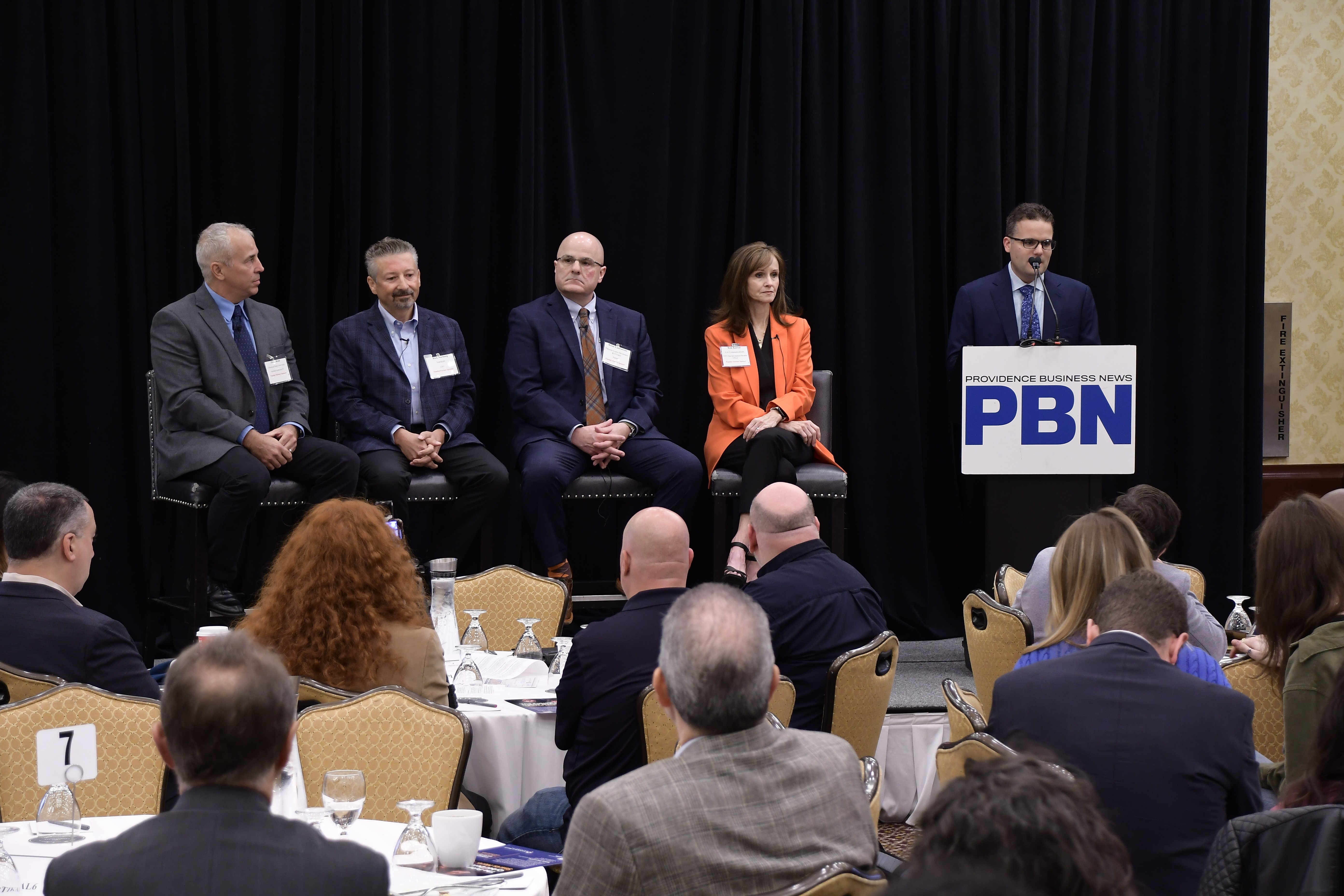
NORMAND DUQUETTE, at right, senior vice president of Starkweather & Shepley Inc, serves as the moderator during one of the panel discussions at Providence Business News' 2024 Cybersecurity AI and Tech Summit at the Crowne Plaza Providence-Warwick on Thursday. Participating in the discussion on strategies for controlling external risk is, from left, Peter Reid, Johnson & Wales University assistant professor of information technology; Rick Norberg, Vertikal6 Inc. CEO; Brian J. Lamoureux, Pannone Lopes Devereaux & O'Gara LLC partner; and Kim Keever, Cox Communications Inc. chief information security officer and senior vice president. / PBN PHOTO/MIKE SKORSKI

WARWICK – When talking about artificial intelligence, Rhode Island College professor Tim Henry encourages his students to think of the software like an uneducated intern.  “You have to be really specific” when working with AI, Henry said. “You can’t trust what it tells you. And [like interns], you have to give them feedback so the

Already a Subscriber? Log in

To Continue Reading This Article

Become a Providence Business News subscriber and get immediate access to all of our premier content and much more.

Learn More and Become a Subscriber

NO COMMENTS

WARWICK – When talking about artificial intelligence, Rhode Island College professor Tim Henry encourages his students to think of the software like an uneducated intern.  “You have to be really specific” when working with AI, Henry said. “You can’t trust what it tells you. And [like interns], you have to give them feedback so the next time they do it, they do it better.”  Henry spoke on the second of two panels at Providence Business News’ 2024 Cybersecurity, AI and Tech Summit, held Thursday morning at the Crowne Plaza Providence-Warwick.   But even if that intern can’t be trusted to turn in quality work now, Henry and proponents of AI say that it has the potential to grow far beyond these stumbling beginnings. Some of the technology’s most vocal champions insist that it will spark a revolution comparable in impact to the Industrial Revolution and that Rhode Island can lead a nationwide leap – as it did during industrialization – into leveraging AI.  Among the technology’s enthusiastic proponents is Christopher Parisi, president of marketing firm Trailblaze Inc. who moderated the panel titled “How AI can transform businesses in R.I.”   Parisi, who hosts an AI podcast and sits on the state’s AI Task Force, described AI in Rhode Island as “raging ahead and not slowing down by any means,” creating “vast opportunities," although he is also calling for risk-mitigation measures.  Part of that safeguarding strategy includes maintaining a human element as the technology grows, Parisi said. But Parisi also urges businesses to capitalize on AI or risk being left behind.   Throughout the discussion, panelists raised a range of potential AI applications — from using the technology to replace menial office tasks to humans creating their own high-tech, “digital twins” that mimic their thinking to assist in day-to-day tasks.  Like Parisi, Arnell Milhouse, co-founder and CEO at AI startups SiliconXL and DevAccelerator, advocated strongly for embracing high-level AI usage.   Among the discussion’s audience, attendees presented a mixed attitude on AI. When informally polled by Milhouse, about half of the room appeared to raise their hand to indicate they were excited about the technology, while the remaining attendees found it anxiety-provoking.   Milhouse also acknowledged the ethical risks associated with AI but discouraged over-regulation during the technology’s early stages and urged the business community to embrace the software.  “We have to treat our road forward the way we treat our cars,” Milhouse said. “We can’t take the brakes off, and we shouldn't remove the gas pedal, either. We have to use them according to the terrain.”  Dori Albert, president of Lincoln-based technology consulting firm Spyglass MTG LLC, said her company finds AI useful for routine tasks. But like Henry, she emphasized the need for human oversight of AI even in smaller tasks.  “You can’t trust what comes out,” Albert said. “You have to go through and add your own thoughts and voice onto anything. [It’s the] same with code. It’s getting better and better … but you have to have human intervention.  “What we need to do as workers is learn how to work with AI so that we all become more productive,” Albert said.  An earlier panel, “The Great Unknown,” included Kim Keever, senior vice president and chief information security officer at Cox Communications Inc.; Brian J. Lamoureux, partner at Pannone, Lopes, Devereaux & O’Gara LLC; Rick Norberg, CEO of Vertikal6; and Peter Reid, assistant professor of information technology at Johnson & Wales University.   Normand Duquette, senior vice president of Starkweather & Shepley, moderated that panel, which focused on cybersecurity measures that businesses can take when working with vendors.  The security discussion comes as cyberattacks are perhaps more top of mind among the general public given recent highly publicized breaches affecting corporations such as Crowdstrike and Ticketmaster.  These incidents aren’t just isolated attacks elevated by big-name businesses, Duquette said. In 2023, FBI-confirmed internet crime complaints in Rhode Island jumped 28%, to 1,425, compared to 2021, with 1,115 confirmed cases. All in all, these events cost more than $46 million.  Nationwide, statistics reflect an even bigger increase in cybersecurity complaints, with these filings rising by 83% from 2019 to 2023.  No security measures will provide businesses or their vendors with complete protection from cyber attacks, panelists said, though companies and individuals can still take measures to limit risks.  That includes maintaining a proactive approach to cybersecurity, Norgberg said.  “Take the assumption that your data is out there, and you need to protect it,” he said.  Businesses must also remain vigilant of their own responsibilities when working with vendors, Reid noted.  “You can’t outsource your responsibility for protecting your customers’ data,” Reid said.  (SUBS 19th paragraph with corrected data on R.I. losses to $46 million.) Jacquelyn Voghel is a PBN staff writer. You may reach her at Voghel@PBN.com. 
Exit mobile version