
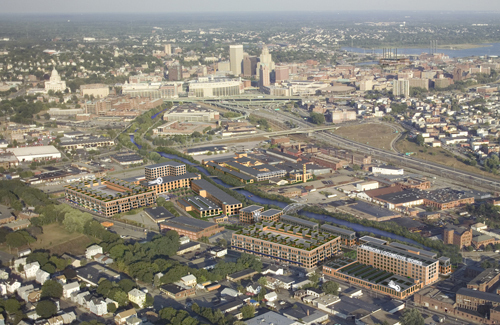
The City of Providence is reviewing an $8 million tax-increment financing plan for the American Locomotive Works (ALCO) site that would include a tax incentive for United Natural Foods Inc., slated to move its corporate headquarters to the Valley Street complex in the spring.
Public hearings are expected this month, said Eric Busch, development director for Struever Bros. Eccles & Rouse Inc., Baltimore-based developer and manager of the ALCO site in the city’s Olneyville section. He says his firm welcomes the public review.
“We’re very much in support of a very public process, a transparent process, and we realize that there’s quite a bit of apprehension when people talk about tax incentives or tax programs,” he said. “We think that, on its merits, this is a fantastic opportunity for the city.”
The tax plan, which comprises five separate ordinances available for review at the city clerk’s office, has been forwarded to the City Council’s finance subcommittee, chaired by councilman John J. Igliozzi, according to City Council President Mark S. Mancini. He confirmed that the City Council will hold public hearings on the matter, and said the Providence Redevelopment Agency and the city planning committee also must review the proposal.
“Preliminarily, it seems exciting,” Mancini told Providence Business News last week, noting however that he has yet to study the specifics of the plan. “It would create jobs, housing and public green space, a lot of positive things.”
“The majority” of the $8 million tax-increment financing bond, Busch said, would be used to support the creation of work force housing and affordable housing, in partnership with the Olneyville Housing Corporation, part of the development’s second phase.
Work on the second phase of the ALCO development, which includes the rehabilitation of two buildings into commercial space and residential units, was scheduled to begin this fall, but Busch said the start has been postponed until spring. “We’re ready to go,” he said. “The credit markets are the issue. In the current economic climate, closing construction loans is extremely difficult, and many banks are just more or less in a state of not making loans right now.”
Busch denied, however, that the $8 million financing request replaces funding that fell through.
The ALCO site is on the National Register of Historic Places and, Busch said, developers will continue to utilize state and federal historic rehabilitation tax credits. Changes in the state tax credit program this year capped the amount of the credits and required advance payment of hefty fees. The changes, Busch said, “definitely created a difficult financial situation for the project, but we’ve been able to continue to work through that, despite the challenges from the overall economic climate.”
McCormack Baron Salazar, of St. Louis, Mo., a company Busch said is one of the best in the nation, would build and manage the housing developments. Another portion of the bond would go to create green space along the Woonasquatucket River, as well as for infrastructure and traffic improvements.
A portion of ALCO’s future property taxes would be pledged to pay off the 25-year bond, Busch said. If values drop precipitously and those taxes never materialize, the ALCO developer would be liable for all future payments, not the city, he stressed.
“It’s a different concept,” Busch said of the financing plan, “and we think a great tool for a project like this. I believe there are a lot of misgivings and apprehension about it because it’s a new program, which is part of the reason we welcome this open and transparent [review] process.” The Providence City Council will have final say on the tax-financing plan.
City officials have said the tax-increment financing plan would include a provision to phase in and stabilize property taxes for United Natural Foods for a decade, and the company also will have access to low- and no-interest loans from the Providence Economic Development Partnership.
State officials have said they will ask the General Assembly to consider a limited sales tax exemption for construction supplies and other materials related to United Natural’s relocation, and a reduction in the corporate tax rate for the new company. Both city and state tax incentives would be based in part on the number of new jobs created, officials have said.
Based in Dayville, Conn., United Natural Foods recently announced plans to relocate its corporate headquarters to the ALCO complex by May 2009, bringing 150 existing jobs and the possibility of 90 new jobs over the next three years. A company official has said that most salaries at United’s corporate offices range between $60,000 and $70,000 annually. United Natural has signed a 10-year lease for the ALCO site.
Under Chairman Michael S. Funk and President/CEO Steven L. Spinner, the publicly traded United Natural Foods Inc. has 6,300 employees nationwide in seven divisions and 12 natural product stores, reporting annual sales of $3.4 billion and annual profits of $48.5 million. City and state officials actively wooed the company for about six months.
United Natural Foods carries and distributes more than 60,000 products to more than 17,000 customers nationwide, serving a wide variety of retail markets. The company will retain its warehouse in Dayville.
Busch called United Natural Foods a “fantastic tenant” and “great match” for the ALCO site because the company, like Struever Bros., believes in adopting green initiatives whenever and wherever possible. “There are currently plans in process for solar panels [at ALCO], the LEED certification is under way for the project and will be followed for the tenant space,” Busch said, referring to the national Leadership in Energy and Environmental Design standards recommended to protect the environment.
United Natural will be located in approximately 53,000 square feet on the second story above the headquarters of the R.I. Economic Development Corporation (EDC), a space that actually spans two separate but connected buildings, according to Busch.
The site is part of the first phase of the ALCO project, which includes five buildings that were rehabilitated last year to create a total of 200,000 square feet of retail and office space. United Natural will join nine other tenants, including the EDC and the Pannone, Lopes & Devereaux LLC law firm.
Busch said more space remains available in the first ALCO phase and “several other prospects” are looking at the site. •


