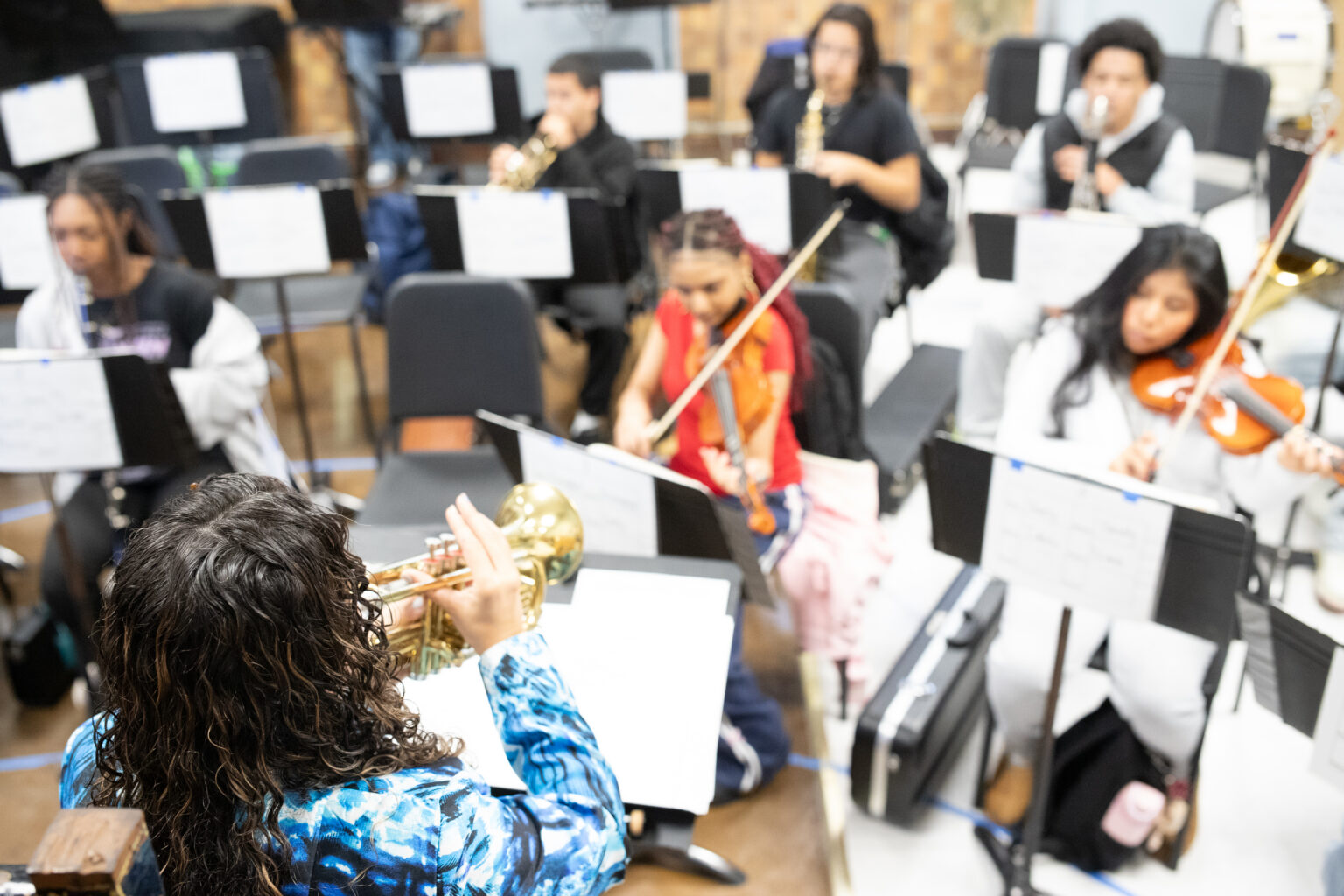
The students in Danielle Trial Lucini’s concert band class were charging through the White Stripes’ “Seven Nation Army” during first period at Mount Pleasant High School in Providence.
Lucini let them finish before offering her review: It was enthusiastic, but too fast.
“I need to hear the space between the notes,” Lucini told them.
For more than an hour, 14 students ran through riffs, motifs and abbreviated band and pop standards. Their teacher often took up an instrument herself to demonstrate or sometimes ceded conducting duties to one of her students. She also sang and played alongside them.
Students often tell Lucini she’s their “strictest teacher.” But Lucini – who was awarded Providence Teacher of the Year in June – expects them to not only show up to class, but to participate.
“You can come to band class and sit with your instrument in your lap,” she told Rhode Island Current in an interview. “That doesn’t help anybody.”
Continuous high school participation in arts classes — especially music — was associated with better school attendance in a new study conducted by Quadrant Research and commissioned by the Rhode Island State Council on the Arts.
The Sept. 17 report’s primary question: “Do arts students have lower chronic absenteeism rates than non-arts students?”
To answer it, researchers looked at state education department data spanning 2018 through 2025. The arts council believes the report’s findings could have implications for how the state deals with chronic absenteeism, which is defined as missing at least 10% of the days in a school year during which students are enrolled.
Reducing chronic absenteeism has been a signature priority of the Rhode Island Department of Education under Gov. Daniel J. McKee. The governor has promoted the Attendance Matters RI campaign, which uses public dashboards, school-level data tools and family outreach to track and reduce absences. In August, McKee celebrated the fourth consecutive year of decline in chronic absenteeism rates, which are now down 14.4 percentage points from a pandemic-era peak.
After accounting for student demographics, year-to-year differences and school district, researchers estimated 25.4% of four-year music students were chronically absent, compared with 37.3% of students without four consecutive years of music.
The gap was not nearly as large, however, when researchers looked at four-year participation across all arts classes – music, visual arts, theater, dance, and media arts – the chronic absenteeism gap between four-year arts students and those who lacked four consecutive years of art was only 1.9 percentage points.
The study shows a correlation, Robert Morrison, a co-author of the report and founder of Quadrant Research, cautioned in an interview.
While data may show a relationship between art classes and better school attendance, it can’t actually prove that art classes are what made students show up, Morrison said. “‘Prove’ is pretty strong language,” he added.
Students who stick with arts classes for multiple, consecutive years may differ in ways the data can’t fully capture, Morrison said. The report notes that individual motivation, academic skill or family circumstances which encourage better attendance may keep students more engaged in the classroom. In the case of music, previous experience or lessons outside school can also help.
“What this study shined a light on through the data is something that many of our music and arts educators have known all along,” Morrison said.
Students who took at least one arts course in each of all four high school years had slightly lower chronic absenteeism rates than students who did not sustain arts participation for all four years, the report showed. The difference was much larger among students who took music all four years.
The same attendance-arts correlation was not observed in all students who took art classes. In fact, the data from 2023 through 2025 showed that high school students taking any arts course had chronic absenteeism rates a smidgen higher than students taking none.
“If you’re just taking it one year, if you’re just getting … an exposure course or like a general course that you’re taking to meet a graduation requirement, that’s not the same thing as sustained engagement,” Morrison said.
Lucini described a current junior who, when she taught him as a freshman taking band for an elective, missed 110 days of school and failed multiple classes. The next year, he asked to try band again, saying he hadn’t given it a fair shot.
In his second year with band, he was absent about 15 school days – still around the state’s definition of chronically absent – but he earned an A in band class. He continues to take band and even volunteered to perform with the band in the most recent PVDFest parade, Lucini said.
“For some kids, it’s the thing that draws them in and gives them a reason,” Lucini said.
Nicole Simpson, Providence Public Schools’ director of fine arts, said it’s important that students have a choice in arts education. They get to make decisions and work toward their own desired final product.
“That level of choice and voice is not present in any other content area,” Simpson said. “Especially in urban education, where all of our teachers are given a curriculum that says, ‘You’re on this page this week, this day, doing this lesson, and here’s how you’re teaching it.’”
For Lucini, it’s all about choice — and the punctuality, teamwork and structure band class requires only serves to reinforce students’ autonomy, rather than weaken it. She doesn’t force beginning band students to play an instrument they don’t like.
“I’m not sticking a trumpet in your hand,” Lucini said. “I want you to pick something that you like the sound of, that you’re drawn to.”
That individual choice ends up affecting the collective responsibility of the band, which Lucini called “the biggest group project you’ll ever have.” Whether practicing or performing for an audience, the players have to listen to themselves and to one another — something they can only do if everyone shows up.
Performance, she said, illustrates well the adage that if you’re on time, you’re late, but if you’re early, you’re on time. A 5:30 p.m. gig means arriving at 5 to assemble instruments and warm up.
“If one person is late, then everyone is late,” Lucini said.
One of Lucini’s senior band students is Sidney Feliz – a drummer and singer who has taken part in band and chorus during all four of her years at Mount Pleasant. She said Mount Pleasant’s music program drew her to the school, and it was her top choice for a high school. (Providence students get some choice in where they go to high school and can shortlist their preferred schools before being assigned.)
“Since I’ve been out the womb, I’ve been totally interested in music,” Feliz said. “I’ve been singing, playing stuff, but once I came here, I started taking drum super serious.”
Feliz credited Lucini with keeping her on beat when her motivation waned during sophomore and junior year.
“She kind of led me back in,” Feliz said of her band teacher. “And I don’t think I would be doing what I do today without her.”
For Feliz, the sense of direction was difficult to find elsewhere in her school day.
“I’m able to push myself to work with other classes, but it’s mainly this class where she gives us the greatest push,” Feliz said of Lucini. “We really give it our all to perform.”
The pushing works even when the students haven’t been playing a dedicated instrument for a long time. Xionangelys Lopez Davila is a sophomore in Lucini’s concert band class who played piano and flute in the past but who only started violin last year.
“It’s very difficult, but at the end, you start to understand it and love it,” she said, adding that she always shows up to Lucini’s class.
The report co-author Morrison – who took music classes himself as a teen, and worked in the music and instrument industries for years before becoming an arts education researcher – offered that the arts are worth more than what they might do for attendance.
“The arts have legitimacy for their intrinsic value in their own right,” Morrison said.
The attendance finding, he added, is a “bonus.”
Alexander Castro is a staff writer for the Rhode Island Current.