
In less than two years, Massachusetts’ health care reform has helped nearly 440,000 adults and children get health coverage, ensuring that they can afford to get the care they need.
But what if there aren’t enough doctors to provide that care?
It’s a concern that physicians have been raising for years, and a new report from the Massachusetts Medical Society shows the problem is real – and rapidly worsening as demographic trends, advances in medicine and health reform itself increase demand.
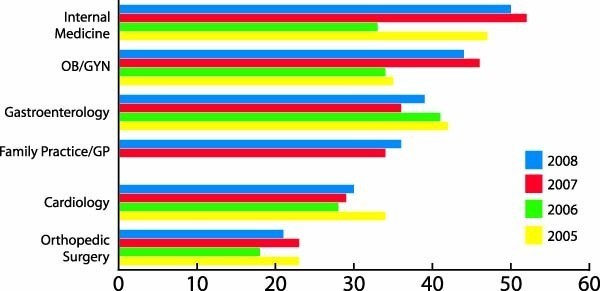
The 2008 Physician Workforce Study, based on a survey of doctors, hospitals and the public, shows the number of specialties in short supply has doubled in three years, to 12, and internal medicine and family medicine are now in “critically short” supply.
Need a new internist? The average wait for an appointment for a new patient is now 50 days – but almost half the state’s internists aren’t taking new patients. Family doctors are a bit more accessible, but there’s still an average wait of 36 days, and 35 percent aren’t taking new people.
Wait times are also substantial for cardiologists, gastroenterologists, neurologists, ob/gyns, orthopedic surgeons, pediatricians, psychiatrists and vascular surgeons – and especially for dermatologists, whose average wait time for new patients is now 67 days, the report shows.
“With more patients, an aging population and rising rates of obesity and chronic disease, demand is overwhelming supply, and our physician work force is coming under more stress and strain,” said Dr. Bruce Auerbach, president of the society, in a news release.
Health reform’s success in insuring hundreds of thousands of people “is a great step forward,” Auerbach noted, but “we now know that insurance without access to care will not result in true health care reform, and that universal coverage does not equal universal access.”
Massachusetts’ experience is closely observed by health care policymakers nationwide, and the new report offers plenty of insights applicable to any state, since many of the underlying trends – the aging population, the obesity epidemic, a rise in skin cancers – are national.
But along with Massachusetts’ dramatic reform effort, several other issues cited by the report are specific to the Bay State or to this region: the above-average cost of living, the profusion of private universities and teaching hospitals, relatively generous tort systems and the resulting high malpractice insurance premiums.
The Rhode Island Medical Society doesn’t do annual studies as its counterpart does, but executive director Newell Warde said most of the issues cited in the new report are affecting Rhode Island and Connecticut as well, and the primary care crunch is even worse in the Ocean State.
“Everywhere in southern New England, the earning capacity of physicians has been progressively depressed by insurers under heavy pressure from employers to control premiums,” Warde said. But ironically, paying doctors less only worsens the problem, especially in primary care, he said, because medical school graduates avoid the field and, without enough doctors, people don’t get the preventive care they need.
The problem is affecting every part of the health care system, from private practices to teaching hospitals, with a special impact on community hospitals, the Massachusetts report shows. The average time needed to recruit a family doctor has risen to 14.5 months; a cardiologist takes 17 months; a neurosurgeon takes 22 months; a dermatologist, 26 months.
And practicing physicians are increasingly unhappy, upset by the high rents they have to pay, the high cost of maintaining their practices, the fast-rising malpractice insurance premiums and the sense that insurers and state regulators micromanage them.
Some of the study’s findings are broken down by region, and the New Bedford/Fall River/Barnstable area does particularly badly on this front: While statewide, 47 percent of doctors said they were dissatisfied or very dissatisfied with the practice environment, in that region it was 61 percent.
In this context, the impact of health reform looks smaller than some might take it to be. In fact, for many doctors whose patients were already insured, it’s been minimal.
Such is the case for Dr. Stephen A. Hoffmann, an internist in Framingham who said his practice turns away dozens of patients every week and is “strained at the gills,” but more because practicing medicine today involves so much wrangling with insurers.
“If we didn’t have all the roadblocks to jump through to get studies and medications approved for patients … I could probably see at least 20 to 30 percent more patients,” he said. “We have to treat our patients as individuals; we have to give them the best care – we take an oath to that – and then we face a health insurance system that seems to thwart us at every corner.”
Hoffmann is also bothered by how little primary care pays compared with specialty care, especially when the demand is so great. When he started his practice, he said, it took him about eight years to surpass 2,000 patients, yet today the demand is such that a new doctor could get there in two or three years. “There is such an enormous need for primary care.”
In an interview, Auerbach, who is vice president for emergency and ambulatory services at Sturdy Memorial Hospital in Attleboro, said that facility and its affiliated medical practices are experiencing all the issues raised in the study, though not as severely as others.
Auerbach does see hope, however, in the second wave of health care reforms passed this year, which focused on promoting primary care, quality improvement and some work force issues.
“It’s our hope that the more information and the more years of data we can provide … will result in policymakers and insurers making changes so we can reverse the trends,” he said. •