 click here. / " title="TO VIEW a full-size version of this chart, click here. /"/>
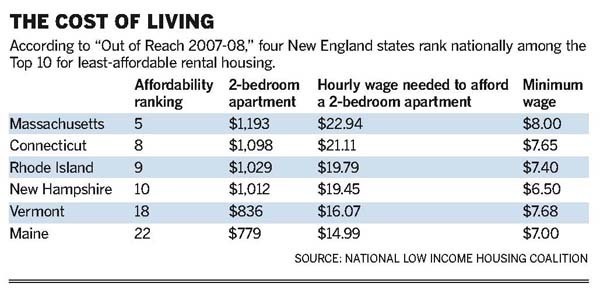
A report released this month places Rhode Island as one of the country’s least-affordable states to rent in – with a family needing to collectively earn an hourly wage of $19.79 – and says it’s seen the second-highest cost increase of any state since 2000.
Rhode Island’s necessary hourly wage pegs it as the ninth-highest in the country, according to “Out of Reach 2007-2008,” released April 7. The report is an annual publication of the National Low Income Housing Coalition.
The report says the cost of renting in Providence has during an eight-year period jumped more than 60 percent.
“That is very high,” said Danilo Pelletiere, research director for the Washington, D.C.-based NLIHC. “Rhode Island is the second-highest growth state, trailing only Hawaii. I think a large reason for that is the growth of Providence, between New York and Boston, which did experience a considerable boom in its housing market and commuter market, as well as the economy.”
In calculating the necessary hourly wage, the NLIHC assumes 40-hour work weeks and that renters don’t pay more than 30 percent of their income, a national standard, said Jim Ryczek, executive director of R.I. Coalition for the Homeless. He added, “These days there are plenty of people who are paying more than 30 percent for their rent, but that’s the standard calculus used.”
In the Newport area, the needed wage – $22.46 per hour – is higher than the state average and the needed wage in the Westerly area – $18.56 per hour – is lower. “But many Rhode Islanders, particularly low-wage and minimum-wage workers, earn significantly less than that, so it’s a real economic development issue as well,” said Brenda Clement, executive director of the Statewide Housing Action Coalition and a board member with NLIHC.
The average wage earned by Rhode Islanders who pay rent is $11.61 per hour, said Ryczek.
He suggested that the state can help bridge the gap between wages and rental rates: “We can either do something like make business raise the minimum wage – which is never a popular option – or we can have programs within the state that mitigate the difference between the cost and what people earn.”
But affordable housing advocates here are already fighting against cuts to programming proposed by Gov. Donald L. Carcieri’s Supplemental Budget FY08, introduced in January, said Clement.
That proposal includes a $26 million cut from Rhode Island Housing’s budget and cutting the entire Neighborhood Opportunities Program (NOP), which had been budgeted at $7.5 million.
Ryczek said he’s critical of the notion that such cuts would help the economy, because “at a time when we have housing as the base of the problem in the economic downturn, you don’t want to disinvest in housing programs that help workers and low-income workers get to work.”
During the last five years that the Out of Reach study has been released, the percentage of Rhode Island residents that rent has stayed close to 40 percent. During the same period, the state’s annual median income has increased 10.5 percent, from $62,348 to $68,908 this year – according to NLIHC data that’s supplied by the U.S. Department of Housing and Urban Development – but the 2008 median income of renters is significantly below that, at $31,498 in Rhode Island.
At the same time, the HUD fair market rental rate for a two-bedroom apartments has jumped 47.4 percent, from $698 per month during 2004 to $1,029 per month this year. According to Out of Reach 2007-2008, that increased cost has pushed the number of hours – at minimum wage – that a family would have to work per week from 87 in 2004 to 107 in 2008.
The difference between wages and rental rates, Ryczek said, is a direct factor in the rate of homelessness in the state. He added that the programs in place now – including the NOP program – are working to reduce homelessness.
In March, the United Way of Rhode Island reported that the rate of homelessness in Rhode Island fell for the first time in six years during FY07, from 6,889 people using emergency shelters the previous year to 6,773.
“About 90 percent of that number is economically-disadvantaged folks [using shelters] for only a short period of time,” Ryczek said. •