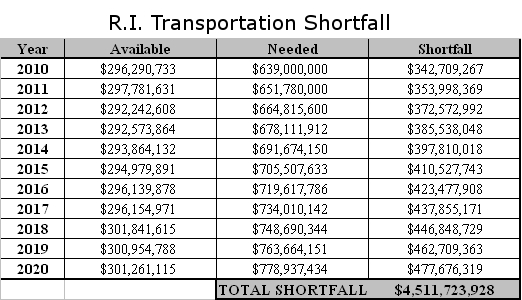
 CLICK HERE. / " title="RHODE ISLAND faces a $4.5 billion transportation shortfall over the next decade, according to research institute TRIP. For a larger version of this chart, CLICK HERE. /"/>
PROVIDENCE – Rhode Island faces a $4.5 billion transportation shortfall over the next decade, according to a report released Thursday.
The report by transportation research organization TRIP also said that 24 percent of state-maintained roads need repair and half of the state’s bridges are structurally deficient or functionally obsolete. The poor conditions and anticipated cash shortfall for repairs stunts economic growth at a time when the state is struggling to emerge from an economic downturn, TRIP said.
“It is critical that Rhode Island adequately fund its transportation system and that Congress produces a timely and adequately funded federal surface transportation program,” said Will Wilkins, executive director of TRIP. “Thousands of jobs and the state’s economy are riding on it.”
Washington, D.C.-based TRIP said that each year $29 billion in goods are shipped from sites in Rhode Island and another $28 billion in goods are shipped to sites in the state. Most of that travels via truck.
But the state-maintained roads they travel on are in sorry condition. TRIP said 6 percent of Rhode Island’s state-maintained roads are in poor condition and an additional 18 percent are in mediocre condition.
Over the next decade, TRIP anticipates the roads currently in the very best condition will become slightly worse and the roads in the very worst conditions will become slightly better.
Roads sorely in need of repair include a 1.5-mile stretch of Route 3 in Coventry, a 3-mile stretch of Route 116 in Smithfield and 1.5 miles of Route 114 in Bristol.
TRIP said motorists are paying the price of the poorly maintained roads. Drivers pay $978 million annually in the form of traffic crashes, additional vehicle operating costs and congestion-related delays. The average Providence-area motorist spends an additional $1,298 each year, including $390 in wasted fuel.
Drivers are increasingly fighting congestion as the state’s roadways built in another era struggle to accommodate modern traffic demands. TRIP, citing a report by the Reason Foundation, said that traffic delays in the Providence area will more than double by 2030 unless the state adds highway capacity. The average rush-hour trip could take 36 percent longer than during non-rush hour.
“This level of traffic delay is equivalent to what is currently experienced in Phoenix, Dallas-Fort Worth and Baltimore,” the report said.
The report also blamed antiquated roadway designs on contributing to the state’s traffic fatalities. Rhode Island’s traffic fatality rate was 0.79 fatalities per 100 million vehicle miles of travel in 2008, lower than the national average of 1.25 fatalities per 100 million vehicle miles. But the rate on rural roads was 2.34 fatalities per 100 million vehicle miles.
Throughout the state, TRIP estimated that roadway design likely contributed to about one-third of all fatal and serious traffic crashes. TRIP said the state could reduce crashes by adding turning lanes, improving medians, widening lanes and shoulders, upgrading traffic signals and signs, and improving intersections.
“Today’s business culture demands that an area have well-maintained and efficient roads, highways and bridges if it is to remain economically competitive,” the report says. “The advent of modern national and global communications and the impact of free trade in North America and elsewhere have resulted in a significant increase in freight movement. Consequently, the quality of a region’s transportation system has become a key component in a business’s ability to compete locally, nationally and internationally.”
Rhode Island pays for most of its highway and bridge repair with money from the federal government, although the state typically has to put in 20 cents for every 80 cents from the federal government. Money from the federal stimulus boosted federal money in the state to the tune of $137 million. So far, the R.I. Department of Transportation has actually spent $87 million, said DOT spokeswoman Dana Alexander Nolfe.
The DOT is also asking voters this November to approve $84.7 million in bonds to provide a state match for federal money.
In a statement, DOT Director Michael Lewis acknowledged the state roadways face challenges.
“Rhode Island’s transportation system faces many challenges, including growing traffic volumes, harsh weather and even impacts from natural disasters such as the floods we experienced this March,” Lewis said. “Economic support, such as state bonds and federal stimulus, enable the department to continually reinvest in our vital infrastructure network of roads, bridges, rail and bike paths.”