
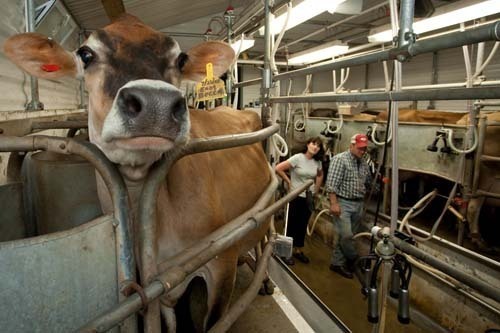
In February 2008, when the price of milk was at a highpoint, the LaPrise family bought 30 head of dairy cattle, built a new milking facility, manure pit and barn at EMMA Acres farm in Exeter and started out as dairy farmers.
The decision to milk cows wasn’t exactly impulsive, Scooter LaPrise explained recently. His wife, Cynthia, grew up on nearby Bailey Brook Farm, which her father has run for years.
But now, with about 1,500 pounds of milk – the standard industry measurement is a hundredweight – coming out of EMMA farm each day, the LaPrises are losing about $90 a day.
EMMA was one of four farms that in April joined Rhody Fresh Milk, the farm cooperative that this month celebrated its five-year anniversary. Before April, the cooperative had five members. The cooperative’s milk retails for a little more than other milk and offers members a more consistently stable price for their product.
Now, milk is about $13 per hundredweight, down from more than $20 per hundredweight last year, said Rhody Fresh Assistant Executive Director Stephen Volpe. Drops in both the cheese and powdered milk markets have in part led to the lowered price paid to farmers, he added.
“The price of milk right now – the price that farmers get paid for it – is really low right now,” he said. “But for Rhody Fresh, we seem to be holding our own and helping our members survive these tough times.”
While farmers’ milk income is dropping, the price of producing it – including the price of corn for feed – is on the rise, Volpe said.
“The thing about producing milk is that you have to feed the cows,” he said. “A general rule of thumb is that every hundredweight of milk, it costs you between $8 and $10 in feed. So if you’re only making $9 – some milk is $9 now – you’re losing money.”
Still, Rhody Fresh is doing fine, he said. In April, the group retired its $125,000 startup R.I. Economic Development Corporation loan. Sales of Rhody Fresh have increased by 40 percent in the last few years and now exceed $1 million a year.
“We had started with the original five members in 2004 and with the co-op, we had to balance our sales to our production,” Volpe said. “So at a certain point, it was hard to grow.”
But with the recent addition of Providence College, Roger Williams University and other contracts, the cooperative could take on new members, Volpe said. Along with EMMA Acres, it added Ashaway’s Elmrock Farm, West Greenwich’s Breene Hollow Farm and East Greenwich’s Bailey Brook Farm.
“It all started with farmers looking for a way to increase their bottom line. With milk as a commodity that becomes a little tough,” Volpe said. “They were looking at direct marketing or a branded-type product. The farmers got together, hired a public relations company – next thing you know, they went with it, developing the product Rhody Fresh.”
They started “knocking on doors” looking for stores that would carry the milk. Dave’s Marketplace was the first to sign on, and now, five years later, it can be found in local Stop & Shop Supermarkets, Shaws Supermarkets, Whole Foods Markets, some CVS/pharmacy stores and other markets and farm stands around the state. Volpe said he didn’t have immediate access to figures for how the cooperative’s sales have grown in the last five years.
Still, with prices dropping, it’s a tough time to be a dairy farmer. In a statement, Gov. Donald L. Carcieri said last month that family dairy farms in Rhode Island have been affected by the economy as have banks and the automobile industry.
Along with the other New England governors, Carcieri signed a letter last month that sought to increase Milk Income Loss Contract Program production subsidies by the USDA. “We need to provide relief before the family farm disappears forever,” Carcieri said.
Rhody Fresh, Scooter LaPrise said, should also help.
“It’ll get better, it always does,” he said. •