PROVIDENCE – The R.I. Coastal Resources Management Council unanimously passed a sweeping plan to regulate the waters off Rhode Island Tuesday evening but with a major footnote.
CRMC Executive Director Grover Fugate acknowledged that the federal government had concerns about sections of the ocean Special Area Management Plan, or SAMP, that pertained to federal waters.
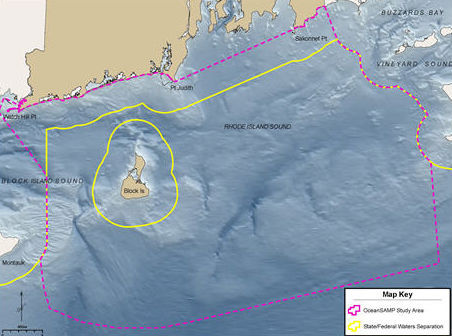
The plan seeks to identify various ocean uses, label environmentally sensitive areas and steer development like wind farms to certain locations. State officials expect it to serve as a national model for ocean planning.
But Fugate told the council that the comments from the National Oceanic and Atmospheric Administration would need to be addressed before the state asks the federal government to approve the plan. That approval is key because it would provide the state leverage over development that occurs in federal waters, Fugate said.
CRMC staff received the NOAA comments, which had not previously been made public, on Oct. 12. The comments were not available for review Tuesday, but Fugate characterized them as surmountable while still protecting the state’s interests. He urged the council to approve the plan, pledging to come back with amendments to satisfy NOAA officials.
“My concern is that we need to start getting the document in place so we can work from it,” Fugate said.
In an interview with Providence Business News during a break in the meeting, Fugate said he did not widely release the NOAA comments prior to the meeting because CRMC staff lacked time to review them and prepare a response.
“If you just put them out there without a response I think it creates confusion,” he said.
Fugate told council members that NOAA had offered two options.
One was to remove all references to federal waters – a less than ideal situation that Fugate acknowledged would essentially wipe out much of the last two years of work on the document.
The other option, more palpable to Fugate, was to specify that although the SAMP addressed federal waters, the document was strictly a state plan.
In backing Fugate’s recommendation to approve the plan and amend it later, the council disagreed with a request by the Conservation Law Foundation to delay a vote. Director of CLF’s Rhode Island center, Tricia Jedele, implored the council to postpone a vote until the organization and others could review the NOAA comments and a proposed resolution.
“We want to make sure there’s enough push back with NOAA that we’re not giving up more than we have to,” she said.
Two years in the making, the SAMP is a joint effort between the CRMC, researchers at the University of Rhode Island and elsewhere to study ocean uses. The document immediately establishes new regulations for state waters off the coast. It is expected to help steer approval of an eight-turbine wind farm in state waters off Block Island proposed by Deepwater Wind.
The SAMP identifies the area desired by Deepwater Wind as an ideal spot for a renewable energy project. In federal waters it points to an area between Block Island and Martha’s Vineyard as ideal for a renewable energy project. That equates in general terms to where Deepwater Wind wants to build a roughly 100-turbine farm many years down the road.
Deepwater Wind has paid $3.2 million of the study’s cost, which has also received money from the state and federal governments. All told, the SAMP is expected to cost about $9.7 million when completed, including $1 million of in-kind services from the University of Rhode Island. Officials insist the source of the money played no role in the study’s recommendations.
And plans call for the council to revise the document as new science emerges.
“This is a monumental step, but we are not done,” said Michael Sullivan, director of the R.I. Department of Environmental Management and a CRMC member. “This is just a step in the journey.”
For a link to the SAMP, click here.