
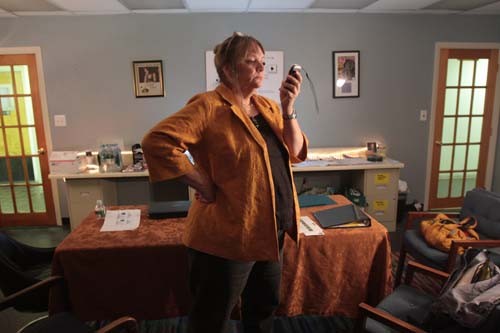
David Hughes leads a group vying to open a state-sanctioned, medical-marijuana dispensary. In addition to assembling operational plans, background checks and employee lists required by the R.I. Department of Health, Hughes, a pharmacist by training, is brushing up on his law.
Hughes predicted that the opening of so-called compassion centers like the one pitched by his Community Care Health and Wellness Inc. would surely involve lawyers.
“I think if you look at history repeating itself with something new like this, I hate to say it but I think there [are] going to be [legal] challenges,” Hughes said.
The process of opening three compassion centers in the state has been bumpy, to say the least.
When the DOH in September rejected all 15 applicants seeking to open a center, the applicants gathered to consider suing to protest the en masse denial, Hughes said.
That lawsuit never became a reality. Neither did one mulled by the American Civil Liberties Union’s Rhode Island affiliate and the Rhode Island Patient Advocacy Coalition. The latter two organizations had considered a suit protesting the delay in approving compassion centers.
State law enacted in June 2009 required the health department to issue one license by Dec. 23, 2009. The health department has until June 2011 to license the final two centers.
ACLU Rhode Island Executive Director Steve Brown said the organizations chose not to pursue lawsuits after the health department announced a second round for applications.
“The ultimate conclusion was by the time the lawsuit got resolved this second process that’s been implemented would be well under way, or at least that’s the hope,” Brown said.
The health department expects to review the 21 applications received during the second round and hold a public hearing early next year. A facility could be licensed as soon as March, department spokeswoman Annemarie Beardsworth said.
Beardsworth said the department failed to meet the deadline set in law because officials needed more time than expected to review the first set of applications. Then the rejections launched the process all over again, and the department must follow laws and regulations that require things like a 30-day notice before a public hearing, Beardsworth said.
“We’re trying to get there as fast as we can,” Beardsworth said.
But JoAnne Leppanen, executive director of the patient advocacy coalition, complained about the pace and said a lawsuit to compel officials to move faster – or at least outline a firm schedule – may be necessary.
“The right thing to do would be to file a lawsuit because the department of health has really neglected the patients,” she said. “On the other hand, we have to balance the practical implications and we don’t want to delay this process any more.”
Brown and Leppanen said it does not help that Gov. Donald L. Carcieri, whose veto of legislation permitting the centers was overridden, has shown few signs of pressuring the department to speed up the process.
“The General Assembly can say 10 times ‘The Department of Health, we want to do this,’ but they don’t have the power to ultimately force them to do it. It’s up to a court of law,” Brown said.
And at least one co-sponsor of the initial legislation is not ready to rush the process. Rep. Anastasia Williams, D-Providence, called the pace of approving centers frustrating but understandable. Williams said state agencies sometimes need more time to act than lawmakers anticipate.
Especially with something as controversial as medical marijuana, Williams said she would prefer the health department undertakes a careful, measured review rather than rush to a decision.
“I am not looking at it being delayed,” she said. “I believe good things come to those who wait.”
And if the wait results in a rejection of all the applicants again? Brown and Hughes said that could lead to a lawsuit. Both question whether the health department’s ranking scale conforms with the law, which does not refer to a ranking scale. What happens, Brown said, if none of the applicants meets the health department’s arbitrary minimum score? Or what happens, Hughes said, if applicants want to contest their scores? The answer, in both cases, appears to be a lawsuit.
“There’s definitely some ambiguity around” the health department regulations, Hughes said.
The ambiguities do not stop there. Trying to mesh municipal zoning ordinances with medical-marijuana dispensaries could prove challenging, said Donald Packer, a South Kingstown lawyer specializing in land-use policies.
It appears just one community, Johnston, has adopted regulations specifically governing where and how medical-marijuana dispensaries operate. It did so to avoid any ambiguity if someone proposed a center in town, said Town Planner Pam Sherrill.
“We want to be in the driver’s seat,” she said. “We want to make sure where these things are going to go.”
For now, local officials elsewhere will fit such centers within existing zoning regulations. Packer said that means shrewd solicitors could shoehorn the center into a use the municipality forbids.
It’s happened before. When the state closed a mental-health hospital and planned to open group homes throughout the state, communities protested. Some claimed they were forbidden under existing regulations while others rushed to create new ordinances.
Eventually, the state stepped in and required towns to allow the group homes. State lawmakers also intervened when local communities tried to regulate day care centers.
But even now debates continue over what constitutes a group home or a day care center or a host of other uses. Introduce a new use and there is bound to be strife, said R.I. Division of Planning Associate Director Kevin Flynn.
“A lot of times in codes the distinctions between these things are subjects of argument,” Flynn said. “Zoning can be worlds of gray sometimes and litigation sometimes is the way these matters get resolved.” •