
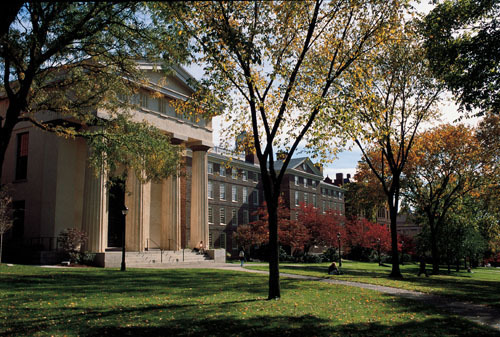
In Providence, where about 50 percent of the city’s land is owned by tax-exempt nonprofits, city representatives and the Greater Providence Chamber of Commerce are looking for ways to derive more indirect economic benefits from those institutions, which include prominent hospitals and prestigious colleges.
“The issue for the city is that [the direct] economic income doesn’t benefit us – it benefits the state,” city Planning and Development Director Thomas Deller said in an interview last week. “So our debate and discussion on this all along has been that there should be a benefit to us.”
In Providence, tax-exempt property – including roads, parks and city and state property – accounts for about 50 percent of the city’s 18.1 square miles, Deller said.
Under a payment in lieu of taxes program that was pushed by Mayor David N. Cicilline during his first term, the state annually reimburses the city for 27 percent of what property taxes would be on those properties, Deller said. “But that program has not been fully funded the last few years,” he added. During 2006, that payment was $20.1 million, according to a report compiled early this year by Laurie Brayton, a R.I. Senate fiscal analyst.
According to the same report, finished during February, tax-exempt city property is worth $7.8 billion and, at Providence’s commercial tax rate of $26.99 per $1,000, it would account for about $211 million in annual taxes.
The two largest groups are the nonprofit hospitals – Butler Hospital, Miriam Hospital, Rhode Island Hospital, Roger Williams Medical Center, St. Joseph’s Hospital and Women & Infants Hospital of Rhode Island – and the nonprofit higher education institutes – Brown University, Johnson & Wales University, Providence College and Rhode Island School of Design. Those groups’ tax-exempt property is worth $1.286 billion and $1.593 billion respectively, according to the report.
For that reason, the exemptions are being questioned by state Sen. Harold M. Metts (D-Providence), who in May introduced legislation that proposed eliminating the tax-exemption for those institutions. (Metts asked Brayton to compile her report before introducing the bill.)
Metts’ bill was an attempt to get a conversation started, he told Providence Business News in an interview at the Statehouse last week. As an assistant principal at Central High School, Metts this year has seen education cuts firsthand, he said. “Forget what’s happening statewide, just look at what’s happening here in my high school. We’re losing three English teachers, three math teachers, three to five special education teachers and an art teacher,” he said. “Our class size for Algebra 2 is going to go up to 32 students.”
On June 3, the Senate Finance Committee recommended that the bill be held for further study, meaning that it likely won’t be heard again this session. Metts acknowledged last week that cutting the tax-exemption program in its entirety might not be the answer. “I don’t yet know the magic number. Maybe they should be paying 50 percent, maybe it’s 25 percent,” he said. “But to me, they need to be paying something. I think it’s high time that they pay their fair share.”
There is, of course, the argument that these tax-exempt entities give back to the community, Metts said. But he feels they aren’t doing enough.
Another bill, introduced by Rep. David Segal (D-Providence) on May 7 and heard by the House Finance Committee on June 16, is for “shared economic growth” for towns and cities where properties are purchased by tax-exempt entities.
That bill, on which a vote hadn’t been taken as of June 18, proposes that the state pay those municipalities either 50 percent of the entity’s income taxes – from employees working at that new location – or an amount equal to property taxes that would have been collected. The bill – House Bill No. 8248 – proposes that the state pay the lesser of the two.
The issue has also caught the eye of the Rhode Island Public Expenditure Council, which this summer will be compiling a report that will include exemptions statewide, said Director of Policy and Research Susanne Greschner.
The high percentage of Providence property is exempt from tax seems to be comparable to other capital cities, said Hartford, Conn., City Assessor Lawrence G. LaBarbera. His city’s tax-exempt land equals about the same, he said.
“We’re at about 47 or 48 percent exempt,” LaBarbera said. “It’s because we’re the state capital so we have all the state buildings and all the colleges and hospitals, too.”
For cities that aren’t a state’s capital, the number seems to fall, he said. Because there’s less state-owned land in those cities, the percentage is more dependent on what type of nonprofits are there, such as Connecticut’s second-largest city, New Haven, where Yale is located. “Because of that, they have a fairly large amount of tax-exempt property,” LaBarbera said.
In Worcester – Massachusetts’ second-largest city – the percentage is relatively low, said Robert J. Allard, the city’s assessor. There, about 18 percent of property is tax exempt and the largest exempt-property landowners are the city, municipal schools, and the University of Massachusetts Memorial Hospital, Allard said.
In Pawtucket, between 20 and 25 percent of property is tax exempt, said Tax Assessor David L. Quinn. Those properties are worth about $800 million, he added. That includes the YMCA and the Boys & Girls Club, said Director of Planning Michael D. Cassidy.
In Providence, the growth of the four higher education institutions has also been examined in past years. That growth, including Brown University’s 2006 purchase of seven Jewelry District properties, will be taxed under a 2003 deal with the city. Under that deal, approved by the city, any nonprofit that buys new property will pay a structured amount of lessening taxes during a 15-year period, which will begin as soon as the buildings have been converted to nonprofit use. After that period, the properties will no longer be taxed, Deller said.
But in striking that deal, the four colleges also acknowledged debts to the city and agreed to voluntarily pay Providence almost $50 million. That money will come through increasing annual contributions during the next 20 years, according to Brown University.
And the city has to now look at new avenues to draw value from the tax-exempt institutions, Deller said. “The reality is that a lot of the new research and development is spun off of these institutions,” he said. “So the question is, ‘How do we take that knowledge, that research and development, and spin it off into taxpaying businesses and the creation of jobs?’”
An answer to that question could come from the “Knowledge-based Economy” study now being undertaken by Washington, D.C.-based New Economy Strategies. The study is being paid for by the Greater Providence Chamber of Commerce. “We have limited land area in the city and, because we basically have to grow the property taxes, we have to figure out how to deal with these nonprofits,” Deller said.
There’s also the 19 acres that will be reopened when the old Interstate 195 section through downtown is removed. New development there would mean new taxes, though it wouldn’t make much of a dent in the city’s percentage of tax-exempt land, he said. •