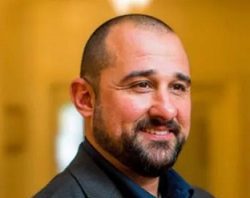
Name: Thomas Shepherd, Ph.D.
Age: 44
Position: President and Chief Executive Officer, Neurotech USA. Neurotech USA is a subsidiary established by a privately held French biotechnology company in January 2000 based upon proprietary encapsulated cell technology and previously owned by CytoTherapeutics, Inc. (now StemCells, Inc., of California).
Background: Vice president, corporate development at Entrabiotics in Mountain View, Calif.; Vice president, business development at ICN Pharmaceuticals in Costa Mesa, Calif.
Education: University of Strathclyde, Scotland (1980)
Residence: Paris (moving to Lincoln, RI this month)
Family: Married, two children
THOMAS SHEPHERD, president and chief executive officer, Neurotech.
PBN: Explain how Neurotech came to be – its connection to CytoTherapeutics.
SHEPHERD: Neurotech started in France in 1995. It is a company founded around cell based technologies from French universities, by a combination of French scientists and U.S. scientists at Johns Hopkins University. Neurotech is based on the technology of naked cells – cells that are not capsulated, not colored. Those cells are used to treat diseases in the eye.
What was the connection to the former CytoTherapeutics?
In biotechnology, there are different technologies that a small number of companies use. We were aware of CTI (CytoTherapeutics) for a long time. Their strategy was quite different in that they were encapsulating cells to form a device.
What does it mean to encapsulate a cell?
Normally, there is one problem with cell therapies. In many situations they are useful, but there is one issue — the body tends to reject the cells. Secondly, it can be quite difficult to remove the cells from the patient. Encapsulation gets around both of those things because the cells are inside a device. You can put them in the patient. They are protected from the immune system and last a very long time. At the end of therapy you just take them out.
Is encapsulation widely used?
No, it is not widely used. It is strongly protected by the patents of the former CTI. What we felt was that with our background in cells – we knew a lot about cells CTI knew a lot about devices from encapsulating cells. When CTI got into financial difficulty because of their clinical studies and over-stretched finances, we became interested in acquiring the technology. We could see the synergy between what we were doing – our five years of experience in cells – and CTI’s 10 years in devices.
What will happen at your facility here?
Basically the facility in France focuses on issues related to the cells themselves. Here in Rhode Island, we’re focusing on encapsulating devices, the engineering and the manufacturing of product. The idea is that the fundamental research activities would be carried out in France, but here we will be focused on development. In other words, making the product — getting a product we can take forward to clinical trials and out to the market. The U.S. facility would be the last link of the chain. We have a manufacturing suite here. We will be doing the economic aspect of producing a product. And also the development phase, which will last several years.
Why Lincoln?
We decided years ago that because biotechnology is a global business, we wanted to be in both continents – Europe and the United States. But we would only come to the U.S. if there were something to bring us here. We didn’t just want to spend a lot of money to set a lab up. When the CytoTherapeutics opportunity arose, it was really what we were waiting for. The reasons for Lincoln, are primarily two things. First of all, the people. There is a team here who have been working on encapsulation for years. We have hired those people – former CytoTherapeutics people. They knew the technology inside and out, and had worked together. It wasn’t a question of hiring 10 new people. Secondly, there are collaborations with Brown University, where there is also experience with encapsulation. It seemed to us a logical place to be. And in terms of future expansion, you’ve got universities, a growing biotechnology industry and it’s not that far from Boston. And the East Coast is a lot closer to Paris than the West Coast.
That’s important – that the East Coast is closer to Paris than the West Coast?
Yes, not so much the difference in geography, but in time zones. There is a six-hour time difference between Paris and Boston. The French people in the afternoon can talk to the Americans in the morning. In California, with a nine-hour time difference, you have about an hour where you can talk. Technology these days requires constant communication.
How many employees at Neurotech?
We have 10 people. Growth will depend on milestones. Some companies in biotechnology made a mistake in the pastjust because they could raise a lot of money, they spent a lot of money. Our view is that we still want to raise a lot of money, but at the same time we will only spend in proportion to the milestones. As we get closer to the clinic and commercialization we will spend more and more. As long as you focus on the core aspects of the program, a small number of people can take it very fast. If you were to compare us to a company like CTI, I would say we’re not into building large buildings or having large groups of people – we’re into small focus teams.
What are we to make of CytoTherapeutics’ time in Rhode Island – was it a successful venture, or a bust?
We’ve come in here with new investors, a new strategybut I have to say, CTI took this technology a long way. One of the things that is interesting to us is that this technology has been in people, it has been to clinical trials. It has been proven safe. I think there were some bad decisions made in terms of choice of diseases to go after. But CTI invested a lot of money in this technology, I believe about $100 million. Because of that, we feel that with a focused approach – focused on the eye, we will be able to take this to patients very quickly as a consequence of what CTI did. People have to know that in biotechnology, there are failures. It happens all the time. It happens in big pharmaceutical companies, and in small biotech companies. It’s all the same. What you have to do is rely on a strategy that has different projects using different technologies that help one another. That way, if you have a tough time in a particular indication, you can keep going.
So CTI made strides?
You should not underestimate the fact that they took this program into clinical trials. They took this product to the FDA. The trouble was, they just didn’t get the results they had anticipated after animal studies. They were trying an ambitious indication, in pain control. Our indication is much more direct, and we think more predictable.
What are you looking to cure – to prevent?
We have had a long, hard look at this technology and believe the best place take this technology is in the eye. There are a couple of very simple reasons for that. One is that you can have a very small device because the eye itself is very small. CTI was using the spine, and so the device had to cover the whole area of the spine. That’s a big volume. In the eye, you have a very small volume. That’s in our favor. Secondly, and this is dreadfully simplebut when you put a device in the eye, every time the patient comes in for a checkup, you can see it. The whole thing becomes simpler. With the eyes, there are some terrible diseases that just have no treatment. In fact, the eye has been neglected by biotech. If you had to list the number of biotech companies working on the eye, it’s very small. Yet, in the U.S. alone we have 1.7 million people that have age related macular degeneration – a blindness – related to age. These are debilitating diseases. We have targeted those diseases that are not yet treated, but would seem to be very simple to treat with our device. And not simply to treat with normal drugs because normal drugs do not get into the eye.
Why should we see biotechnology as a potential economic generator?
Biotechnology is a highly value added business. If you have one biotech product in which you are successful, you can have one facility here in Lincoln and you can supply the whole world’s needs for that product.
Are you confident Rhode Island will provide the workforce you need?
Having Brown University and having a small but growing biotech industry here certainly helps. Then when you look to the future and you see some of the infrastructure changes planned for the region – high speed trains, for example – and you see the problems with rentals in Boston, you see that Rhode Island has an excellent prospectif Rhode Island has the facilities and some established companies, it is going to be the logical place to go.
What are your early impressions of Rhode Island?
Before living in Paris, I lived for six years in California. In coming to Rhode Island, I expected it to be similar, but in fact it is not. There is a big difference between the West Coast and the East Coast. I get a much more European feel on this side of the country than I would in California.
Are you ready for the winter?
That’s still to be seen. Coming from Scotland, I am used to the odd cold day, but not the kind of snow I hear you can get here. We’ll see how it goes. I’ve got a snow shovel already.
You’re from the birthplace of golf. Do you golf?
I do, but not to the extent that I broadcast it widely. It’s not good for a Scotsman to be not very good – and I’m not very good.