
NEW YORK – Motorists from Maine to Florida will soon feel the wrath of Hurricane Harvey without seeing a single raindrop.
Fuel prices at the pump are likely to climb after Colonial Pipeline Co., the largest U.S. gasoline conduit, was forced to shut parts of its main diesel line late Wednesday and planned to halt a portion of its gasoline line Thursday because about half of Gulf Coast refining capacity was offline. The company anticipates resuming some service late Sunday. Valero Energy Corp. and Royal Dutch Shell PLC, both major Gulf Coast refiners, told wholesale customers Wednesday they don’t have enough gasoline and diesel to sell retail suppliers.
“It’s one thing to not have refiners,” Dan McTeague, an analyst at GasBuddy.com, a company which tracks retail prices and availability, said by phone. “It’s quite another thing to not have pipelines.”
Hurricane Harvey has potentially cut U.S. fuel-making capacity to the lowest level since 2008 after its initial strike on the Texas coast late last week. As Tropical Storm Harvey hit southeast Louisiana on Wednesday, it brought torrential rains that shut the biggest U.S. refinery, owned by Motiva Enterprises LLC in Port Arthur, Texas, and one nearby held by Total SA. They join more than 12 other plants with almost a quarter of U.S. refining capacity.
As refineries along the Gulf Coast turned off the lights, Colonial, which carries fuel from Gulf Coast refineries to the East Coast, indicated that portions of its two main Lines 1 and 2 west of Lake Charles, Louisiana, would be offline and operating at reduced rates east of Lake Charles. Many smaller lines branching off from its main artery are also likely to shut.
Pace of Supply
“The issue is the pace of supply that we’re getting from the origins,” Buster Brown, Colonial’s director of scheduling, said in a telephone interview. “It’s not as much running out of supply as the timing — the speed at which supply gets to market.”
Once shipments from the Houston area resume, Colonial will be able to ship fuels east, bypassing shuttered terminals in the Port Arthur, Texas, area, Brown said, noting that “Houston supply and Port Arthur supply are independent, so to speak.”
Harvey also submerged pump stations and terminals along the Gulf Coast with its dayslong deluge, and operators such as Valero and Shell had no choice but to stop sending fuels.
Valero stopped supplying gasoline stations across the Northeast at stores that don’t carry its logo, while Shell reduced supplies to some company-branded stations in the lower Atlantic, according to people familiar with the operations of both companies who asked not to be identified. Motiva Enterprises holds exclusive rights to distribute Shell fuels to the majority of the southeast, said Natalie Gunnell, a spokeswoman for Shell’s U.S. products unit.
BP PLC was said to be moving a tanker authorized to carry fuels between U.S. ports to Florida from New York Harbor, according to a person familiar with the cargo.
Spokespeople from Valero and BP didn’t return requests for comment.
Fuel Waivers
The U.S. Environmental Protection Agency, in an effort to stay ahead of potential shortages, has been issuing waivers exempting more and more southeastern states from requirements that they use fuel that meets clean-air quality standards.
Gasoline futures for September delivery at New York Harbor rose for an eighth session Thursday, the longest rally since 2013, and climbed above $2 a gallon. Prices for the contract, which expires Thursday, had surged 30 percent for the week as of 12:34 p.m. on the New York Mercantile Exchange. The more-active October contract was up 15 percent for the week. The premium of September to October fuel has almost tripled since Aug. 25.
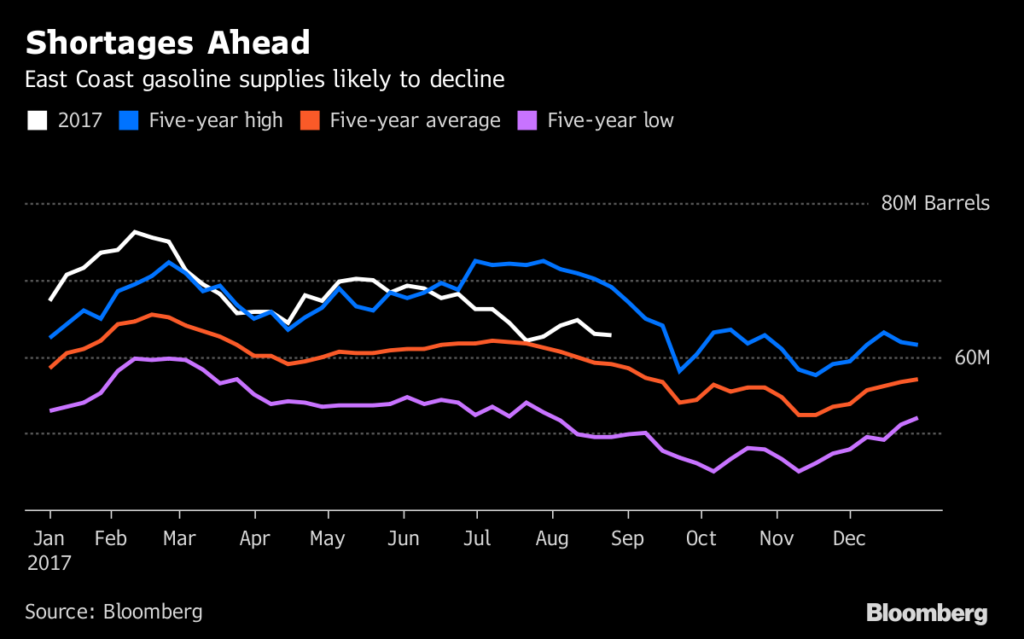
As shortages ripple across the East Coast, the most likely suppliers left standing are refiners from Louisiana and Europe, according to Zachary Rogers, a refining and oil products analyst at Wood Mackenzie. The ongoing gasoline supply issues could reduce East Coast inventories to 3- to 5-year lows, he said by phone from Houston.
At least 20 tankers were booked to load European fuels for the U.S. since Harvey made landfall, a rate nearly double the average for August, shipping data compiled by Bloomberg show. Shipbrokers said cargo flows to New York are expected to be the highest since November, when Colonial Pipeline exploded and cut off supplies.
“Because of the shortage, you will likely see a price increase in the East Coast, which would incentivize the other refiners to shift gasoline yields,” Rogers said.
While suppliers of gasoline stations from Georgia northward may have reason to be concerned, the Sunshine State has one key advantage: It’s not winter yet.
“In Florida, we’re not in the main season, so demand is not as high as it would be normally from November to May,” said Ned Boman, executive director of the Florida Petroleum Marketers and Convenience Store Association. “We should be OK.”
Laura Blewitt is a reporter for Bloomberg News.