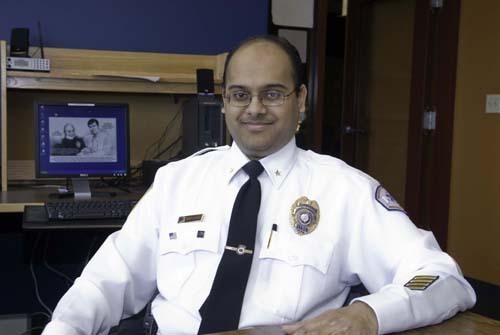
Shad Ahmed has been part of the largely volunteer University of Rhode Island Emergency Medical Services team since he was a freshman in 2000. Now, he’s the squad’s commander and has been cited as the national Collegiate EMS Provider of the Year for his work restructuring and building the organization into an around-the-clock response team.
Now in his last semester of graduate study, Ahmed spoke with Providence Business News about the changes he’s overseen and what he’d like to see in the future.
PBN: What are your basic duties?
AHMED: I oversee the entire medical services organization. We’re an organization that has, at any given time, about 75 to 100 active volunteers and we provide 911 ambulance-transport services to the University of Rhode Island community and campus. We also provide mutual aid with neighboring communities, as requested. My job is basically to oversee the long-term sustainability of the organization, to do long- and short-term strategic planning.
PBN: You were named collegiate EMS provider of the year. Tell me about that award.
AHMED: The award is given by the National Collegiate EMS Foundation. That is a national organization, all the members of which are collegiate EMS organizations. So they’re ambulance services based out of a college. Every year they give out a couple of different awards. I was awarded under organizational leadership and I was the only one to receive that award this year.
PBN: What type of organizational changes have been made during your time with EMS?
AHMED: I oversaw the transition to a new $1.4 million headquarters, secured $50,000 in federal and state grants to upgrade our communications system [and] transitioned our service … to a full-service 24/7/365 department. We do about 250 special-event details every year. That’s a significant amount of details for any EMS organization, even some municipal departments. So we’ve been very actively increasing our services.
I’m a [Federal Emergency Management Agency]-trained incident command system instructor, so I’ve been pushing for what’s called NIMS compliance at the university. That’s the National Incident Management System, which is basically where all municipalities, all agencies – police, fire, EMS and also non-traditional responders – those kinds of organizations are being pushed toward NIMS compliance by the federal government. That’s supposed to increase cooperation and interoperability for large-scale and small-size emergency incidents. …
One of the things I’m trying to push for, more so than NIMS compliance, is NIMS competence. It’s easy to have a piece of paper that says we’re NIMS compliant, but it’s another thing to say that we actually practice, exercise and use the NIMS system in training and real-world scenarios.
PBN: How far off is that compliance, because you’re not likely to be a student much longer?
AHMED: I think the minimum level of compliance and competence could be achieved possibly within a year’s time. We are actively seeking grant funding that might help us achieve that goal and also help others achieve that goal. We’re actually looking at some programs right now where we might be able to join forces with some other colleges and universities in the area.
PBN: Does you coursework as an MBA student work its way into your job?
AHMED: I think it has definitely helped me change some of the dynamics of our organization. We’ve gone through some reorganization and I’ve used the insights gained from that program to help us.
PBN: You mentioned that you work with local fire and police departments – do you also communicate with other universities?
AHMED: We do. I’ve been in touch with Brown University’s EMS program – they’re actually about the only other full-service EMS program in the state, as far as actually having an ambulance and being student-based. We want to increase that going forward, because it’s definitely important in terms of learning from each other.
PBN: Do you have a budget separate from the university?
AHMED: Every student pays tuition and then a few other fees. Those fees go to support auxiliaries and health services is an auxiliary. They don’t get any money from tuition or any money from the state or the university. They just get that money from that one fee that every student pays. A portion of that fee is then used to support our operation. We also actively seek donations and try to do some fundraising.
PBN: URI’s student body is growing – do you plan to grow, also?
AHMED: Kind of by default we’ve been forced to. Not even three or four years ago, we were doing maybe 400 runs a year. That’s what our call volume was and we’re at a point now where we’re doing, in addition to 250 special-event details, we’re doing a little over 1,000 calls for service. •
interview: Shad Ahmed
Position: Chief of URI Emergency Medical Services
Background: As a freshman at URI in 2000, Ahmed volunteered for the student-run Emergency Medical Services team, serving as lieutenant, captain and deputy chief. He has been chief of the team since 2004
Education: B.A. in mathematics in 2004 from the University of Rhode Island, MBA from URI, expected graduation in May.
Residence: Warwick
Age: 25