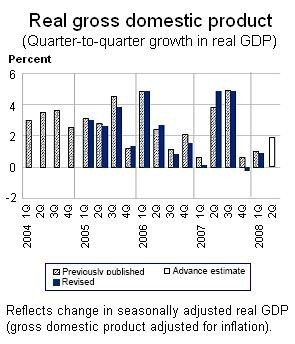
WASHINGTON – The U.S. economy grew at an annual pace of 1.9 percent in the second quarter, after rising at a revised 0.9-percent rate in the first quarter, the U.S. Department of Commerce’s Bureau of Economic Analysis said today in its initial report for the April to June period.
The BEA credited the acceleration to three factors: a slowing of the housing decline; an increase in consumer spending; and growth in net exports, as exports increased while imports fell more than in the first quarter. (READ MORE) But its “advance” estimate of growth in the real gross domestic product – the nation’s total output of goods and services, adjusted for inflation – lagged the 2.3-percent median forecast from a Bloomberg News survey of 79 economists.
Current-dollar GDP – the market value of the nation’s goods and services – increased 3.0 percent, or $105.7 billion, to a level of $14.26 trillion, the BEA said. That lagged the revised first-quarter increase of 3.5 percent, or $119.6 billion.
Meanwhile, the BEA’s measure of consumer spending – real personal consumption expenditures; that is, PCE adjusted for inflation – rose at a 1.5-percent annual rate in the second quarter, accelerating from the first quarter’s downwardly revised 0.9-percent pace.
The price index for gross domestic purchases accelerated to an annual growth rate of 4.2 percent, after rising 3.5 percent in the first quarter, the BEA said. But the core index excluding food and energy rose at a 2.2-percent annual rate, matching the revised first-quarter pace.
“Exports are making the difference between a near recession or mild recession and a deep recession,” Nariman Behravesh, chief economist at Global Insight Inc. in Lexington, Mass., told Bloomberg News. “We don’t really see a recovery until some time [next] spring or summer.”
Today’s report also included the bureau’s annual revision of GDP statistics, incorporating the latest data for 2005 through 2007.
“The general economic picture over the period was unchanged, with a continued decline in housing offset by growth in exports,” the BEA said. Overall GDP growth for the period was revised downward by 0.1 percentage points, while the index for gross domestic purchases was revised upward by 0.1 percentage points, the bureau said.
But in general, “the relatively small revisions to the annual estimates reflect partly offsetting revisions to quarters,” the BEA wrote. Last year, for instance, “annual GDP growth for the second quarter was revised up to 4.8 percent from 3.8 percent, while growth for the fourth quarter was revised down 0.8 percentage point, from a small increase to a small decrease.”
“This confirms the general picture of weakness, but it is surprising that GDP declined,” Martin Feldstein, former chief of the National Bureau of Economic Research and a member of the group’s recession-dating panel, told Bloomberg News. Today’s revisions underscore his estimate that a downturn began in December or January, Feldstein added.
Among other revisions, the BEA report said, “national income was revised up for all 3 years: 0.8 percent for 2005, 1.2 percent for 2006 and 0.4 percent for 2007,” while corporate profits were “revised up for all three years: 5.5 percent for 2005, 7.4 percent for 2006 and 3.0 percent for 2007.”
Additional information – including the full second-quarter Gross Domestic Product report, which features revised estimates for 2005 through the 2008 first quarter – is available from the U.S. Department of Commerce’s Bureau of Economic Analysis at www.bea.gov.