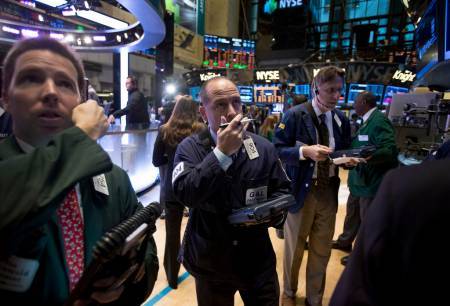
NEW YORK – U.S. stock futures advanced, with the Standard & Poor’s 500 Index poised for a second weekly decline, as President Barack Obama prepared to meet Republican lawmakers for talks to prevent tax increases and spending cuts from automatically coming into force next year.
Gap Inc., the largest U.S. specialty-apparel retailer, climbed 3.8 percent after raising its full-year earnings forecast as sales in North America advanced. Dell Inc. declined 2.7 percent after its revenue forecast missed analysts’ estimates amid a slump in demand for personal Computers. Dynavax Technologies Corp. tumbled 56 percent after its hepatitis B vaccine failed to win the backing of U.S. regulatory advisers.
S&P 500 futures expiring in December rose 0.4 percent to 1,356.3 at 8:42 a.m. New York time. The benchmark gauge has fallen 1.9 percent so far this week. Dow Jones Industrial Average futures added 23 points, or 0.2 percent, to 12,545. The number of shares changing hands in Stoxx Europe 600 Index’s companies was 9.8 percent below the 30-day average at this time of day.
“The market is rotating back to a bit more optimism,” said Peter Jankovskis, co-chief investment officer for Oakbrook Investments in Lisle, Illinois, which manages about $2.9 billion. “We’re all on this wait-and-see mode right now. The fiscal cliff is the most obvious factor for that.”
President Obama will hold an opening round of talks with Congressional leaders today to reach a deal to avoid a $607 billion deficit-cutting package known as the fiscal cliff. White House officials are in talks about a plan to replace the sweeping spending cuts set to begin in January with a smaller, separate package of targeted spending cuts and tax increases, the Wall Street Journal reported, citing people familiar.
Industrial production
U.S. industrial production probably cooled in October as superstorm Sandy knocked out power in the Northeast, economists said before a report today.
Concern about the so-called fiscal cliff has driven the S&P 500 to the lowest level since July 25. The index has retreated 5.3 percent since President Obama’s re-election set up a budget showdown with the Republican-controlled House of Representatives.
Gap climbed 3.8 percent to $34.52. The company has been among the top performers on the S&P 500 this year as improved product and marketing at its namesake, Old Navy and Banana Republic brands drive sales in North America. The retailer, which said revenue this fiscal year has increased 6.4 percent to $10.9 billion, is benefiting from lower cotton costs and new management, especially at value-oriented Old Navy.
Dell retreated 2.7 percent to $9.30. The No. 3 PC maker is struggling amid a deep slump in demand as companies wait to upgrade machines and consumers turn to smartphones and tablets like Apple Inc.’s iPad and iPhone to manage their work and personal lives.
Safety data
Dynavax tumbled 56 percent to $2.03. While Heplisav works to treat the contagious liver disease, Dynavax didn’t provide adequate safety data to support approval, Food and Drug Administration advisers voted yesterday. The FDA, set to make a decision by Feb. 24, isn’t required to follow the panel’s guidance.
Options traders are paying the most in 15 months to protect against swings in the largest U.S. companies relative to the Standard & Poor’s 500 Index as earnings growth declines.
The CBOE OEX Volatility Index, which tracks the cost of S&P 100 Index options, has jumped 56 percent since its low on Sept. 21 to 19.28. That’s the highest level since August 2011 relative to the CBOE Volatility Index of S&P 500 contracts, data compiled by Bloomberg show. The S&P 100 slipped 8.4 percent since its Oct. 4 high, compared with a 7.4 percent decline for the U.S. equity benchmark.
Biggest companies
Profits for the biggest U.S. companies are forecast to slow more than smaller ones amid Europe’s debt crisis and China’s weakest economic expansion in 14 quarters. Data yesterday showed that the euro-area economy entered a recession for the second time in four years as governments imposed tougher budget cuts.
“There’s been a deafening silence among optimists regarding revenue growth for blue-chip companies,” Chad Morganlander, a Florham Park, New Jersey-based fund manager at Stifel Nicolaus & Co., which oversees about $138 billion, said by phone, referring to the largest U.S. companies. “The global macro situation is disconcerting, which is forcing market speculators into hedging their portfolios.”