Former Washburn Wire complex to become ‘New England village’
Just days after announcing perhaps the biggest development proposal in East Providence’s history, city manager Paul Lemont was out on his boat on the upper reaches of East Bay with a couple out-of-town developers, trolling for another big catch.
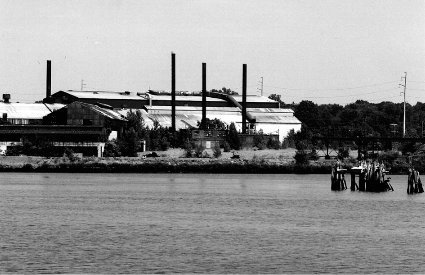
The developers wanted a close-up look at properties along the city’s scarred waterfront, and Lemont was happy to oblige. The long-time city manager says he wants to build on the excitement sparked last month, when Lemont disclosed plans by Geo Nova Development to transform the rusting, 27-acre Washburn Wire Co. complex along the Seekonk River into a vibrant, mixed-use "New England Village."
"We’ve always had all this great land, but it sits idle because of these brownfield sites," Lemont said. "Now we have a number of redevelopment projects on the drawing board, and hopefully in the not-too-distant future we’ll be announcing others."
The $200 million East Pointe project would add 500 high-priced condos, townhouses or single-family houses, offices, shops, restaurants, a marina, public parks and webs of green space.
Robert Everton, a spokesman for Geo Nova, declined to discuss specifics about a timeline for the project, nor would he talk about how Geo Nova would mitigate the site, which is plagued by heavy metal and possibly oil contamination.
"There’s still an awful lot to be done on this project," Everton said. "We’re at a delicate phase in the process."
He added, however, that "everybody and their brother wants the project to happen," and that the developer is confident that it would be able to clean up the site using proprietary technologies. The city plans to help the developer obtain about $5 million in federal grant money to help clean up the site.
The city’s other decaying brownfield sites are sure to face similar challenges, but Lemont is undeterred. He says the East Pointe project is a harbinger of good news for East Providence’s long-neglected waterfront, which has garnered the attention of developers as Rhode Island’s real estate market heats up.
The fate of the East Providence’s riverfront was sealed at the beginning of last century, Lemont said, when the city’s forebears chased a lucrative oil industry and tapped its demand for waterfront oil storage facilities. When that demand waned with the advent of supertankers and oil refineries, the strategy left the city with abandoned, rusting storage tanks. In short: "some pretty crummy land," Lemont said.
Two years ago the city decided to reverse course, aiming to make redevelopment of its industrial land the engine of the city’s economic revival. It hired a consultant, North American Realty Advisory Services, to plot out a vision for cleaning up the city’s blighted waterfront.
The firm generated a report that was decidedly upbeat.
"Rarely does an older community have such a diverse selection of prime parcels for redevelopment," North American Realty’s report reads.
It identified 320 acres along a three-mile ribbon of land on the Seekonk and Providence rivers: 180 acres to the north of I-195 (including the Geo Nova site) and 140 acres to the south of the highway. Although much of the land is brownfields, the majority, 180 acres, is vacant and ripe for "higher value" development, the report says.
The brownfields also hold promise. One prime parcel: Kettle Point, a 40-acre site along Veteran’s Memorial Parkway with commanding views of Narragansett Bay and downtown Providence. The property, formerly owned by an oil company, was approved years ago for 580 residential units and is suitable for "large-scale office, hotel and research development," according to the city’s Web site, which prominently displays aerial views of Kettle Point and other prime "development opportunities" of brownfields on the water.
Lemont said he is hopeful that separate pieces of legislation recently passed by Congress and the Rhode Island legislature, which offer grant money and tax breaks for redeveloping gray industrial eyesores, will further entice developers to take chances on some of the city’s waterfront brownfields.
Meanwhile, Lemont is guarding against development pitches that he says would constitute a step backward. For instance, before Geo Nova’s plan surfaced, Lemont heard a string of dismal plans for the Washburn Wire site, including a waste-storage facility and a tire-shredding operation.
"Some of these properties are absolutely breathtaking, and if they’re not developed properly, I’m afraid it will end up looking like the Atwells Avenue section of Providence," Lemont said, referring to the avenue flanked by huge oil-storage tanks and dingy strip clubs on the south side of Providence.
"I think there are higher and better uses for the property we have here," Lemont continued. "We’re trying to bring in something special, so that 70 or 80 years from now residents will look back and say ‘those guys at the turn of the century knew what they were doing,’"