
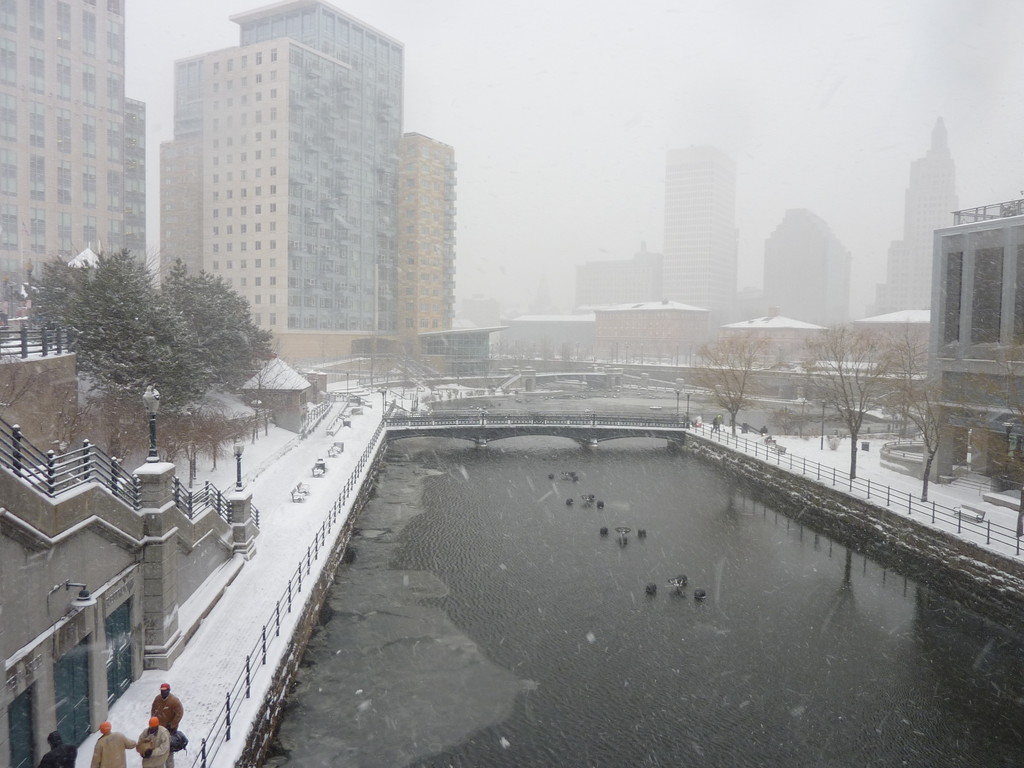
PROVIDENCE – As the seemingly countless weeks of snowstorms have decided to give New England a break from the constant shoveling and plowing, a question looms: Will business and government be able to pay for the next storm?
This season’s snow has cost Providence more than $1 million of its $1.8 million budget for snow removal already. Cranston has run through its $550,000 snow budget and now is eating into its $200,000 contingency account. Warwick has spent 90.53 percent of its $470,000 budget.
Rhode Island’s Department of Transportation has run up a winter operations bill – including overtime, vendors and materials – of $14.55 million, well more than the full-year 2011 budget of $9.62 million and the revised winter budget of $12.82 million.
In 2010, the DOT budgeted $9.8 million and spent $8.9 million; in 2009, it budgeted $10.8 million and spent $14.3 million.
And although local residents may feel like it has been a particularly difficult season, it is far from the snowiest one on record. Providence has seen 47 inches of snow fall to date in four “appreciable” snowstorms, a far cry from the 72.9 inches seen in 1948. However, the nearly 50 inches of snow do significantly outpace last year’s total to date, 28.5 inches, and the area’s 30-year average of 27.1 inches, the Taunton office of the National Oceanic and Atmospheric Administration said.
“Last winter, the mid-Atlantic states were pummeled by successive snowstorms. This season, the pattern shifted, and the I-95 corridor from New York to Boston has been buried by the Dec. 26, 2010, Nor’easter and almost weekly storms since early January,” the Northeast Regional Climate Center observed.
What kind of financial implications do the storms have for the state? A 24-hour closure has an estimated $4 million price tag, said Mike Trainor, spokesman for Gov. Lincoln D. Chafee.
This year, state government has only been closed for one 8-hour shift during the Jan. 12 snowstorm. The Rhode Island Department of Administration estimated the cost of closure at $130,480.42 in employee overtime.
“It’s safe to say the snow budget [is being depleted] faster than in the past couple of winters because of the weather that we have been experiencing this winter,” said David Ortiz, press secretary for Providence Mayor Angel Taveras.
Although Ortiz says pinpointing the exact costs is a bit of a “moving target,” the city did up its budget this year from the $1.6 million allotted in the previous two budgets.
For Cranston, another big storm could easily soak up the $200,000 contingency account. Cranston Mayor Allan Fung estimates the cost of clean up after a significant storm ranges from $140,000 to $170,000. The city relies heavily on outside vendors for snow removal, with about 100 vendors who could be used in a major storm to supplement the 40 or so pieces of municipal equipment.
Still, Fung is not worried about how to keep roads clear if the bad weather continues. In the worst-case scenario, Cranston could rely on its rainy day fund, which boasts upward of $12 million.
“That’s why it’s so critical for towns and cities to maintain a healthy rainy day fund for emergencies just like this. That’s what it’s there for and should only be used for these unexpected situations that come up,” Fung said.
Keeping the roads, driveways and sidewalks clear does come with another challenge: What to do with all that snow once it’s been removed?
To deal with the piles of white stuff – now grayish-black remnants of snow lining every spare inch of garden, sidewalk or simple crevice – locals have gotten creative or have simply decided to live with it until the spring.
And government officials are faced with the same quandary.
In Providence, the snow is piling up in the North Burial Ground while Cranston has chosen its stadium parking lot.
“There’s quite a bit … [the piles of snow are] getting pretty big,” said Fung. “Even if you come to the City Hall parking lot, we’re running out of room, too.”
Despite the warnings and urgings of local government to keep sidewalks clear, no fines have been issued to Providence residents for not having their section cleared.
“The city has reached out to homeowners … this is a public safety issue. Our sidewalks need to be safe and passable,” Ortiz said.
For Warwick’s T.F. Green Airport, snow has meant flight cancellations but not a closing of the facility.
“The airport is always open. However, the ability to get people out of flights hinges on whether we can get aircraft in from other markets where they may be experiencing the storm first,” said spokeswoman Patti Goldstein.
The airport does not keep cumulative data on how many flights are canceled or delayed.
The Warwick government, like its airport, has determined to “remain open” despite the weather.
“It costs a lot of money to keep government closed. We know that overall, if businesses get shut down all over the state, it’s about a $60 million loss for the state. … We try to keep government open every day that we can,” said Warwick Mayor Scott Avedisian. Nevertheless, the mayor could not provide information on how much it would cost to close the local government’s offices for a day.
Despite the airport’s – and the government’s – best efforts to keep their doors open in bad weather, Avedisian noted that the flight cancellations have affected local businesses that rely on travelers to eat, stay and, generally, spend in Warwick.
“Flights have been canceled at T.F. Green this season [and] that has such a spillover effect on our hotels, on our restaurants, on our car rental companies … on all of the ancillary airport uses that happen in this city,” Avedisian said.
Parking bans are also an issue for Warwick businesses, Avedisian said, noting that “if people can’t get to restaurants and situations where they can spend money and engage in commerce, then it’s problematic all around.”
“Our No. 1 concern is removing snow from the roads and [being] able to get emergency vehicles to and from Kent Hospital. However … we need to [make sure] we’re not unduly affecting all of the restaurants in Warwick … that we’re not creating a problem near the airport,” he said.
And, because most travelers have been well forewarned of the impending storms, most have not been caught off-guard seeking refuge at local hotels.
“We [have ended up] losing revenue instead of making money because of the storms,” said Jose Estrompa, general manager of the Radisson Hotel Providence Airport.
Estrompa estimated just food and beverage revenue losses this season are in the $20,000 range.
“Keeping the sidewalks and parking lot accessible and safe is very expensive,” added Estrompa, while noting that despite the weather effects, his business has actually picked up this year. “We’re doing much better than last year.”
“We have seen a significant increase in [reservation] cancellations, primarily in the corporate sector,” said Steven Shanger, general manager at the Courtyard Marriott in Warwick. “It is hurting us.”
Shanger was not able to release specific numbers on the impact of the storms but noted “for the most part, it has reduced our occupancy.”
“It has been worse this year and it all depends on what day it hits. If it happens on the weekends, it doesn’t impact the corporate customers,” he added, noting that sporting event cancellations have also contributed to the declines. “But it’s better for us if it doesn’t happen at all.”