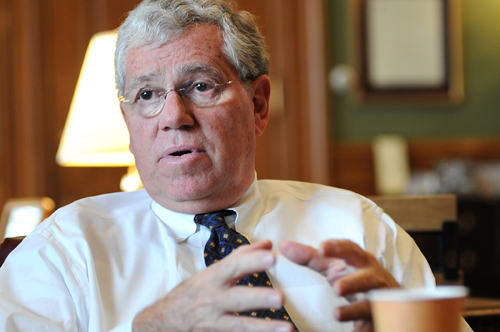
The last 14 months of Gov. Donald L. Carcieri’s term may prove the most challenging for his ambitious energy agenda.
• The push for an offshore wind farm at the center of his pledge to reduce Rhode Island’s dependence on fossil fuels last month ran into what he hopes is only a temporary roadblock.
• National Grid is pushing for an increase in electricity rates.
• And to top it all off, the administration’s top energy and economic-development positions – which the governor sees as related – remain vacant.
In an Oct. 22 interview with Providence Business News, Carcieri said he remains confident that a wind farm off the coast of Block Island will come to fruition. And he holds no regrets over naming developer Deepwater Wind the state’s “preferred developer” last year. That moniker left New Jersey-based Deepwater the only viable candidate to build a wind farm and sell National Grid the renewable energy a new state law requires it to procure. But last month National Grid rejected Deepwater’s proposed power-purchase agreement, saying it wanted a fixed-price contract with rates below what the developer proposed.
Carcieri responded by speaking to executives at both companies, but he says it is up to the R.I. Public Utilities Commission (PUC) to determine a fair contract. (On Oct. 30 he sent a letter to the PUC urging it to facilitate a long-term contract between National Grid and Deepwater Wind.)
The governor said it was important the two sides come to an agreement if Rhode Island is to remain on schedule to build the first offshore wind farm in America, which Deepwater wants online by 2012.
“What I’m trying to do is drive a policy that I want Rhode Island to be the first, because I believe once someone puts up a project … you’re going to see these things just proliferate,” Carcieri said.
In June Deepwater signed a 10-year, $20.7 million lease for 117 acres at Quonset Business Park in North Kingstown, where it plans to assemble the supports for the wind turbines. The privately financed company also pledged to bring 800 jobs and utilize Rhode Island as the hub for offshore wind projects along the upper East Coast.
Besides a possible economic boost for a state experiencing some of the highest unemployment rates in the nation, the project also would vindicate the administration’s selection of Deepwater. In September 2008 a group handpicked by the governor sifted through seven companies looking to gain the state’s blessing to develop an offshore wind farm. After closed-door meetings, the five-member committee selected Deepwater, a choice Carcieri continues to back.
“I think we’re happy with that decision,” Carcieri said. “It was a good one. They went through an extensive process.”
To critics who accused Carcieri of picking a company with no experience, the governor pointed out no one has ever developed an offshore wind farm in the United States. And with no turbine-manufacturing infrastructure in America, it was reasonable for Deepwater to pitch higher-than-market rates to National Grid, Carcieri said.
The project also continues to enjoy broad support across party lines, making it easier for the Republican governor to see the project through, said Maureen Moakley, a political science professor at the University of Rhode Island. And although the governor is term-limited from seeking re-election, the image of a wind farm helping the environment and delivering energy rates not dependent on the volatile fossil fuel market plays well with voters, Moakley said.
“This is where he can show real leadership with a substantial cadre of voters who see it his way,” Moakley said.
The message of stable energy costs could also prove appealing as National Grid, the state’s largest electricity distributor, requests permission from regulators to raise rates. The utility says that under its plan now before the PUC, rates will increase 11.2 percent for most residential customers, while commercial customers could see rates jump by as much as 7.1 percent, although some industrial customers claim they would see increases three times that size.
Carcieri said the proposed rate increase came at a poor time for businesses already struggling during a recession. But the governor stopped short of saying he would move to personally intervene as he did during a prior rate case.
“It’s on our radar,” Carcieri said, adding that the larger issue was keeping “Deepwater and the wind farm on track.”
The project is moving forward without a commissioner of the R.I. Office of Energy Resources. The position has been vacant since Andrew Dzykewicz resigned in July. Carcieri told PBN he is waiting to fill the job until he hires a permanent executive director at the R.I. Economic Development Corporation (EDC). Michael Saul has been filling that position on an interim basis since Saul Kaplan resigned in December 2008.
Carcieri said he wants the General Assembly to pass legislation that would allow him to sign a multiyear contract with the new EDC director rather than see the director leave in January 2011 when governor’s term ends. A longer contract would attract a better a candidate, Carcieri said. The Senate would also need to sign off on the candidate.
Carcieri says the EDC and energy positions are linked because renewable energy holds the potential to lower energy costs for businesses and spur a new “green” industry in the state. But perhaps the biggest reason Carcieri has held off filling the energy post is that he is toying with the idea of imbedding the chief energy-adviser role directly within the EDC, which already manages the state’s Renewable Energy Fund.
“What I want that role to concentrate on is the real development of renewable energy,” Carcieri said.
More mundane tasks such as distributing weatherization grants would be left to the Office of Energy Resources, a subset of the Department of Administration, Carcieri said.
Carcieri also dismissed suggestions that his energy agenda was adrift without a chief energy adviser. If the state is missing opportunities, the governor said, “It’s not for lack of focus.”
Alteris Renewables Wind Business President Bob Chew said he looks forward to the governor filling the energy-adviser post. But he cautions against focusing too much on an offshore wind farm, as he felt the administration did in the past.
“It was very frustrating to me to see them put a hold on any land-based energy projects and put all their eggs in one basket with offshore wind, and as a result of that not much has happened,” Chew said.
If the wind farm does come to fruition, it could serve as bragging rights for the state’s Republicans and a lasting legacy of Carcieri, who is struggling to find good news in a dismal economy.
“I think that if I were running a state like Rhode Island in such difficulty in so many ways, [a wind farm] is a great way to get something done as your legacy,” said June Speakman, a political science professor at Roger Williams University. “But I also think wind power is one of those win-win situations as long as it works out economically. My guess is it’s not a political motivation for the governor. At this point it’s more of a desire to achieve something in an environment where it’s so hard to achieve something.” •