An effort by the federal Environmental Protection Agency to help cities and towns in the region reduce their energy use and air pollution highlights a dilemma faced by municipalities throughout Rhode Island: Can they afford to conserve more energy during the state’s worst fiscal crisis in more than a decade?
Launched by the EPA last year, the New England Community Energy Challenge is part of the Energy Star Challenge, a nationwide campaign to improve energy efficiency in commercial and industrial buildings nationwide by 10 percent or more.
Cities and towns participating in the challenge pledge to assess their energy consumption, improve their energy efficiency and expand renewable energy choices in schools, wastewater facilities and other municipal buildings. Participants are provided with tools and financial resources through the EPA, regional utility companies and other businesses and nonprofit partners in the program. (READ MORE.)
The EPA is touting the energy-efficiency initiative as crucial for cities and towns throughout the region at a time when oil, gas and electricity costs are at record highs and may continue to rise.
“The time is right for all our New England leaders to step up to the plate to improve our environment and save money,” said Robert W. Varney, the EPA’s regional administrator for New England, in a press release. “As much as 30 percent of energy consumed by buildings is wasted, offering program participants a significant opportunity to strategically reduce unnecessary consumption in buildings, while reducing energy costs and greenhouse gas emissions.”
More than 75 cities and towns throughout New England, representing 20 percent of the region’s total population, are currently participating in the program. But Warwick and North Providence are the only two municipalities in Rhode Island that have so far signed on to the initiative.
Just across the state border in southeastern Massachusetts, Dartmouth, Easton, Mansfield and New Bedford are all taking part in the program.
More Rhode Island municipalities have probably not committed to joining the initiative because they are loathe to start spending money on energy efficiency projects during a time of severe budget shortfalls faced by every city and town in the state, said Scott Avedisian, Warwick’s mayor.
The reluctance to invest in energy efficiency is unfortunate, in Avedisian’s view, because such efforts will start saving municipalities money within a few years and continue to pay for years to come.
“It’s going to cost you a little bit in the short term, but your long-term benefit is much better,” he said. “Unfortunately, when we look at that kind of an outlay of money, most communities will back away from it, because there is no cash out there at the moment.”
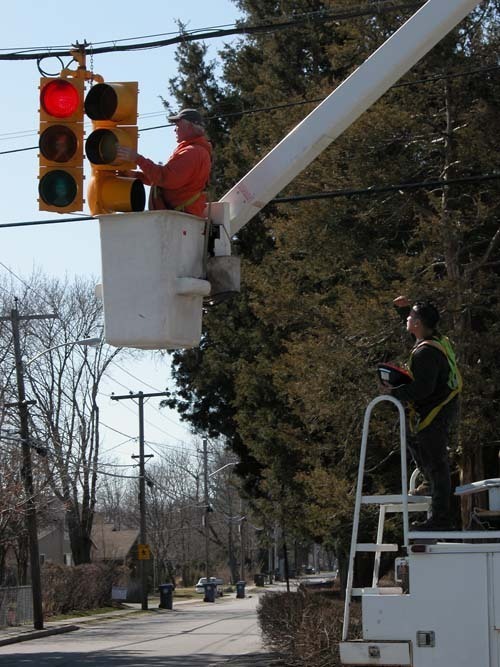
Seeking to save money and protect the environment, last spring Warwick replaced all of the incandescent bulbs in the city’s traffic signals and cross-walks with energy-efficient LED bulbs.
The project, which cost about $70,000, was paid for in part with $23,000 in rebates from National Grid, Avedisian said. Warwick is projected to save about $30,000 annually from the transition to LED lights, he said.
Officials in Warwick are currently studying ways to reduce energy costs at the city’s public swimming pools and skating rinks, including possibly installing co-generation systems that would help to power the buildings by using steam produced to heat the pools, Avedisian said.
The city is also considering installing vegetative roofs on some municipal buildings to lower their heating bills in the winter and reduce air conditioning costs in the summer, he said.
North Providence Mayor Charles Lombardi’s office did not return a telephone call seeking information about that town’s energy-efficiency efforts before this story went to press.
Hoping to enlist more municipalities in the state in its energy efficiency program, the New England office of the EPA will host a panel discussion explaining the initiative at the Rhode Island League of Cities and Towns’ annual convention on Jan. 31.
Avedisian hopes other mayors and town administrators in the state will consider joining the EPA’s initiative, though he appreciates the tough choices that each must make to balance their budgets this year.
“It’s more difficult to be able to sell those kinds of programs in bad economic times, but it definitely is much better for all of us,” he said. •