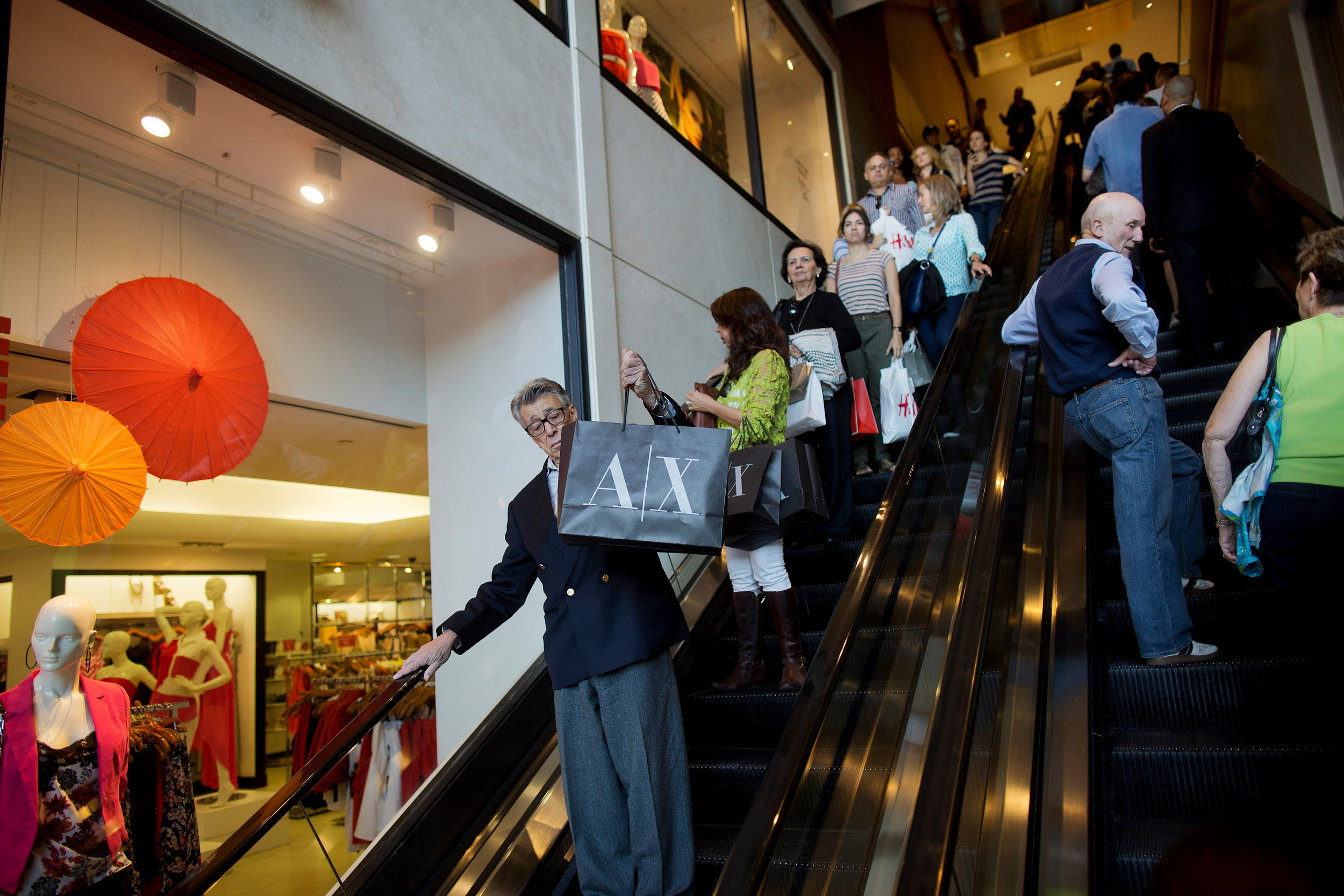
WASHINGTON – Retail sales in the U.S. rose more than forecast in May, showing job gains and lower borrowing costs are encouraging consumers to spend.
The 0.6 percent increase was the biggest in three months and followed a 0.1 percent gain in April, Commerce Department figures showed today in Washington. The median forecast of 83 economists surveyed by Bloomberg called for a 0.4 percent advance. The figures used to calculate economic growth, which exclude categories such as automobiles, climbed 0.3 percent.
Interest rates held down by the Federal Reserve’s record monetary stimulus are bolstering car sales in the face of higher taxes and limited income growth. Higher stock and home prices are shoring up confidence, driving orders at retailers such as Gap Inc. and underpinning the household purchases that account for about 70 percent of the economy.
“The consumer seems to be faring very well,” said Brian Jones, senior U.S. economist in New York at Societe Generale, who correctly forecast the gain in sales. “The labor market is getting better. People realize that the employment situation has improved so they feel better and are probably willing to go out and spend money.”
Other reports today showed applications of unemployment benefits and consumer confidence dropped last week
Jobless claims dropped by 12,000 to 334,000 in the week ended June 8 from 346,000 the prior period, the Labor Department reported in Washington. The median forecast of 51 economists surveyed by Bloomberg called for 346,000.
Confidence falls
The Bloomberg Consumer Comfort Index declined to minus 31.3 in the period ended June 9, the lowest since early April, from minus 29.7 a week earlier. Consumers’ views on their personal finances fell to the weakest in more than two months and their opinion of the buying climate was at its lowest since mid-March.
Stocks fluctuated between gains and losses amid speculation that Federal Reserve policy makers will pare stimulus. The Standard & Poor’s 500 Index rose less than 0.1 percent to 1,613.09 at 9:56 a.m. in New York.
Estimates for retail sales in the Bloomberg survey ranged from a 0.1 percent drop to a 0.8 percent advance.
Eight of 13 major categories showed gains last month, led by the biggest increase in purchases at auto dealerships in six months. Receipts at general merchandise stores climbed by the most since August.
Sales at motor vehicle dealers increased 1.8 percent in May, more than twice the 0.7 percent gain a month earlier.
Auto sales
Cars and light trucks sold at a 15.2 million annualized rate in May, making it the sixth month out of the last seven to exceed the 15-million mark — a level that previously hadn’t been reached since February 2008.
A pickup in growth in the world’s largest economy is convincing executives at Toyota Motor Corp. that the Japanese automaker will meet a sales goal for its Prius model in the U.S. after saying in April that the world’s biggest carmaker may adjust the target as declining gas prices restrained demand.
“We’re on target for sales of 250,000 units of the Prius family,” Jim Lentz, Toyota’s North American chief executive officer, said yesterday in Nagoya City, Japan. “The U.S. economy finally seems to be improving.”
Sales at general merchandise stores rose 0.5 percent in May after a 0.3 percent drop. Purchases also improved at building materials outlets, sporting goods stores and so-called non-store retailers.
Growth impact
In the category that excludes autos, gasoline and building materials, which are the figures used to calculate gross domestic product, sales increased in May after a revised 0.2 percent gain in the previous month.
Same-store sales also showed signs of strength last month, rising for nine of the 10 companies tracked by Swampscott, Mass.-based Retail Metrics. L Brands Inc.’s sales climbed 3 percent, beating the 2.9 percent estimate. Purchases at the company’s Victoria’s Secret brand were up 4 percent, while the Bath & Body Works brand gained 3 percent.
San Francisco-based Gap, the largest U.S. specialty apparel retailer, last week reported a 7 percent increase in May sales compared with the same month in 2012, almost double the 3.7 percent gain projected by analysts on average.
The American consumer “is incredibly resilient,” Eric Wiseman, chief executive officer of VF Corp., the world’s largest apparel maker, said in an interview yesterday. “Are there risks that the economy could slow down? Yes. But for now, the consumer seems pretty engaged.”
Spending forecast
Household spending will grow at a 1.9 percent annualized rate this quarter after expanding at a 3.4 percent pace in the first three months of the year, the most since the end of 2010, according to the median forecast of 66 economists surveyed by Bloomberg from June 7 to June 12. Purchases are projected to climb at an average 2.4 percent annualized rate in the second half of the year.
Strength in the stock and housing markets is helping to bolster household balance sheets and keep Americans spending amid higher taxes. The Standard & Poor’s 500 Index has advanced 13.1 percent this year.
Property values rose 10.5 percent in the 12 months through March, the biggest gain in seven years and the 13th consecutive advance in national home prices, according to Irvine, Calif.-based CoreLogic Inc.
Bigger job gains that lead to increased wage growth would help contribute to an even faster pace of consumer purchases. Employers added 175,000 jobs last month, the Labor Department said last week. Job gains averaged 176,250 in the year ended last month.