
At the Church of the Immaculate Conception in Cranston, people are able to reach out and touch someone – and it has nothing to do with religion.
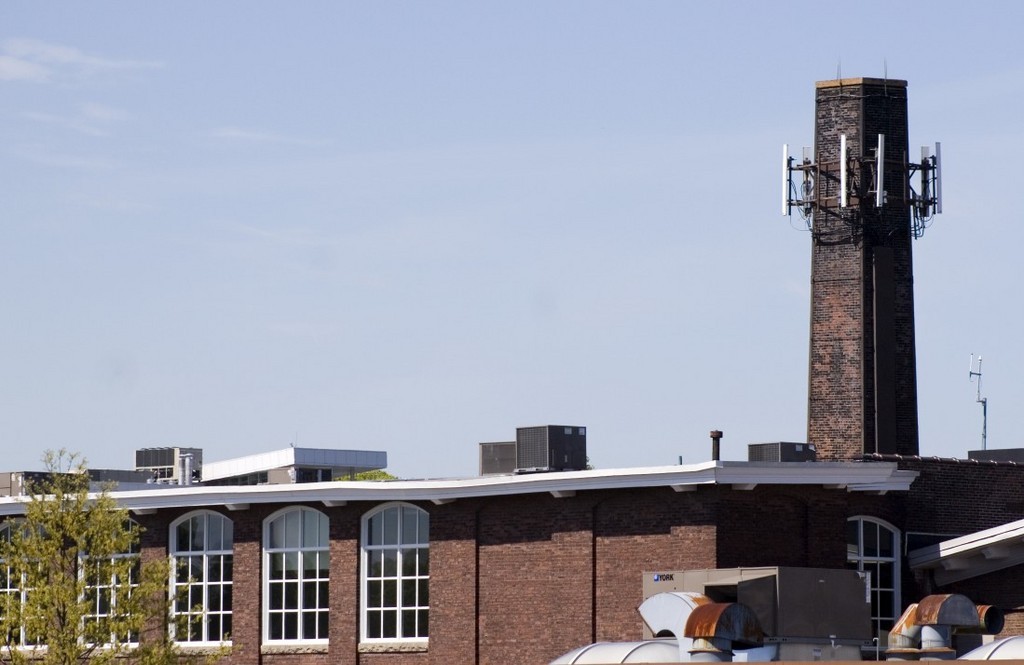
About 12 to 15 years ago, the church was approached by a telecommunications company to use its bell tower, which stands about 100 feet tall right next to the church, to set up antennas for its business.
According to Joe Shekerow, administrative assistant to the pastor, the tower appealed to the company because of its height. He added that the church is being compensated for the antennas, though he would not say how much.
Right above the brick tower and right below the cross are two white beams. They’re so inconspicuous that it’s difficult to even tell they are antennae unless someone tells you. And that’s the point: When it comes to cell phone towers and antennae, it’s best not to be seen.
Wendy Bulawa, spokeswoman for Verizon Wireless, said her company takes pride in the fact that no one notices its cell phone towers and antennae – also known as cell phone sites – that are painted and designed to blend in. “You don’t want to interrupt [the view] with a big, mechanical structure,” she said.
Bulawa said Verizon Wireless strives to make its cell phone sites “aesthetically friendly.” Bulawa and Richard Enright, the company’s director of network performance for New England, said Verizon Wireless has “thousands” of towers and antennae in New England, and most antennae are attached to existing structures rather than in towers built by the company. (Bulawa would not disclose the exact number of cell phone sites on existing structures.)
Cell phone towers and antennae are nothing new. But in places such as New England, telecommunications companies are on the lookout for existing structures – water tanks, billboards, smokestacks and church steeples, to name a few – where they can place cell phone antennae and towers to increase their coverage.
“Before we even propose to do a new structure, we want to make sure that there’s not an existing structure there that we can make work,” Enright said. “We want to make the existing structure work.”
Enright said in New England, Verizon Wireless uses two types of structures the most: raised water tanks and church steeples. Enright said church steeples are good because they are usually at the center of town and tend to have a higher elevation. And while water tanks can be unsightly, people have gotten used to having them in their communities.
Since 2000, Verizon Wireless says it has invested $35 billion into developing its cell sites. In New England alone, Verizon Wireless spent $318 million. AT&T Inc., formerly Cingular Wireless, says it has spent $340 million on its network in New England over the past two years.
Last year, AT&T set up a cell site in St. John the Baptist Church in Pawtucket, according to company spokeswoman Kate McKinnon. She said approximately 26 percent of the company’s cell sites are attached to existing structures.
Adam Sullivan, a telecommunication consultant who represents T Mobile and other carriers, said the companies’ goal is for people to never realize that a tower is there. Existing structures are great locations because they are “usually the highest spots in town,” he said, and they also cover up the eyesore of a cell tower.
Sullivan added that there is a growing need for towers because wireless service is increasingly used to transmit data as well as phone calls. Moreover, consumers “have gotten more and more demanding,” he said, in terms of the quality of their signal regardless of where they are. “They expect to be able to use the phone everywhere,” he said.
This also represents the paradox in the cell phone business: Everyone wants the best coverage with no dropped calls, yet no one wants to spoil the scenery.
Enright said the industry will just have to become more creative in where to put its cell phone sites. One advantage, he added, is that antennae don’t have to be as tall as they used to. Instead of having to find a 100-foot-tall water tank, Verizon can now use a 60-foot structure.
But cell phone companies aren’t the only ones that need antennae for wireless service.
Towerstream, a wireless broadband company that services businesses, has antennae set up on several tall structures, including at the top of One Financial Plaza in Providence.
The company’s vice president of engineering and operations, Arthur Giftakis, said cell phone companies started out the same way, and expanded to lower buildings to fill the holes in their networks. Although Towerstream does not compete directly with the cell phone companies currently, Giftakis said he expects they will cross paths as his company expands.
“Every provider, including ourselves, you try and cover 80 percent of the geographic area right away,” he said. “Then you start figuring out, ‘OK, well, there are more people over here so I need to cover this area.’
“You might move to a lower building – we might move to lower buildings – to make sure at the end of the day, you’re really looking for 100-percent coverage,” he said.