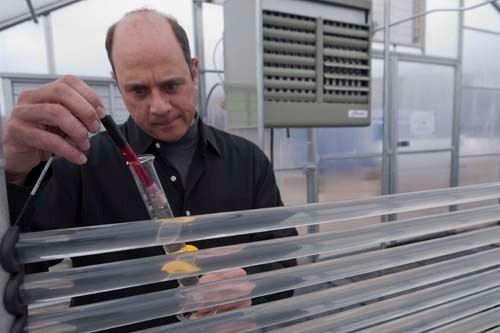
In a nondescript 20-foot-by-8-foot shipping container and an accompanying 5,200-square-foot greenhouse in Cranston, Tomorrow BioFuels’ Larry Dressler believes he can prove the viability of capturing carbon dioxide and using it to feed algae, which then forms the basis of biofuel.
“My ultimate goal is to have someone stand in our parking lot and look and say, ‘I get it,’ ” Dressler, the company’s president, said last week.
Work on the $500,000 test facility, which the company hopes to show can generate electricity, started in August, paid for in part with a $125,000 grant and a $125,000 loan from the state’s Renewable Energy Fund.
The plant recently started growing its first batch of algae in a network of clear pipes horizontally stacked to resemble a towel rack. Within the next few weeks, workers will transfer the algae from there to one of four blue, blown-up plastic pools.
In December arrives the first prospective investor. For Dressler the visit may prove the real test of his 3-year-old company.
At the heart of the test will be a piece of equipment sitting in the shipping container connected to generators, some drawing methane seeping from the defunct municipal landfill next door. As the generators burn methane and biodiesel, Tomorrow BioFuels’ equipment captures the released carbon dioxide, a greenhouse gas blamed by scientists for global climate change.
Workers then remove the sponge-like carbon dioxide collector in the machine and deliver the gas as dinner to the pools of waiting algae. Accelerated by the infusion of carbon dioxide, the algae bloom at a rate of once every 24 hours. Put another way, Dressler expects his facility to generate between 25 pounds and 100 pounds of algae a day depending on the weather.
“It’s almost like we’re playing with Mother Nature,” Dressler said.
The algae will pass through machines that extract its naturally occurring oil. Tomorrow BioFuels workers will use some of that oil to make biofuel on the spot to generate electricity. Additional oil will head to biofuel refinery companies. That fuel produced on-site heads straight back to one of the generators and the process repeats. In industry lingo, it’s a closed-loop system – or one that can self-sustain.
“Sometimes what you can do on the lab bench you can’t repeat on the intermediate or the industrial site,” Chirkov said.
If the plant impresses, Chirkov and Dressler want to scale it up further, perhaps at a facility covering 15 acres and including more water tanks to grow algae. Along the way, the company will seek ways to interconnect its carbon dioxide-capturing equipment with other types of power plants or the like.
Power plants in particular could prove a lucrative market for Tomorrow BioFuels. Dressler said he anticipates the federal government further restricting the amount of carbon dioxide that plants can release. Tomorrow BioFuels aims to position itself to take advantage of that demand and Americans’ constant desire for electricity.
“We happen to have the one piece of business that people need, which is power,” Dressler said.
And the company is not stopping at power plants. It is investigating harvesting nutrients from treated wastewater. And the algae-growing techniques the company is testing – which permit growing algae in deep water – could set the company up to grow it for pharmaceutical uses. And if the Cranston facility concept does not work out?
“If it’s a failure we got a sauna pool,” Dressler said with a laugh. •