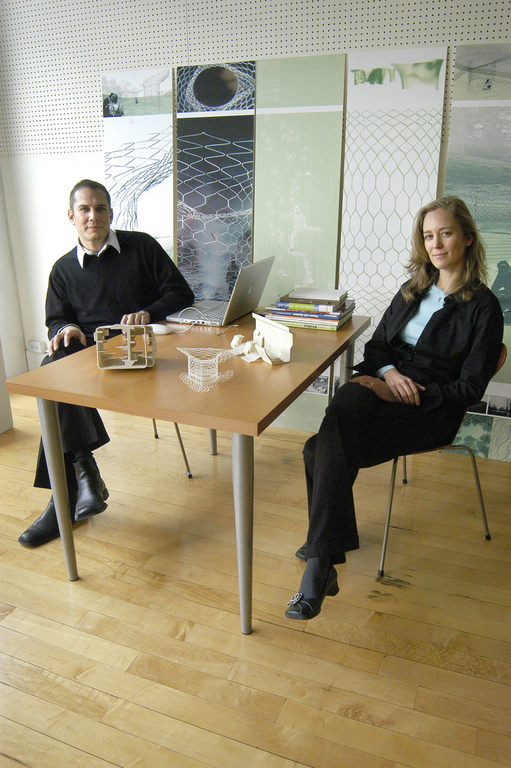
Andrew Thurlow and Maia Small Thurlow consider themselves part of the first wave of architects capitalizing on digital technology in their profession.
The couple met while attending graduate school at Columbia University in New York City. At that time – the late 1990s – there was a heightened interest in the use of digital technologies such as CAD/CAM, or computer-aided design/computer-aided manufacturing, in architecture.
The computerized system used by engineers in designing and controlling the manufacturing process of products has been used in manufacturing and by industrial designers for years.
Columbia’s graduate program was one of the first to teach how it could be used in the design and production of small-scale architectural models in addition to other applications, Thurlow said. And that’s what had attracted the pair to the program in the first place.
As a result, Thurlow and Small Thurlow created what they call a digitally driven architecture firm, Thurlow Small Architecture.
One thing that separates the firm from others is that it doesn’t use the digital technology just to represent architectural designs, Small Thurlow said. Digital technology is part of the process from conception to execution.
At the conception level, the firm uses 3-D modeling software and animation software to create architectural models that can then be converted into physical form at the click of a button, Thurlow said.
It’s like printing a document, except the output is not a piece of paper with words – it’s a 3-D model printed using a special 3-D printer.
It’s the same sort of technology used in industrial design for rapid prototyping, Small Thurlow said.
“It’s a new thing becoming part of the architectural world,” she said.
“You don’t see it in the offices around here.”
In addition, the modeling software allows the couple to determine the number of bricks or stones or other materials needed for any given structure, which gives the client an idea of how much the structure will cost “prior to the contractors coming in giving their price quotes for the material,” Thurlow said.
But the use of digital technology is only one component of the firm’s capabilities.
The couple moved the firm to Pawtucket in 2004 for a few reasons – partly because Thurlow was offered a teaching position at Roger Williams University, but mainly because they liked the affordability of the area and its proximity to New York City and Boston.
“New York was becoming totally unaffordable,” Small Thurlow said. “It was difficult to even imagine trying to [grow] a practice there.”
Finding a place conducive to growing the firm was a huge priority for the couple because, as Small Thurlow put it, “we’re thinking big.”
The firm employs two people besides its founders. The staff is working on five projects at the moment, but the number is growing.
Being involved in projects like The Pawtucket Agenda has helped the firm build contacts with developers and other design firms locally.
Agenda is a group of community members working to develop strategies to revitalize downtown Pawtucket. Small Thurlow is volunteering her time to the project.
But through her involvement, the firm was asked to conduct an architectural study of the Pawtucket/ Central Falls Train Station for the Pawtucket Foundation.
Being involved in the project also has made the firm more active in the support of Pawtucket as a hotbed for artists and design firms. It is part of the reason why the firm last week moved from a studio in a former mill on Mineral Spring Avenue to a larger space at 165 Broad St. in downtown Pawtucket.
The firm focuses on three main areas: interiors, architecture and urban design, which includes landscaping. It has completed designs for everything from showrooms to master plans. But perhaps what’s most unique about the firm is its growing interest in marketing and manufacturing its architectural designs commercially.
For example, Thurlow recently completed the design for a Japanese-inspired tea house for the back yard of a private client in Massachusetts. Now he is thinking about designing a lower-cost version that could be marketed to stores such as Home Depot and Lowe’s.
That type of direction would shift the firm from a traditional, service-based architectural firm to more of an industrial design type of firm. It might require starting a parallel business that focuses on architectural product design.
Because the firm is small and wants to grow, “we have to be really active in how we go out and either find clients or how we think about our revenue streams,” Small Thurlow said. “So we can develop an architectural product and sell that product as a tea house or manufactured housing … that’s a whole other track we’re working down as well.”
The firm already is working with clients in China to design manufactured houses.
“It’s a very different approach toward architecture,” Thurlow said.