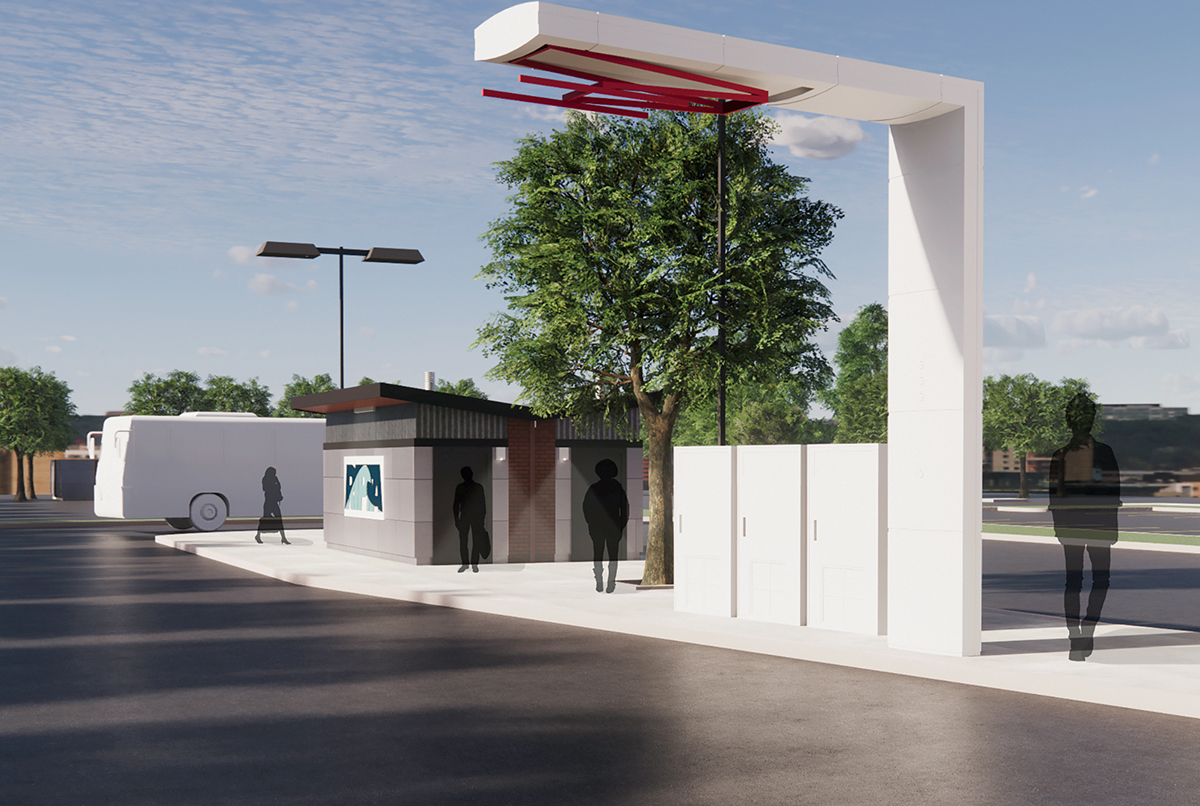
Going electric is about to get a little easier for the R.I. Public Transit Authority.
The bus agency is preparing to start construction on a $6.7 million, state-of-the-art charging station along the busy R-Line that will allow electric buses to be charged in just minutes.
Experts say the new station will be faster and more efficient because it uses an overhead – or pantograph – drop-down system enabling drivers to pull up, charge up and drive off.
“The technology is complex and industry-leading,” said Jordan Barletta, the project executive for Bond Civil & Utility Construction Inc., a Medford, Mass.-based construction firm hired to build the station in Cranston.
Right now, RIPTA operates three electric buses along the popular R-Line from Pawtucket to Cranston through downtown Providence. RIPTA says the route has averaged 6,768 passengers per day so far this year.
But the three buses currently use plug-in stations that require an individual to physically connect wires to the buses to recharge slowly overnight. The new technology allows for quicker recharging en route – between five and nine minutes – and no human interaction with charging cords. A fully charged bus can run about 32 miles.
The faster speed in charging buses will be needed when RIPTA adds another 14 electric buses to its fleet by the end of the year to run on the R-Line, which will no longer use diesel buses.
“RIPTA’s first fully electric route will lower emissions on this key corridor, where many low-income and [Black, Indigenous and people of color] have been affected by air pollution,” said Cristy Raposo Perry, a spokesperson for RIPTA.
The new charging station will be located on a 1.5-acre lot at 1533 Broad Street in Cranston and will have four drop-down units that connect to charging rails on the roof of the electric buses. The driver can remain inside the bus as the charging takes place.
The station, which will be able to charge up to three buses at one time, will also feature driver restrooms, an on-site snow melt system, new parking, areas for bus turnaround and layover, and other site improvements.
“Combined, this offers RIPTA employees and riders with a cleaner, better experience, while electrifying a public bus fleet to lower emissions,” Barletta said.
While construction was supposed to start earlier this summer, Raposo Perry says the project was postponed due to snags in the supply chain, among other problems. The project is expected to start in August, after Bond finalizes permits with the city of Cranston. Construction is slated to be completed by spring next year.
The $6.7 million price tag is being covered by federal aid and part of the state’s share of the 2018 settlement from the Volkswagen AG diesel emissions scandal. In 2018, Rhode Island received $14.4 million as part of the German carmaker’s settlement with the Environmental Protection Agency. The state has allocated the funds toward improving air quality.
This included RIPTA’s Zero Emissions Electric Bus Program, a plan to replace its bus fleet with new, all-electric, zero-emission vehicles. RIPTA launched the pilot program by leasing the three electric buses and chargers for $2.5 million in 2019. Raposo Perry says RIPTA is now in the process of purchasing the three buses for $975,000. The construction of the new charging station launches phase two of the project.
The additional 14 heavy-duty 40-foot transit buses are being produced now, says Raposo Perry. Each bus costs a little more than $1 million and funding came from a combination of the Federal Transit Administration aid, Volkswagen settlement funds and RIPTA capital funds.
About 40% of the state’s greenhouse gas emissions come from transportation and Rhode Island is racing to meet the requirements set in the state’s 2021 Act on Climate, which calls for the state to achieve net-zero emissions by 2050.
Electrifying public transit will help curb the emissions, but some argue that this is only one step to improving public transit and reducing greenhouse gas emissions.
“We should put this in the broader context of how we look at the entire transportation and transit system,” said John Flaherty, deputy director of Grow Smart Rhode Island. “We still have much work to do.”
And much of that work should include addressing how little Rhode Islanders currently rely on public transit and invest in a system that will incentivize them to switch their car for more sustainable alternatives. That is what will make a significant difference when it comes to emissions caused by transportation, Flaherty says.
There are many reasons why Rhode Islanders choose to drive their own car instead of taking the bus: lengthy wait times, limited hours, infrequent service and unreliable transportation.
But if Rhode Island hopes to meet the target set by the Act on Climate, Flaherty says, it needs to make a financial commitment to implement the entire Transit Forward master plan, created by RIPTA, the R.I. Department of Transportation and the Division of Statewide Planning.
“We’ve only got eight years globally to make these important changes to reduce emissions in order to avoid the worst effects of climate change and that clock keeps ticking,” Flaherty said.