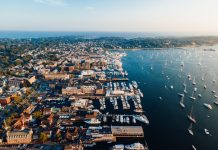
Just as she reaches Narragansett Bay’s first buoy by Castle Hill in Newport, Rum Runner II whirls around in the gray waters in an abrupt about-face.
Facing the Newport Bridge now, Capt. Mark Paltridge guns her engines. Groaning at first, the twin turbo-charged diesels respond, sending the little wooden yacht barreling ahead. Speed leaps from 15 to 30 knots. The engine purr swells to a loud hum. Spray gusts sprinkle passengers as she cuts a swath through the bay toward the harbor, a black banner with the silver lettering “Rum Runner” flapping from her mast.
Building a Strong Data Foundation in the Age of AI
Artificial intelligence (AI) has become a key priority in the boardroom and across management —…
Learn More
“We’re doing 30 (knots) now,” says Bob Spagnolo, general manager of Classic Cruises of Newport — which runs charter tours on her now — turning his face from the wind, “you can imagine what 60 feels like.”
Sixty was top speed when Rum Runner II darted about the waters off New Jersey, carting cases of booze for mobsters during Prohibition. Today, refitted, she carries English journalists reporting on Newport’s yachting industry, and on a school that teaches the art of restoring wooden yachts — as Spagnolo did with Rum Runner II, discovered in Albany, N.Y.
That center of this activity is the International Yacht Restoration School, at 449 Thames St. Now in its second year, the school is where students, of varying ages and backgrounds, come to study what is considered the most demanding of woodworking crafts. In so doing they are preserving an ancient art.
“It’s the highest end of woodworking,” says instructor Paul Murphy, standing on the shop room floor amid workbenches and power tools. “It requires a lot more foresight, and their workmanship has to reflect that.”
Nine full-time students are learning that workmanship now. Each weekday they file into a converted electric plant, a brick building with tall windows that cast light on a large, open work area. The air smells of sawdust. The grating noise of power tools occasionally breaks the quiet as the students tend to their boats.
Their study will take two years. It starts with measuring, lofting — drawing the boat to full size — technical drawing, and restoring hulls and furnishings. It ends with advanced restoration techniques, project management, navigation, and seamanship. When they finish they will have multiple projects in their resume — from tiny “Beetle Cats,” used to row out to other boats, to larger vessels. They will be qualified to work in boatyards or on their own projects. And they will have lots of hands-on experience.
“It’s not the kind of education you can get by sitting there reading a book,” said Clark Poston, program director of the school. “You have to do it — there isn’t any other way to learn.”
Poston should know. His resume includes boat-building and restoration projects around the world. Before coming to Newport he studied at Mystic Seaport Museum in Mystic, Conn., led yacht restoration teams in England and Spain, and started a nonprofit boat-building school in Annapolis, Md. His enthusiasm is evident when he speaks.
“One of the most exciting things is the vehicle you have to teach with is so demanding that you end up teaching a higher level of skills,” he says “These guys can turn around and do anything in woodworking.”
The boat’s very nature makes the work demanding. It has no straight lines. A boat plank must be made thick at the center but taper off at the ends. A small mistake in trying to hang the plank and it could split. But the physical skills are just part of it. Students must also learn to research each vessel to determine when it was built. This allows them to renovate each yacht exactly, using the same materials its builders used. Once this history is documented, they learn to loft the boat on sheets of plywood. From the lofting they develop a table of offsets that shows the yacht’s measurements on a grid. Then they form a construction plan. And they go to work.
The skills, however, come only after a lot of practice — and patience.
“You need to build repetition into the program,” Poston said. “You’ve got to let them break a plank and do it twice.”
Students — whose education runs through the winter and summer of the two year program, capping with a week-long offshore passage — receive written evaluations rather than letter grades. Students here need no experience to be accepted. Enthusiasm and sincerity are the only requirements. All boats are donated, but the school only accepts those that provide good learning opportunities — opportunities students could not get just anywhere.
Like the opportunity to replace the stern of a yacht tender, as first-year student Thomas McAndrews was doing on recent Wednesday morning. Working deliberately, he removed the stern piece by piece so that it could be replaced as it was built originally.
“(You) disassemble the old pieces as carefully as you can and replace it as accurately as possible,” McAndrews said.
Students enroll for a variety of reasons. Some, like recent Simsbury, Conn. high school graduate Rodney Vessels, came because boat building seemed the most exciting way to make a career of woodworking. Others, like second-year student Irene Hubbard, want to embark on their own restoration projects. Either way, the students will have the requisite skills when they receive their yacht-restoration certificate at the end of the program, accredited by the state Board of Higher Education.
Poston said he would like to see the program grow to allow students who want to come back and study after their two years are complete to do so. One of the projects students will have the opportunity to work on is the Coronet, a 133-foot, 1885 schooner yacht that floats in the marina outside the school. She made two around-the-world-trip voyages in her day but now needs extensive work, including hull repair. When it is complete the school will use the boat to teach sailing. Money for major projects such as this one comes in part from donations.
“This is a challenging project,” Poston said. But it’s the kind of project Poston and his students enjoy. The efforts of the school — supported by Spagnolo, who has placed a flag with the letters IYRS at the bow of Rum Runner II — are best appreciated when a boat students have restored is finally dropped in the water, Murphy said.
“When you get done, when you splash a boat, that’s just a completion of everything you’ve done,” he said. “There’s a history (to the boat). You’re giving it new life.”