
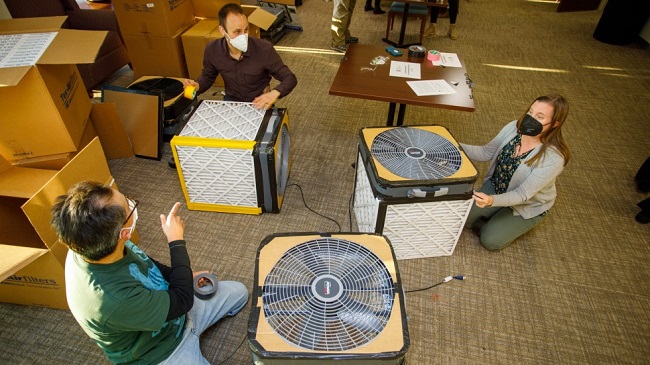
PROVIDENCE – A simple air filtration system could play a significant role in reducing indoor air pollution, a team of Brown University researchers found.
The device, a Corsi-Rosenthal box, can be made for about $100 per unit from four materials readily found at hardware stores: MERV-13 filers, duct tape, a cardboard box and a 20-inch box fan.
Rhode Island's Market Has Changed. Developers, Builders, Investors and Sellers Must Change With It.
By Emilio DiSpirito IV License Partner | Engel & Völkers Oceanside Leader | The DiSpirito…
Learn More
In a project led by Brown University’s School of Public Health, School of Engineering and the Silent Spring Institute, students and researchers found that the boxes, developed prior to Brown’s research project, significantly decreased air concentration of PFAS, also known as forever chemicals, by 40% to 60%. PFAS is an abbreviation for perfluoroalkyl and polyfluoroalkyl substances. The boxes also decreased phthalate air concentration by 30% to 60% when tested in 17 rooms.
Both compounds have been linked to health problems such as asthma, low birth weight, some cancers and reduced vaccine response in children.
These results support that the boxes could serve as an “accessible, easy-to-make and relatively inexpensive” means of combating air pollutants, said Robin Dodson, a research scientist at Silent Spring Institute. The devices are already in use at universities and in homes around the U.S., Dodson added.
A potential downside of the boxes is that they can be perceived as distractingly noisy, said Joseph Braun, an associate professor of epidemiology at Brown and lead author of the study. But Braun said that health benefits likely outweigh this effect.
Full results were published in the Environmental Science & Technology journal.
Jacquelyn Voghel is a reporter for Providence Business News. You may reach her at Voghel@PBN.com.



