Diana Campbell, executive director of the Mosaico Business & Community Development Corp. in Bristol, and Diane M. Williamson, director of community development for the town, are hopeful a $200,000 brownfield-cleanup grant will help ensure the firm’s site at the Bristol Industrial Park will soon be put to good use.
“Our work now is focused on bringing the industrial park up to fire and building codes,” Campbell said. “A Phase II site assessment was conducted last year. They found petroleum in the parking lot area but the buildings don’t have those issues anymore.” Luckily for Mosaico, very little oil contamination was found at the site so it requires relatively minor removal and repaving work, but the real beneficiaries are the potential industries, businesses and boarders; therein lays the true economic benefit.
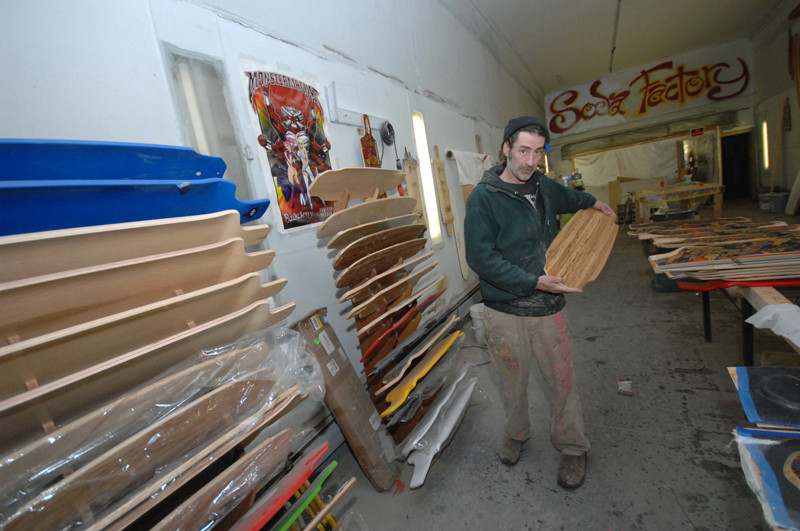
Almost half the town worked there, at Kaiser, during World War II. “The plan is to bring it back as a vibrant, industrial complex,” she said. “So far it’s going well; the site is half full with small businesses, artists, a few manufacturers, woodworkers and entrepreneurs. We want to bring in more tenants in the hope of making it a small-business incubator. We’re hoping to have an impact on local employment.”
As director of community development, Williamson agreed: “We’ve been behind this project from the very beginning and have helped out in any way possible, including assisting with the applications for grant funding,” she said.
In June 2011, the U.S. Environmental Protection Agency awarded the R.I. Department of Environmental Management a $400,000 grant for evaluating the presence of hazardous materials, including petroleum, on suspected sites. Half of the money went to hazardous-material assessments and the other half to petroleum. That money supports local municipalities and environmental consultants to investigate and assess property damage due to environmental contamination. In some cases cleanup costs are also allotted.
Last week, the EPA said it would provide $1.2 million in brownfield grants this year to help Rhode Island communities assess, cleanup and redevelop abandoned or contaminated properties. Among the recipients is Mosaico; Paul Cuffee School, Providence, $400,000; the state DEM, $400,000; and Blackstone Valley Community Action Program, Pawtucket, $200,000.
According to Sen. Jack Reed, D-R.I., there are about 300 brownfield sites in the state that merit investigation. Some may have superficial environmental contamination while others could require substantial study and cleanup.
Cynthia Gianfrancesco, a principal environmental scientist with DEM, serves as the state’s brownfield coordinator.
“The grant money is fundamental to the program,” she said. “One category is for initial, “Phase I” investigations and for more detailed “Phase II” assessments. A second program caters to cleanup costs,” she said. A third program is for revolving loan funds that usually entail large sums of money for cleanup costs. According to Gianfrancesco, there are about 30 sites statewide that are presently under various stages of remediation, and 2,000 sites have been identified as being contaminated to some degree.
Without the Phase I grant money, most projects would be at a standstill. This would impact environmental contractors such as GZA GeoEnvironmental Inc., Fuss & O’Neill Inc. and Woodard & Curran, as well as grind all progress on site rehabilitation to a halt.
In some cases the costs are relatively minor while for others it can run into the millions of dollars, a fact not lost on Matthew Wojcik, the economic-development director of Woonsocket. Wojcik also supervises brownfield rehabilitation for the city, which is currently working on the former Woonsocket Color & Chemical parcel.
The site is “a pretty typical brownfield,” according to Patrick J. Dowling, project manager for Fuss & O’Neill Inc. of Providence, who has consulted with the city on the project. “There hasn’t been a lot of recent interest in redevelopment of it because of the financial constraints associated with the property. It needs some remediation and the cost to do the cleanup automatically makes it undesirable. The city hasn’t been successful in finding somebody to invest the money.”
According to Dowling, brownfield redevelopment represents a significant portion of Fuss & O’Neill’s work in their Providence office. “We do not only the environmental portion but also site design, redevelopment and transportation planning. We like these projects because we are a multidisciplinary engineering firm,” he said. “It requires a team of engineers, scientists and planners.”
Dowling has also worked on the city’s new and former middle schools. The new middle school on Hamlet Avenue was put on a once-contaminated brownsfield site, which he said required significant effort, but the end result won the 2011 Brownfields Renewal Award Social Impact award from Brownfields Renewal Magazine.
“That was a very successful project,” he said.
The old middle school on Park Place suffers from asbestos piping and floor tiles and remains a challenge. “It’s a significant cost to get in there and remove all that material,” Dowling said. As for its future use, that remains to be determined.
The city has been in negotiations with a possible developer to convert the building into housing, he said. •