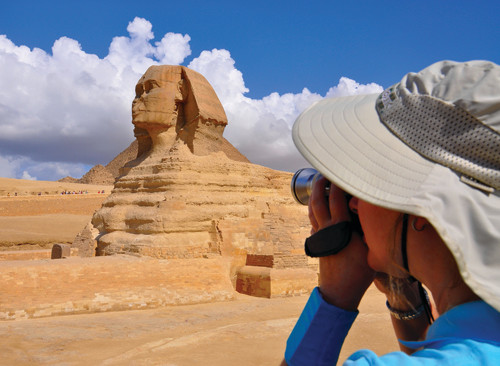
Recent pro-democracy demonstrations in Cairo were more than a television and Internet curiosity for those stuck in the city as tensions escalated, including a group of 160 United States tourists with Collette Vacations.
Yet, because the company is used to dealing with crises abroad and maintains an around-the-clock emergency task force to handle such eventualities, the Pawtucket travel business was able to safely shepherd home the 160 American travelers within days of the time the turmoil started, according to Paula Twidale, executive vice president of Collette. No injuries to local travelers and or major problems were reported.
“In any disaster or crisis, Collette has an emergency plan and we immediately jump into action,” Twidale said in a recent telephone interview, recounting how she and Collette staff managed to bring home the stranded tourists.
For some other travel companies, however, the crisis in Egypt scarcely scored a blip on their radar screens.
Cruises to Egypt make up “only a tiny bit of our business,” said Steve Gelfuso, CEO and president of Cranston’s Cruise Brothers, which Gelfuso said works with about 30,000 cruise-goers each year. “You’ve got to be a real serious traveler to go to Egypt,” he said. “Not everyone will go there even in the best of times.”
The turmoil in Cairo reached a peak the weekend of Jan. 28-30, when anti-government protestors clashed with police and supporters of the country’s then-president, Hosni Mubarak, during violent riots in the nation’s capital. Air travel and road travel were disrupted. For a time, the Internet and cell-phone services were disconnected by the government, which imposed a 6 p.m. to 7 a.m. curfew. Looters targeted the Egyptian Museum, but Egyptian civilians helped minimize damage by spontaneously forming human chains around the facility, which houses some of the nation’s most precious artifacts. Later reports said about 70 objects at the museum were damaged, but all can be restored.
Noting that Collette arranges trips to all seven continents, Twidale explained that the company maintains a special task force seven days a week, 24 hours a day, to handle emergencies or other problems tourists may encounter in different time zones overseas. The task force was called into work the last weekend of January, all day Saturday and Sunday, to bring home the 160 American tourists on Collette tours trapped in Cairo.
Days earlier, as the crisis deepened, Twidale said she personally urged travelers not to visit the Egyptian Museum because “that’s in an area where people were rioting.”
Not all of the 160 trapped travelers had made their arrangements directly with Collette. Many had booked Collette trips through travel agencies. But most travel agencies were not open for business during the hours when the Cairo crisis occurred and regardless, Twidale said, customers are expected to call Collette with problems. “We deal with all emergencies here,” she said.
By Monday, Jan. 31, all the Collette travelers were home or on their way home, according to Twidale.
Most were able to leave in the first day or two, she said, by going to nearby cities for flights out of Egypt. As the crisis continued, it became “increasingly difficult to get people out,” Twidale said. A second group of travelers went home through Tel Aviv. “Any city outside Cairo was the plan,” Twidale said.
The final group of about 20 travelers left on Jan. 31, taking flights to Cyprus chartered by the U.S. Department of State, which later reported that it had evacuated more than 1,900 U.S. citizens and their family members out of Egypt. Usually, Collette travelers to Egypt are not registered with the State Department, but in this case, “we took it upon ourselves to register all of our people,” Twidale said. “We knew exactly how many people we had and where they were.”
Looking ahead, Twidale said Collette has cancelled all trips to Egypt through September, refunding 100 percent of the money to those who had made reservations rather than issue credits. The situation will be reassessed in the fall, she said, because “it is not apparent right now if, over the next month or two, it will be appropriate for people to be there and be safe. We always err on the side of caution.”
Another Rhode Island travel agency that does business internationally, Lincoln’s Travel Advisors International, did not immediately return calls seeking comment.
If there is any silver lining in this cloud for Collette, it would come from the gratitude and loyalty of those 160 travelers the firm helped get out of Egypt. “We are adept at dealing with crises,” said Twidale, recalling that the ash cloud over Europe last year resulted in 10 to 12 days of stranded customers. The Cairo crisis means those 160 people “are our customers for life now,” Twidale said.
At Cruise Brothers, Gelfuso said a large group of the company’s customers planned a cruise to Egypt in the fall because “they always wanted to go there,” but it has been canceled. “All the cruise lines have stopped going there, at least for the time being,” he said. He reported that there were no Cruise Brothers customers in Cairo during the recent turmoil.
ElSayed Khalifa, consul-director of the Egypt Tourist Authority in New York City, could not be immediately reached for comment last week, but a spokeswoman said travel to Egypt is now safe, though travelers should check with the State Department about any restrictions. Khalifa was quoted in Business Travel News on Feb. 9 saying he expects a quick recovery from the recent crisis and suggested that the political dialogue now taking place will make the country a more desirable destination for international travelers.
Tourism is one of the top industries in the 7,000-year-old country, accounting for 13 percent of all jobs and 11 percent of the gross domestic product. In 2010, the Egypt Travel Authority said 14.7 million tourists, of whom 361,000 were from the United States, brought in $11 billion in revenue. •