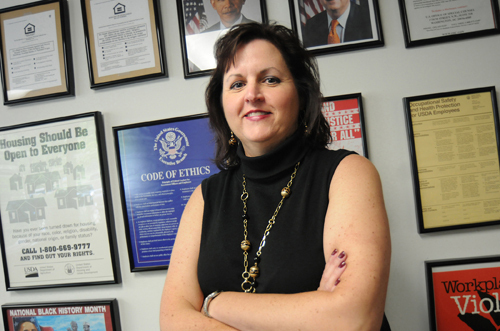
After some turbulent years that included a sinking credit score, piles of credit card bills and a divorce, Jennifer Denbrow thought owning a home was many, many years away. Then her sister passed her a news release detailing a federal homebuyers program and Denbrow’s life changed. On Sept. 18, she was scheduled to close on a house in South Kingstown thanks to an unlikely lender: the U.S. Department of Agriculture (USDA).
The federal agency normally associated with farmers and tractors also administers loan programs for people with low incomes who are looking to buy homes in rural areas. Nationally, it has handed out or guaranteed billions of dollars in loans, and business in the Ocean State is booming.
So far this fiscal year, which ends Sept. 30, the Rhode Island USDA office has provided 15 direct loans at a cost of just shy of $4 million. It also has guaranteed 82 loans to the tune of $16.5 million. Last fiscal year the office handled 42 loans, including both direct and guaranteed loans.
“The word got around,” said Pamela Miller, a specialist at the USDA’s Warwick office.
Congress also helped fuel the rush by providing an additional $10.7 billion in stimulus money for the so-called 502 loans, which started in 1949. That brought overall money available for direct loans to $2 billion and made almost $15 billion available for the guarantee program. Last fiscal year the USDA provided just $1.1 billion in direct loans and $6.97 million in guarantees.
To qualify, applicants must purchase or build a “modest” house in a rural area as defined by USDA Rural Development. In Rhode Island, areas in 25 communities qualify (see attached chart). Applicants also must hold a credit rating above 640, and their adjusted household income must be less than the “low-income” limit for the respective household size and area in which the prospective property is located. In Rhode Island, that generally translates into an income of less than $44,000 for a single person.
Determined not to move her son, Jeremiah, to another school district, Denbrow took scissors to her credit cards, enrolled in financial-literacy classes, secured a better-paying job and raised her credit score to 780. She applied again in July and this time USDA officials offered her a $248,000 loan.
“I was thinking I would never be able to buy my own home, but if you just work toward something and change your attitude, I think it actually helps you achieve your goal,” she said.
As an extra bonus Denbrow, 34, found a two-bedroom, raised ranch just two streets away from her sister and in the same neighborhood where she was renting.
“My main goal was to eventually be able to purchase a home, however, I did not expect it to be within two years or six years,” she said. “I can’t believe it’s actually happening.”
Miller, from the USDA, said the agency has worked hard to inform banks of the program as the economy started tumbling last fall. Officials sent out literature, met with bankers and sought community connections. And when the credit markets dried up, the USDA looked appealing.
“We’re starting to be the only game in town,” USDA spokeswoman Maril Alsup Stockwell said. “You can’t get 100 percent financing anywhere [else] and you can here.”
Miller said most homeowners never approach the direct-loan cap. The biggest direct loan she approved this year was $215,000, and the largest loan the local USDA office has guaranteed was $230,000. New homeowners, Miller said, appear wary in this economy of taking on huge amounts of debt.
Most loans are used to purchase existing homes and few recipients wish to take on constructing a new home, Miller said. Either way applicants come from all walks of life.
“We’ve seen families. We’ve seen single applicants, young men and women in their late 20s,” Miller said.
The vast majority of those seeking a guarantee in Rhode Island rather than a direct loan started at national banks. Miller said the agency guaranteed 18 loans handed out by the now-defunct Taylor, Bean, Whitaker, 14 from JPMorgan Chase, 11 from National City Mortgage, nine from Shamrock Financial and six from Rhode Island Housing. Other banks each handled less than a handful of loans. Regardless of its source, the money usually flows to homebuyers with nowhere else to turn.
“It’s helping out a lot of people I think who could otherwise not afford the home,” Miller said.
Last week, Denbrow was packing her things and imagining hosting a housewarming party and her son playing with the neighborhood kids.
“It’s just not even real,” she said. “I’m starting to get a little freaked out.” •