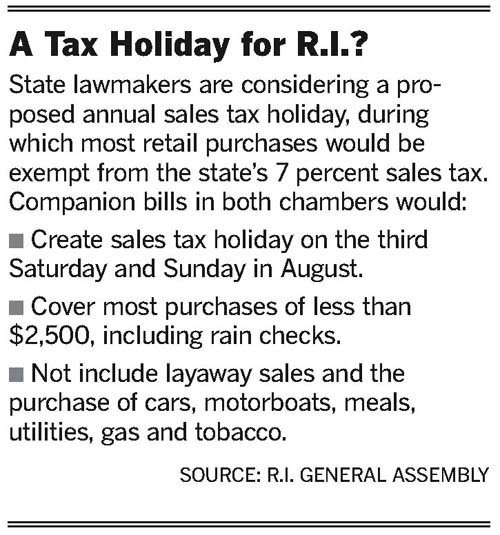
Supporters of a proposed weekend sales tax holiday on most Rhode Island purchases say it would help stimulate the Ocean State’s ailing economy and boost consumer confidence, though it could cost the state millions in tax revenue.
In an effort to keep Rhode Islanders’ retail spending in-state, the holiday would be scheduled for the third weekend in August, just before Massachusetts’ annual sales tax holiday.
“And obviously we would graciously welcome Bay State shoppers to Rhode Island for the weekend,” said Rep. Deborah L. Ruggiero, a Jamestown Democrat and the bill’s sponsor, who acknowledges that the proposal faces an uphill fight.
The bill, H-5471, was heard on March 18 in the House Finance Committee. The committee has yet to vote on it, but hasn’t shown strong support, Rhode Island Retail Federation Executive Director Paul DeRoche said last week.
“The finance committee pretty much just said they couldn’t afford it this year with the state’s budget deficit,” he said.
But Newport County Chamber of Commerce Executive Director Keith Stokes, who helped shape the legislation, remains hopeful a sales tax holiday can still win approval. He said the Senate bill, S-0353, should be scheduled for a hearing this month in the Senate Finance Committee. Sen. Louis P. DiPalma, a Democrat representing Little Compton, sponsored that legislation.
The measure would exempt purchases during the third Saturday and Sunday of August – Aug. 15 and 16 this year – from the state’s 7 percent sales tax. It would apply to purchases of less than $2,500.
The legislation came out of conversations between the sponsors, Secretary of State Ralph A. Mollis and NCCC members, about 90 percent of whom support creating the holiday, Stokes said.
Stokes said he recognizes that the state’s dire fiscal problems don’t make the program very appealing right now. He added, “I know that in previous years legislation had been submitted and failed, mostly because many people are concerned it would have a tax-revenue impact on the state budget.”
Ruggiero said the tax holiday would cost the state about $4.6 million in revenue.
The big-ticket items that shoppers might buy during the tax-free weekend would likely lead to other smaller purchases – “If you buy a computer, there are ancillary products,” Ruggiero said.
And the tax holiday would allow Rhode Island retailers to push the “Buy Local” campaign, a statewide program started last fall by Lt. Gov. Elizabeth Roberts to encourage buying from local retailers and manufacturers.
A December 2008 Mass. Department of Revenue analysis of that state’s program pegged lost sales tax revenue at $14.9 million for the 2008 sales tax holiday.
Twenty-three states that have used sales tax holidays have successfully boosted retail sales, Ruggiero said. New York pioneered the tax holiday in 1997. Massachusetts has been running the program since 2004.
“It may not be the best business tax policy, because it’s really structured to one industry sector, retail, over a fixed period of time,” Stokes said. But because the retail industry has been particularly hard hit by the current recession – it has lost about 3,500 jobs in the last year, second only to manufacturing’s 4,800 lost jobs – this could serve to boost consumer confidence and help small business in the state.
“Clearly, our sense was that in a perfect economic system, you want to have the broadest-based tax policy,” Stokes said. “But this isn’t anything near a perfect economic system. It’s a very difficult one.”
DeRoche agreed that it would be a positive step toward restoring consumer confidence, but said he’s gotten the sense that the bill will likely not make it to the House floor for a vote.
“It would be beautiful if we had the opportunity to compete with [Massachusetts] and do it here in Rhode Island,” DeRoche said. “It would [allow] Rhode Islanders … to buy some merchandise cheaper than it is now. I don’t see that happening, though.” •