
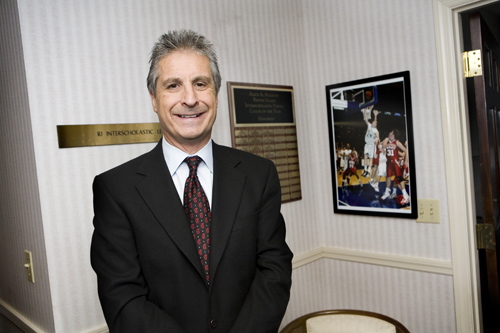
The Rhode Island Interscholastic League (RIIL) has revised its policy to remove a provision intended to prevent media outlets from posting extra photos of sports event on their Web sites and is now asking – not requiring – that interviews with players and coaches be held after awards ceremonies.
“We want our kids to get as much exposure as possible,’ ” said Thomas Mezzanotte, executive director of the Providence-based RIIL, which represents 54 public, private and parochial high schools in the state and sponsors playoff and championship games. Virtually every high school in Rhode Island, except charter schools, belongs to RIIL.
Concerns were raised when the league as recently as last year, as part of its registration form for media credentials, informed representatives of the press that they “may not conduct post-game interviews until the awards ceremony has been completed,” and the only photos posted on the Web “for commercial purposes” must be those that already appeared in a newspaper. Some newspapers sell on their Web sites extra photos that are never published.
“These are public high school kids playing in taxpayer-funded, organized games, and there shouldn’t be anything to stop the media from effectively covering these events,” said Scott Pickering, managing editor of Bristol-based East Bay Newspapers and president of the Rhode Island Press Association (RIPA).
Pickering was one of several editors contacted by Providence Business News who said they simply ignored the RIIL regulation regarding the posting of Web photos.
Mezzanotte confirmed, however, that the prohibition against posting extra Web photos is no longer in effect and has not been since the start of the current season. Pickering said Mezzanotte told him in late summer that this prohibition was null, and that’s why his newspapers ignored it, too.
In recent seasons, the league hired an official photographer to take photos at sporting events and sell them, as a “service for parents,” Mezzanotte said, explaining the rationale behind the regulation. But such a practice turned out to be “too much of a hassle,” he explained, so RIIL has no official photographer this season, and so no ban on posting Web photos.
However, the league’s “Media Credential Registration Form” still carried the Web-posting prohibition until Mezzanotte was questioned by Providence Business News recently. Mezzanotte then sent a revised form to PBN that does not include it. Also revised on the new form is the regulation governing access to players; media are now “asked” to conduct post-game interviews after the awards ceremony (the previous form said they “may not”).
“I don’t have a huge problem with that,” Pickering said of the post-game limit. “We’re a weekly, so a five-minute delay is no big deal. If access is prevented for 30 minutes, that could be a big problem for the dailies.”
Terry Nau, sports editor of The Call in Woonsocket and The Times in Pawtucket, both dailies, denied any problem. “Generally, there are ways around that, especially when you’re on deadline,” Nau said of the access restriction.
Peter Phipps, manager of the sports department at The Providence Journal, declined comment.
Brian Pernicone, sports editor of the North East Independent and South County Independent, weekly newspapers based in North Kingstown, said there has been some difficulty accessing players. At the hockey finals a year ago at Boss Arena at the University of Rhode Island, while the television reporters and their cameras were allowed on the ice to interview players right after the game, Pernicone said print reporters had to wait approximately 30 minutes until players were in locker rooms. He said he feared players, particularly those who lost the game, would leave during the wait and he called the situation “confusing.”
The league generally has no problem with print and television photographers going onto the field or the ice right after a game, taking pictures of the agony and ecstasy of winning and losing, because “we want them to capture the moment,” Mezzanotte said. While this is taking place, league officials set up tables and otherwise prepare for the post-game awards ceremony, when trophies are distributed, he explained.
Reporters ready to interview the players are asked “to hold back until we have our awards ceremony,” Mezzanotte said. “We don’t want to see any interviews until after the awards ceremony.” Awards ceremonies can last as little as 3 to 7 minutes, he said.
“We can get a lot of media” at the games, he said, and parents have complained that they have not been able to see their children receiving awards due to the press blocking the view. In addition, five or six different media outlets may want to talk to the most valuable player or the winning coach, Mezzanotte said, and waiting for individual interviews would delay the ceremony too long.
Pickering said RIPA has not taken an official stand on RIIL’s access limits. “I’m not sure we need to,” he said. “I asked for feedback from our member papers and I’ve heard nothing since the fall.”
A member of the National Federation of High Schools, RIIL is a private nonprofit organization established in 1932 that receives no state funding. Revenue comes from membership dues and fees, gate receipts and corporate sponsorships. The league is governed by a committee made up of principals and assistant principals from member high schools. The league sponsors annual playoff and championship games in 24 sports, representing more than 20,000 student athletes. •



