
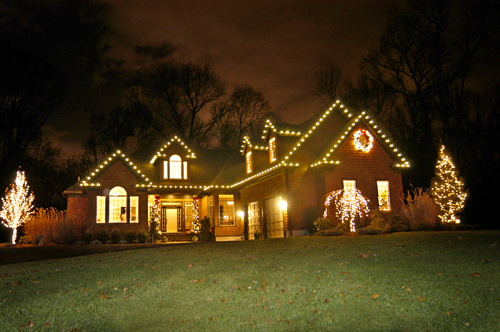
When Seth Wilson decorated his house with holiday lights last year, he decided to mix in some LEDs with traditional incandescent bulbs and measure the difference.
LEDs – short for “light-emitting diodes” – look like incandescent holiday lights, but they are actually a type of semiconductor, which generate light using an electric current. They are also brighter and longer-lasting than incandescent bulbs, and much more energy efficient.
At Wilson’s house, the results were striking – switching from incandescent bulbs to LEDs reduced his electricity usage by 75 percent. This year Wilson, general manager of SeaScape Lawn Care Inc. in Coventry, decorated his home with half LEDs and half incandescents to show people that the two types of lighting look indistinguishable.
Wilson said he expects LED holiday lights to be standard within a few years. “I think all the holiday lighting industry will be converted to LED,” he said. “The cost-per-kilowatt-hour isn’t getting any cheaper, so we’ve got to figure out a way to use fewer kilowatts, and LED is one of those ways.”
If Bing Crosby were alive today, he might consider trading “White Christmas” for “Green Christmas,” because the environmental zeitgeist has spread to the holiday season. Christmas and the other winter holidays are a resource-intensive time of year, from lights and wrapping paper to millions of trees. More and more people are looking for ways to curb the season’s footprint without diminishing its traditions.
Holiday lights are a top target for greening. The average household can save 90 percent or more on electricity by switching from incandescents to LEDs on a six-foot tree that is turned on for 12 hours per day for 40 days, according to the U.S. Department of Energy, which estimates it would reduce the bill from $25.13 to $0.56.
The Energy Department also points out that the LEDs are cooler, reducing fire hazards, and more durable than incandescent bulbs. The department estimates that if every U.S. household switched to LED holiday lights, the country would save approximately $410 million in electricity costs – and if businesses did the same, the total savings almost would be equivalent to the output of a large power plant.
When LED’s first came out, they looked faded compared to incandescents, and customers didn’t like them, said Wilson, whose company is affiliated with Christmas Décor, the nation’s largest professional holiday-decorating firm. “They’ve tweaked it now so that you can’t tell the difference,” he said.
This year, all of Wilson’s new customers had their homes decorated with LEDs, and about a quarter of his existing customers opted to switch, as well. Using LEDs raises the average cost of decorating a home from $1,300 to $1,450, but it can reduce a household’s total electricity bill from $250 down to $25, Wilson said.
“Most people’s perception is, this is great, wonderful,” he said. “The cost of electricity is a concern that people have when they’re thinking about what they want to do.”
In Attleboro, La Salette Shrine, which uses more than 400,000 lights to illuminate its annual Christmas light display, is gradually transitioning to LEDs. “We want to do the right thing,” said Jack Battersby, the shrine’s business manager.
The shrine pays around $60,000 in electricity costs to power the light show each year, and Battersby said he would welcome the energy savings that would come from a complete switch to LEDs. Only about 10 percent of the shrine’s lights are LEDs now, however. A complete conversion would cost close to $250,000, and the shrine is relying on donations to pay for the pricier LED.
“If I had the money, I would do a full-bore press to have this place switched over by next year,” Battersby said.
It’s not just professional holiday decorators using LEDs. The country’s three major lighting companies – General Electric, Osram Sylvania and Royal Philips Electronics – have all introduced more LED products for consumers in recent years.
The pharmacy chain Rite Aid, which has 46 stores in Rhode Island, had no LED holiday products a few years ago. This season, the company has more than a dozen LED strings, as well as figurines, models and other products, at prices ranging from $5.99 to $59.99. “You can pretty much do all your decorating with them this year,” said Eric Harkreader, a spokesman for Rite Aid.
Demand for LED holiday products has increased as prices have fallen and consumers have become more environmentally conscious, Harkreader said, adding that “it’s only a matter of time before LEDs replace their incandescent predecessors.”
Karina Lutz, deputy director of the nonprofit renewable energy purchaser People’s Power & Light, said LEDs could help reduce the nation’s energy consumption, but not if people use the energy savings from LEDs to add more lights. “The first thing to think about is how much light do you really need to celebrate,” she said.
Scott Biers, an analyst with the research firm Deloitte, recently conducted a survey of customers at 11 major U.S. retailers to gauge whether a product’s sustainability factored into their purchasing decisions. Deloitte found that more than half of consumers will, to varying degrees, weigh a product’s environmental impact when deciding what to buy.
However, the large majority of people are resistant to paying more for sustainable products compared to conventional ones, and Biers believes that, along with a lack of knowledge about the technology’s benefits, could hold back LED light sales. “I imagine customers are still on their learning curve about this,” he said. “I also suspect they’re probably pretty price-sensitive about Christmas lights.”
The amount of waste generated during the holidays is another area where observers say savings could be generated. The R.I. Resource Recovery Corporation says the amount of waste delivered to the state’s Central Landfill in Johnston increases by 29 percent during the holiday season.
“There is definitely a lot of opportunity for recycling, for reuse, and also to take a look at our general consumption as consumers and see if there are different and innovative ways to do gift-giving,” said Sarah Kite, a spokeswoman for the agency.
Kite has a number of suggestions for consumers, including making sure they recycle gift wrap, cardboard boxes and other containers. She also recommends that people recycle their used Christmas trees, which the agency turns into compost and eventually sells.
The recycled Christmas trees create a brightly colored, almost fluorescent-green mulch, according to Kite. “It’s an amazing sight,” she said. “And it smells amazing.” •



