
November’s by-the-pound lobster prices are the lowest in at least 20 years in the Ocean State and are causing a slowdown throughout the region for lobstermen and lobster-based economies, but the bottomed-out pricing likely will leave seafood retailers unscathed.
Falling prices don’t necessarily help sell lobsters, according to a few Rhode Island market managers who spoke to Providence Business News last week.
The falling price of lobsters doesn’t equate to customers buying more, especially in a bad economy, said Jack O’Donnell, manager at Aquidneck Lobster Co. in Newport. In fact, he said, many customers prefer lobster when prices are high because they deem it a “luxury” item.
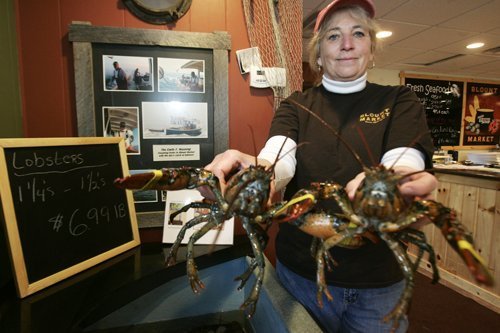
In Warren, Blount Seafood Market Manager Emily Hall said business has been steady, even with prices that are drastically down.
“Usually around this time of year, the boat price – directly off the boat – is about $6 per pound,” she said. “And right now that’s between $3.75 and $4.50 per pound.”
But because it hurts lobstermen, it seems that retailers in Rhode Island are reluctant to convey cheerfulness about lowered wholesale prices. In conversations with local retailers, there seemed to be measurable solidarity between them and the lobstermen.
Low prices are “good for the consumer, but not for the lobstermen. … They’re the ones who are having a tough time this year – between the high gas prices and the low lobster prices,” said O’Donnell. He has been at Aquidneck for 32 years, dealing with some of the same wholesalers for much of that time.
“Naturally, I don’t mind paying less,” he added. “But I only make a certain markup whether I pay $3 per pound or if I pay $8 per pound.”
It’s about $1 profit per pound either way, he said.
Lobster pricing follows an annual pattern, with lows in the fall and highs in January and the summer months. O’Donnell put it this way last week: “Nobody likes to be in the lobstering business in November.”
But the current pricing rut is the lowest that’s been seen in at least 20 years, said Andrew Rock, who runs the mail-order Web site Lobster.com. His prices are more directly fixed to shipping rates than to wholesale value of the lobsters.
“It may seem like a good thing [that prices are down, but] there are hundreds of New England communities that depend on family-oriented lobster fisheries,” he said. “So we’re all concerned about that.”
Rock linked the falling prices to a few market forces, including the price of oil and the decline of the euro against the U.S. dollar. “The effect of that is that there is less being shipped out of the country,” he said.
Of the market forces that control lobster pricing, it seems that inventory is one of the most influential. Right now, there’s more “production” than the market can handle, Rock said.
Lobstermen in eastern Canada usually increase the number of lobster that they catch during the fall and then hold them until January and February – when locals aren’t out catching lobsters – to sell them to New England.
But this year, the inability for lobster-based businesses to get the preseason loans that they need to afford to hold those lobsters – a sign of the current economic state – could force those lobstermen to flood the New England market this fall, O’Donnell said. “That will maintain the low price that there is now and there will be no lobsters put away for later in the year, when the prices are higher,” he said. “So they’ll be sky-high [in January], the highest prices ever,” he predicted.
From mid-October to mid-January, there’s usually about 50 million pounds of lobster harvested in New England and Canada, said David Burnell, seafood, deli and meat manager at McQuade’s Marketplace in Jamestown. “And about 40 percent of that, nobody knows how it’s going to be absorbed into the industry,” he said.
Massachusetts Lobstermen’s Association Executive Director Bill Adler told a Canadian newspaper last week that the low prices, coupled with the economic downturn, could cut as much as $100 million from lobster-based economies in the region this year. Rhode Island Lobstermen’s Association President Lanny Dellinger didn’t return several calls to his cell phone for comment last week.
To compound the problem, Canadian companies have stopped buying lobsters from Maine lobstermen. Right now, Maine lobstermen are out on their boats, catching plenty of lobster, but much of their fall catch of soft-shell lobster is usually sold to Canadian companies that process it for lobster-based products, O’Donnell said. But the Canadians’ “inventory is high, and they’re having trouble getting credit from banks,” he continued, “so they’ve quit buying stuff from Maine. Or they tried to talk them into not going out for a while, so they could reduce their inventory.”
They have also lowered their buying price to about $2 per pound, in an attempt to discourage lobstermen from flooding the market, O’Donnell said.
That price drop has been in effect for a few weeks, he added, and it’s been pushing prices lower in the rest of the region, including in Rhode Island.
But without the reserves that are usually shipped from Canada during the winter, the supply in Rhode Island and elsewhere is expected to drop, leading to a sharp spike in local retail and wholesale prices come January.
A few retailers also made it clear that the biggest test of the current inventory is whether customers buy lobsters during the weekend after Thanksgiving, when family members are usually together. That’s usually a fall high, said Burnell. He said his small shop sells a few dozen lobsters a week in the fall. But how well lobsters sell depends on so many factors other than the pricing. Something as simple as warm weather could make a big difference by encouraging more customers to venture out.
“It’s not an item that you can really guess what it’s going to do for you when you get it in,” said Burnell, who has been at McQuade’s for 36 years. “Sometimes it goes fairly well and someone will come in and buy eight. And sometimes it will sit there for a week.”
Even after 36 years of working in seafood retail, Burnell said it’s tough to predict just how well lobster will sell this holiday season.
He’s planning to put it on sale for the weekend after Thanksgiving, “just to see what happens.” •



