
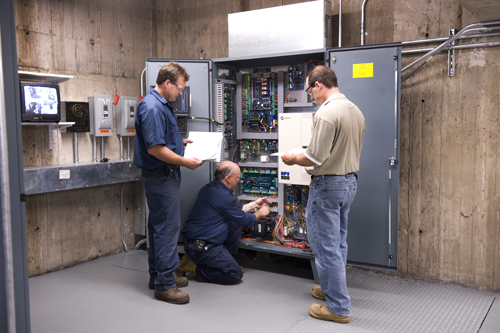
When organizations look for ways to reduce their energy consumption, they often focus on obvious targets like light bulbs or air conditioning. But a recent renovation at Brown University shows that opportunities for energy savings are available from top to bottom – literally.
Brown recently replaced all four elevators inside the school’s Sciences Library, the 14-story concrete building on the corner of Thayer and Waterman streets that has towered over Providence’s East Side since its opening in 1971. More than 3,000 students and faculty use the “Sci-Li,” as it’s called, during the busiest parts of the academic year, and by late 2006, after 35 years of heavy use, the original gearless-traction elevator machines were wearing out.
Most types of technology have evolved since the building was opened, and elevators are no exception. The big, noisy, dirty and complicated machines that ran elevators in the 1960s can’t match the sleek and quiet ones available today, said Jeffrey Parker, Brown’s project manager.
“It’s amazing – we’d look at it and say, who would figure this out?” he said. “From our perspective, it’s wildly archaic. But it worked, and it worked for over 40 years.”
Parker called in the university’s elevator-repair company, Seekonk-based Atlantic Elevator South Company Inc., a family-owned firm that says it is the largest independent elevator-service business in southern New England. Atlantic services elevators for a number of other large institutions, including Providence College, the University of Massachusetts and Memorial Hospital.
After studying an analysis of the elevators performed by Cranston-based Delta Electro Power and seeking input from consultant Noel Herschell of Lerch Bates and Associates Inc., Brown and Atlantic decided to replace everything but the cabs and counterweights in the three main elevators and the service elevator.
The project took a year, and presented a logistical challenge for Atlantic, because the busy library had to stay open – and quiet – throughout the construction phase.
Elevators are also one of the most energy-intensive parts of a building, and as part of Brown’s commitment to “greening” the university, all capital projects are required to emphasize sustainable design. The school and the outside companies found a variety of ways to incorporate that mission into the new elevators.
The elevators’ drives, for example, reduce an elevator’s energy consumption by up to 50 percent. The new magnetic-motor system and its component parts take up a fraction of the space in the upstairs machine room, generate less heat and don’t give off carbon dust.
The elevators’ dispatching computer has also become smarter – not only does it dispatch cars more efficiently, but it also learns the rhythms of the building, so that it can station idle cars on the floors where they are most likely to be needed during different times of the day. Even the old incandescent lights inside the elevator cars were replaced with fluorescent bulbs.
The inside of the elevator cars were also refurbished with new stainless steel walls, and Atlantic installed a video monitor in the library’s downstairs lobby.
“From what we have had to what we have installed is a quantum leap,” said Parker.
But they still were not done. Six months after Atlantic finished modernizing the elevators, Jonathan Driscoll, the company’s service manager, returned with his staff and set up the elevators’ regenerative drive units in order to recapture the energy generated during the elevator-ride cycle, which now gets funneled back into Brown’s electricity mix.
The university is planning similar green technology in other buildings.
In the coming years, Driscoll expects to see the type of energy efficient, high-tech elevators now installed at Brown become the norm. “This is where the industry’s going,” he said. •



