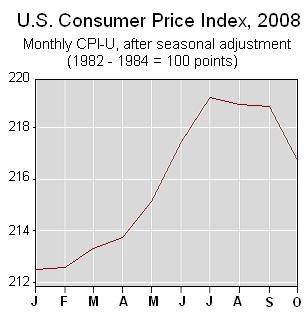
WASHINGTON – Consumer prices nationwide last month took their sharpest dive since record-keeping began in 1947, the U.S. Department of Labor’s Bureau of Labor Statistics reported today.
The nationwide Consumer Price Index for All Urban Consumers (CPI-U) fell a seasonally adjusted 1 percent compared with September. The CPI-U previously had dipped 0.03 percent in September and 0.14 percent in August, when it had its first monthly decline since October 2006. (READ MORE)
The reported decline in the CPI-U was 20 percent steeper than expected, based on the median forecast from a Bloomberg News survey of 77 economists, which called for a monthly decline of 0.8 percent. (The estimates of those polled ranged from a decline of 1.2 percent to an increase of 0.1 percent.)
Core prices excluding food and energy products fell 0.1 percent compared with the month before, in their first decline since 1982, after rising 0.1 percent in September and 0.2 percent in August.
Energy prices continued their retreat from July’s record highs, plunging 9.0 percent in October after falling 1.7 percent in September and 3.2 percent in August. Gasoline prices led the decline, falling 14.2 percent compared with September, although they remained 12.0 percent above year-ago levels. But food prices continued to rise, although their gains slowed to 0.3 percent in October from the 0.6-percent gains of the preceding two months.
Compared with a year ago, the CPI-U rose 3.7 percent – the smallest year-over-year gain since the same month of 2007 – to an October level of 216.573 points (December 1999=100). The core price index rose 2.2 percent compared with October 2007, slowing from September’s 2.5-percent gain. Food prices rose 6.3 percent compared with a year ago, while energy prices rose 11.5 percent.
In the Northeast, the CPI-U rose 4.0 percent compared with a year ago, but fell 0.9 percent compared with this September.
Meanwhile, the BLS said in a separate report, “real” earnings adjusted for inflation rose 1.4 percent in October compared with the month before, as average hourly earnings rose 0.2 percent and the national price index for urban wage earners and clerical workers (the CPI-W) fell 1.2 percent compared with September. Compared with October 2007, however, real earnings fell 0.9 percent.
“The economy’s really just in horrific shape,” Joseph LaVorgna, chief U.S. economist at Deutsche Bank Securities in New York, told Bloomberg News. The Federal Reserve will “take rates as low as they have to” to avoid “a deflation-type scenario, which now all of a sudden is very possible,” LaVorgna added. He predicts that the Fed’s policymaking committee will cut its benchmark rate in half, to 0.5 percent from the current 1.0 percent, at its next regular meeting on Dec. 16.
“Inflation pressures have evaporated,” James O’Sullivan, a senior economist at UBS Securities LLC in Stamford, Conn., recently told Bloomberg News. “Deflation is a word that will be increasingly used over the coming months.”
Additional information, including the 18-page Consumer Price Index report, is available from the U.S. Department of Labor’s Bureau of Labor Statistics at www.bls.gov/cpi; the related five-page Real Earnings report for October can be found at www.bls.gov/ces.
ISO 9001:2026: A Practical Opportunity to Build for What’s Next
For Rhode Island manufacturers, ISO 9001 has been much more than a certificate on the…
Learn More