
The overhaul of the Pawtucket Water Supply Board (PWSB) system serving approximately 100,000 customers in the northern part of the state means not only better-tasting water for consumers, but also potential opportunities for businesses looking to locate in Pawtucket, Central Falls and the Valley Falls section of Cumberland.
James L. DeCelles, chief engineer for the water supply board, said improvements to the system, including a $44 million treatment plant that opened in March and ongoing replacement of distribution pipes, could help the area draw new commercial and industrial businesses.
“We are able to provide [better]-quality water, more reliable service and better fire flows,” DeCelles said, “so I would think all of that would encourage business.” The PWSB is also open to the idea of selling water to other communities. “We’re looking at that whole issue right now,” DeCelles said last week.
Bob Bryer, maintenance supervisor at Teknor Apex Co. in Pawtucket, said his company is able to “run backflow preventers now with minimal maintenance, so apparently the water is better.” Backflow preventers keep water from flowing back into and contaminating the entire system. About 10 or 15 years ago, Bryer recalled, the backflow preventers would be “full of rust and crud” on a regular basis.
The PWSB was awarded the largest Drinking Water State Revolving Fund (DWSRF) financial-assistance package in state history, a $70 million low-interest loan, according to a U.S. Environmental Protection Agency (EPA) report released in September that praises Pawtucket’s water and the board’s work to improve it. The PWSB financed a total of $135 million for the project, including restructuring a $27 million existing debt.
Earth Tech, a Long Beach, Calif., company, designed, built and operated the new plant until July, when Earth Tech was acquired by AECOM, based in Los Angeles, Calif. AECOM is currently working on design and construction of an Olympic Park for the 2012 games in London.
The PWSB owns the water treatment plant and pays AECOM to run it.
When the new plant went online in March, “we received several calls from customers telling us the water tasted better,” DeCelles said. In the past, the PWSB could receive as many as 100 calls each week complaining about taste and color, but now “if we get one or two a month, that’s a lot,” he said.
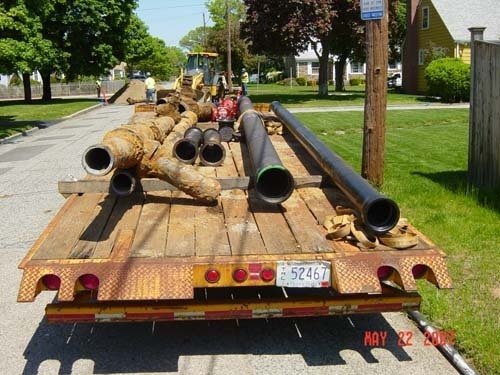
The new plant, with a capacity of 25-million gallons a day, has allowed for the use of less chlorine and lowered the level of disinfectant byproducts, the EPA said. Also adding to water quality is the ongoing replacement or cleaning of 260 miles of pipes, including mains and distribution lines to the curb, in all three communities, a project DeCelles reported is “right on schedule” for 2015 completion date. About 77 percent of the pipes are slated for cleaning or replacement.
The PWSB 53-member staff, which includes an engineering division, is in charge of designing and implementing the pipeline work. DeCelles roughly estimated that about $7 million or $8 million is being spent each year on replacement/cleaning, and about 75 to 80 percent of the work is already done. Water rates have kept pace with the improvements. In 2000, for example, the average annual household bill was roughly $164, and now it is approximately $433, including an 11-percent rate increase last month.
The quality of Pawtucket water became the butt of jokes after the summer of 1992 when it was declared unsafe due to high counts of fecal coliform bacteria, forcing consumers to boil water for more than two months.
That crisis, DeCelles said, put the overhaul improvement project “on a fast track.” •



