WASHINGTON – Consumer prices dipped last month for the first time since October 2006, as fuel prices retreated from July’s record highs, the U.S. Department of Labor’s Bureau of Labor Statistics reported today.
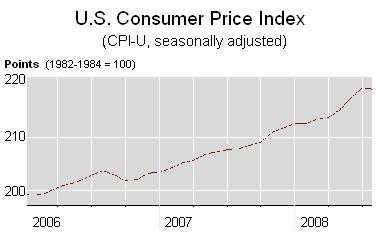
The nationwide Consumer Price Index for All Urban Consumers (CPI-U) fell a seasonally adjusted 0.1 percent compared with the month before, after rising 0.8 percent in July and 1.1 percent in June, the BLS said.
The new reading matched the median forecast from a Bloomberg News survey of 75 economists. (Their estimates for the August CPI-U ranged from a decline of 0.3 percent to a gain of 0.4 percent.)
Core prices excluding food and energy products rose 0.2 percent last month compared with the month before, matching the survey’s forecast, after rising 0.3 percent in both July and June.
Energy prices fell 3.1 percent compared with the month before, after rising 4 percent in July and 6.6 percent in June. Leading the decline were fuel oil, which fell 9.6 percent in its biggest one-month decline since 2003; natural gas, down 5.8 percent; and gasoline, which fell 4.2 percent compared with July. But food prices continued to rise, although their gains slowed to 0.6 percent in August from 0.9 percent in July and 0.8 percent in June.
Compared with a year ago, the CPI-U rose 5.4 percent to an August level of 219.086 points (December 1999=100), slowing from a 5.6-percent year-over-year gain the month before that Bloomberg said was the sharpest since January 1991.
The core price index rose 2.5 percent compared with August 2007, lagging analyst estimates but matching July’s year-over-year gain. Food prices rose 6.1 percent compared with a year ago, while energy prices rose 27.2 percent.
In the Northeast, the CPI-U rose 5.5 percent compared with a year ago. Energy costs rose 29.1 percent while food rose 5.8 percent.
Meanwhile, the BLS said in a separate report, earnings adjusted for inflation rose 0.6 percent in August compared with the month before, after falling 0.8 percent in July. Average weekly hours were unchanged from July, while hourly earnings rose 0.4 percent, more than offsetting a 0.2-percent rise in the price index for urban wage earners and clerical workers (the CPI-W).
Compared with August 2007, however, real earnings fell 2.5 percent last month.
“Inflation is not a concern for the Fed,” Ryan Sweet, an economist at Moody’s Economy.com in West Chester, Pa., told Bloomberg News. Today’s report reflects “lower energy prices, a global economy that is on the edge of recession and modest wage pressures.”
Additional information, including the 18-page Consumer Price Index report for August 2008, is available from the U.S. Department of Labor’s Bureau of Labor Statistics at www.bls.gov/cpi; the five-page Real Earnings report can be found at www.bls.gov/ces.