Even on a quiet day, the emergency room at Memorial Hospital of Rhode Island is not very pleasant. Triage is done at a desk off the corridor. Inside, patients lie in narrow treatment bays separated by curtains. There’s little room for family members; privacy is elusive.
It looks and feels, actually, like countless urban ERs across the country.
But at Memorial, that’s soon to change.
Early next month, after a year and $3.5 million in renovations, the Pawtucket hospital plans to open a larger, more streamlined and high-tech emergency facility.
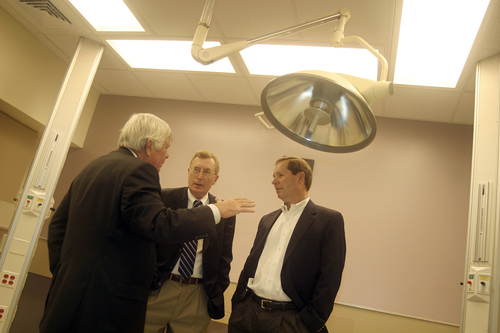
Memorial President and CEO Francis R. Dietz and Dr. Liudvikas Jagminas, chief of emergency medicine, last week offered a first look at the new ER with a “hard-hat” tour for hospital board members, supporters, senior staff, doctors and the media.
“The whole premise” of the project, Jagminas said, “is trying to improve the flow, the function throughout the department, and also enhance privacy. We [also] spent a lot of effort and time and money getting technology to the bedside.”
Indeed, the new ER – which is still partially under construction, and has almost no furniture or equipment in it yet – represents a major upgrade from the old space (currently, the ER is in yet another area, the former rehabilitation center). The new space is about 1,200 square feet larger than the old emergency department.
There’s also the new horseshoe-style design: On one end is the entrance for walk-in patients, with a waiting room and a special space for children; on the other end is the ambulance entrance, which also includes a decontamination room for patients who may have been exposed to toxic chemicals or biological materials.
Between the two entrances are two private triage rooms – a smaller one for the walk-ins, and on the ambulance side, one with a communications gear designed to make it easy for the ER team to share information with rescue crews headed to the hospital.
A particularly big improvement, Jagminas noted, will be new technology that will allow paramedics to take 12-lead electrocardiograms and transmit them to the hospital, so doctors can review the EKGs and either direct treatment right in the ambulance, or gear up to immediately begin treatment when the patient rolls in.
“This is one of the first sites in Rhode Island to have this,” Jagminas said, adding that the system will accelerate treatment of cardiac patients, for whom time can be critical.
For patients, however, the most visible change will be the treatment area setup. Instead of narrow bays separated by curtains, there are now small rooms with walls on both sides (but open in the front), most of them arranged around a central nurses’ station.
There’s enough room for a family member to stay with the patient.
The new design also provides far better visibility, Jagminas noted.
“The line of sight is enhanced, so we can see the patients, the patients can see us, and we never lose sight of each other,” he said. At the same time, enhanced technology will allow nurses at the desk to monitor all the patients’ vital signs. Overhead, on a big screen, an electronic tracking system will give them an overview of the entire department, with an “acuity score” for each patient, status updates, and alerts anytime a new order is put in by a doctor.
Memorial already uses that tracking system as well as electronic medical records, and increasingly, those systems are integrated with the hospital’s record systems.
In addition, X-rays, CT scans, MRIs and other imaging procedures are all digital now, and lab test results are also conveyed electronically.
In the new ER, clinicians will be able to make the most of those resources, Jagminas said, by using portable computers. “The goal is to bring caregivers the information right at the bedside,” he said. •