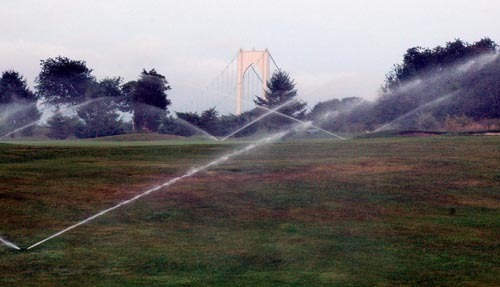
With its lush, well-tended grass, the nine-hole Jamestown Golf Course on Conanicut Island is an idyllic spot for a late afternoon game. But the grass isn’t the only thing that’s green about the place. It’s also one of the few golf courses in the Northeast that gets irrigated using partially treated wastewater, an innovation environmental advocates hail as a sustainable and practical way to address chronic summer water shortages.
A half-mile-long pipe connects the Conanicus Avenue golf course to the local sewage treatment plant. Flowing through it is a continuous stream of partially treated wastewater, or effluent, that gets deposited into a retaining pond at the course, which in turn supplies the 300 sprinkler heads that water the grass there each night.
Officials say the quality of the effluent, which is tightly regulated by the R.I. Department of Environmental Management, is safe and suitable for irrigation, though not for human consumption.
The pipe-to-pond system was constructed in the late 1990s, after queasy neighbors complained about the old method of delivering effluent to the course – spraying the partially treated sewage onto the course out of a tanker truck. That approach wasn’t particularly effective, either.
“It’s been great,” said the course’s general manager, Jon Mistowski, whose family has managed the town-owned golf course since 1987. “With the truck we could only do, like, a couple of greens at night. With the irrigation we can do the entire golf course, so the entire golf course is green now, and growing.”
Despite its success in Jamestown, effluent irrigation is still rare at golf courses in the Northeast, where just 3 percent of courses have developed it, according to a 2007 study by the Golf Course Superintendents Association of America.
By contrast, 37 percent of courses in the Southwest irrigate with treated wastewater, and 24 percent do so in the Southeast, the study found. In Prineville, Ore., the town built a municipal golf course specifically to dispose of its wastewater.
The reason for the variation is simple, said Greg Lyman, director of environmental programs for the golf association. “Those [regions] are where water issues are the order of the day each and every day,” he said. “They don’t have drought cycles like we have in the Northeast – they live in drought. Water is just a much more precious commodity there.”
The Jamestown course’s managers don’t pay for the effluent, which would otherwise be discharged somewhere else, but they did spend $200,000 up front to construct the pipes and special filters, and continue to pay for maintenance, Mistowski said.
Using effluent instead of tap water for the golf course makes particular sense on Conanicut Island, which has limited access to fresh water. It could also serve as a model for other communities statewide, says Sheila Dormody, Rhode Island director of the advocacy group Clean Water Action.
“We spend so much money making sure our water is safe to drink, and then we spread it all over our lawns – it’s crazy,” Dormody said. “So I think using that treated wastewater that’s perfectly safe to create lawns or golf courses is a much better use.”
Golfers like the effluent irrigation system, as well. One of the state’s most prominent environmentalists, Chip Young, also happens to be a golfer who plays on the Jamestown course.
“The course is beautiful,” he said. “You don’t go a week playing out there without somebody that hasn’t been around for awhile saying, ‘I can’t believe what’s happened to this course!’ ”
It’s also made it easier to play. By midsummer, the Jamestown course “used to be a lot of hard-baked ground with very little grass – you’d hit a line drive and it would roll like a bowling alley; it would run forever, like hitting on asphalt,” Young recalled. “Now it’s got lush greens and good fairways.” •