The warning signs of trouble at the Education Partnership were visible months ago, Linda Borden realizes now.
Borden, whose two children were selected for scholarships by the education advocacy group, first had difficulty getting the organization to re-send a notification letter last spring.
Then her contact at the partnership left her job. And Borden received various excuses as to why a promised awards dinner hadn’t been scheduled yet.
“I should have known then,” Borden, of Warwick, said last week.
The Education Partnership – which had numerous local corporate partners – closed suddenly last month, entering receivership and leaving dozens of students and their families such as the Bordens with an unexpected hole in their financial plans to pay for college. (READ MORE)
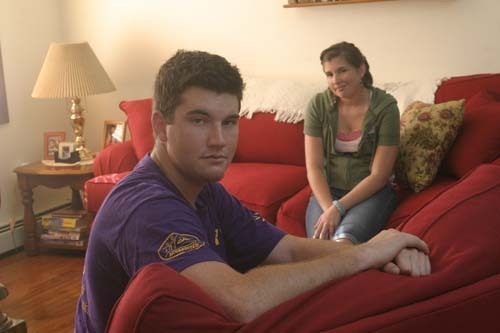
Linda Borden’s children, Ryan, 19, and Jaimie, 17, each had been promised $2,000 a year for tuition and supplies, and another $2,000 upon graduation.
Those promises have now vanished and Linda Borden, a widow, has to figure out how to make up the difference to finance the $5,700 annual tuition at Rhode Island College for both her children.
“My son knows he’ll have to get a loan,” said Linda Borden, who isn’t hopeful that they’ll ever see the scholarship money.
Last week, the court-appointed receiver – bankruptcy lawyer Alan M. Shine of Winograd, Shine & Zacks PC – was working out the details of hiring a forensic accountant to determine how the Education Partnership got into financial trouble. A hearing before Superior Court Judge Michael Silverstein to appoint that accountant was scheduled for July 24.
Earlier this month, Shine said he didn’t want to speculate as to why the partnership had failed. “That’s why we’re appointing a forensic accountant,” he said.
Meanwhile, the R.I. Attorney General’s Office is tracking the situation, according to Assistant Attorney General Jim Lee, chief of the department’s civil division.
More than would-be scholarship recipients were caught by surprise by the Education Partnership’s sudden closure.
Shine told Providence Business News last week that hundreds of creditors have filed claims with his firm, and that number continues to grow daily. Creditors have four months to make a claim, so it isn’t clear how much the partnership was in debt when it ceased operating in June.
So far, 36 students who were promised as much as $10,000 each in scholarships have posted claims, Shine said. There probably are dozens more who have not contacted him as yet.
Also on the list of creditors is the landlord of the building where Education Partnership rented offices on South Main Street in Providence – the landlord said it is owed $50,000 in rent – and Sovereign Bank, which is owed about $300,000 in loans.
The bank, as a secured lender, is one of the first in line to be reimbursed as the partnership’s assets are sold off and the money left in its accounts are distributed, according to Shine.
It has not been determined how much is owed to the local, state and federal tax agencies. Those agencies would also be a priority.
Shine said an auction for Education Partnership’s office equipment has been scheduled for next month and is expected to bring in about $10,000. Selling the furniture and fixtures would serve a double purpose, bringing in dollars for creditors and allowing for the partnership to officially vacate the office and prevent further rental costs.
It didn’t look promising last week that students who were expecting scholarships totaling about $177,000 would ever see the money.
“It’s a difficult situation for everybody,” Shine said, who has advised former staffers and members of the board of directors not to talk to reporters.
Rebecca E. Book, the chairwoman of the Education Partnership’s board of directors, did not return a call seeking comment last week.
The Education Partnership formed in 2003 with the merger of two other organizations, the Business Education Roundtable and the Public Education Fund.
With corporate and foundation backing, the nonprofit organization developed education policy, offered contract-analysis services to municipalities and school boards across the state and created its own education programs.
Between 2005 and 2007, the partnership had released an annual report, “Teacher Contracts: Restoring the Balance,” which examined how those contracts could be used to improve student grades.
The organization also offered scholarships through the Louis Feinstein Memorial Scholarship, which was established by philanthropist Alan Shawn Feinstein with a $2.4 million donation to the Public Education Fund in 1993.
Feinstein said last week that he was shocked to learn of the Education Partnership’s demise.
But Feinstein said he had difficulty communicating with the Education Partnership in recent years. He said he wasn’t allowed to know the names of the scholarship recipients.
After he filed a lawsuit, Feinstein said, he was allowed to have a representative sit on the selection committee, and he received a report on the amount of money left in the fund.
Feinstein said a report last year indicated that there was about $700,000 left in the fund, $88,000 of which had been promised to scholarship winners.
“Well, what’s happened to all that money?” said Feinstein, who named the scholarship to honor his father. “I’ve never heard of a situation like this. We’re just baffled by all this. This scholarship was working fine for the first 12 years when the Public Education Fund was overseeing it.”
Kellie Randall was counting on the Education Partnership scholarship to ease the financial burden of attending the Community College of Rhode Island.
She said she spent her senior year at Exeter-West Greenwich High School this past school year taking classes at CCRI as part of a special program that allowed her to get a jump-start on college. After this coming school year, she would be allowed to transfer to RIC for early-childhood education classes.
She’s still going forward with those plans, but working full time in hopes that she will be able to afford it. “The bill is going to be due soon, and I’ve got to figure out a way to pay for it,” she said.
The Bordens are in a similar situation.
Both children are working full time and are turning to other scholarships to make the financial numbers work. “We’ve applied for every one of them out there,” Linda Borden said.
Ryan attended Assumption College in Worcester, Mass., last school year, but decided it would be more affordable to transfer to RIC for his sophomore year to study education.
Although he was awarded an Education Partnership scholarship after graduating from Bishop Hendricken High School, he couldn’t take advantage of it because he attended an out-of-state school. With his transfer to RIC, the partnership told the Bordens that Ryan could use the scholarship this coming year.
Now it’s unclear if they will ever see the money.
Still, Linda Borden is determined. Asked whether she’d want them to take a year off to earn money for tuition, Borden said, “I couldn’t do that to my kids.” •