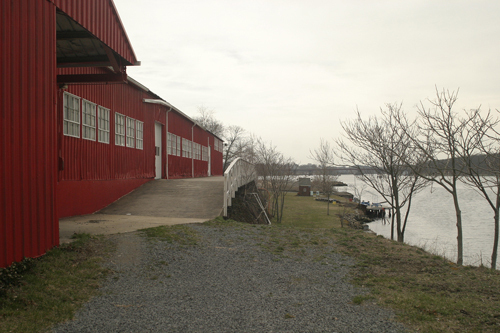
Construction hasn’t started yet on a 17-building, mixed-use, mill renovation in East Providence called Phillipsdale Landing, but the developer learned recently he won’t be able to rely as heavily as he’d hoped on the R.I. Historic Preservation Tax Credit program.
That’s because a bill approved by the General Assembly last week would lower the tax credit percentage available for about 100 projects that have earned first approvals, said Edward F. Sanderson, executive director of the R.I. Historical Preservation & Heritage Commission, which administers the credits.
For those projects, total construction costs are estimated at about $900 million, according to Sanderson’s office.
That bill – a second draft of a measure introduced by House leadership last month – is an attempt to restructure and lower funding for an economic development program that Gov. Donald L. Carcieri – in the face of a budget deficit estimated at about $150 million this fiscal year and $384 million during the next – proposed phasing out within 10 years, Sanderson said.
Under the bill approved by lawmakers and supported by Carcieri, projects completed during 2007 would be grandfathered into the current program, which offers a 30-percent credit with a 2.25-percent state fee.
Under the new program, to earn credits projects must have been approved last year. The bill also offers a lesser credit percentage for those approved but not completed by the end of 2007.
The 100 projects that had not been completed but had earned first approval – given by Sanderson’s office prior to construction – before January 1, 2008 would be eligible for a 22-percent state credit. Developers would be required to enter into contracts with the R.I. Division of Taxation and would have three options for their credit level and fees: a 25-percent credit with 3-percent fee, a 26-percent credit with 4-percent fee or a 27-percent credit with a 5-percent fee. All three credit options work out to 22 percent.
“Apparently, some developers thought they would be able to better handle a higher credit with a higher fee, and other developers thought they would be able to handle a lower credit and a lower fee,” Sanderson said, referring to input developers had in the crafting of the bill approved by lawmakers.
The state will take out bonds to fund the program and will also create a trust, into which all the fees paid would be invested, Sanderson said.
For Lance Robbins, principal of Urban Smart Growth, defining eligible projects by whether they were completed during 2007 is “onerous” and cutting the percentage for in-development projects adds a new level of uncertainty for many developers.
“It’s uniformly bad,” though not necessarily fatal, he said. Including Hope Artiste Village, Robbins’s company has about $152 million in projects that have first approval.
Another big change to the program – that state fees have to be paid upfront, by May 15, instead of when the project is completed – might stop some developments from going forward, too, Robbins said.
Sanderson agreed, saying, “for projects that are in an early stage, that is a big change.”
Phillipsdale Landing’s general contractor, New England Construction, is now calculating with Essex River Ventures Inc., the Charlestown, Mass.-based developer, the bill’s possible implications for the $20 million project. The project has its first approval and would qualify for the 22-percent credit, which is less than the developers had planned for when putting together financing.
“If [Essex River president John Fenton] is not able to do the project because of tax credits, and that’s up to him, obviously that would be a significant impact on our business,” said David Sluter, president of New England Construction.
Robbins said that’s what many developers are now doing – recalculating their financing.
Developers don’t have many alternatives to the state program to turn to, Sanderson said. Some towns offer tax treaties for historic structures, like Woonsocket’s façade-renovation program and Warren’s tax waivers, but those won’t draw in developers the way the state’s program can, he said.
While Sanderson said that the program’s future will likely be discussed by state leaders following this General Assembly session, the bill approved by lawmakers would put a moratorium on the program for now.
In Pawtucket, Lawrence Platt, president of Platt Realty Group, had been putting together an agreement with the city to renovate the former Old Colony Bank, a historic flat-iron-style building near Main Street. The state credits were a “critical component” for bringing investors and financing to the project, he said. He told Providence Business News before last week’s General Assembly votes that if the proposal becomes law “in no uncertain terms, we’re dead in the water.”
He added that he’s been hammering out the arrangements for about a year and is finally ready to begin construction in 2008.
“What I’ve just learned is that doing business with the State of Rhode Island is not something that one should be counting on,” Platt said.
The day following the General Assembly votes, Sandeson said his office had been drafting emergency regulations for the new program. He said infomation will be available to developers on the R.I. Historical Preservation & Heritage and Division of Taxation Web sites and that certified letters would be sent out soon. •