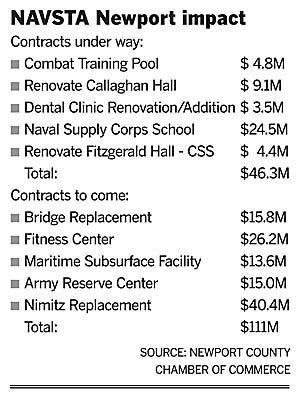
At a time when good economic news has been hard to come by in Rhode Island, the U.S. Navy last week announced expansion plans for the Newport naval base that include a big increase in officer training and at least $46.3 million in federally funded construction projects.
Capt. Michel T. Poirier, commanding officer of Naval Station Newport, told a Newport County Chamber of Commerce luncheon that the changes are a result of the federal Base Realignment and Closure Act of 2005 (BRAC).
The measure that closed or drastically reduced the size of military bases in almost every other state, but Rhode Island fared well. Poirier said he is “fairly certain” that no other military base in the country will grow as much as Newport in the coming years as a direct result of BRAC.
The biggest anticipated change is a 74-percent increase in the number of officers who will be trained in Newport. The base this year trained 9,200 students, a figure that will rise to an expected 16,000 over the next three years, Poirier said. The training is done at such sites as the Naval War College, the Officers Training Command, the Naval Justice School and the Surface Warfare Officers School.
Coming to the Newport base by fiscal year 2010 are the Naval Supply Corps School and Center for Service Support, now in Athens, Ga., and the Officers Training Command Pensacola, now in Florida, which Poirier called “a huge piece of our pie.” The latter will merge with the existing Officers Training Command Newport.
Other major BRAC changes include the consolidation of three Rhode Island reserve centers on the base and consolidation of the research activities of the Naval Undersea Warfare Center. (READ MORE.)
Three facilities are leaving the Newport naval station as a result of BRAC: the Navy Warfare Development Command and the Naval Reserve Readiness Command are both moving to Norfolk, Va., and the Chaplains School is going to Fort Jackson, S.C.
Regarding new construction work, Poirier said the Navy has $46.3 million worth of projects in progress at the Newport base, including building the Naval Supply Corps School and renovating Callaghan Hall and Fitzgerald Hall. And there’s more to come.
“We’ve got about $100 million in contracts we’re working on” Poirier said, with other projects in various stages of development.
To illustrate how important the Navy is to the state’s economy, Keith W. Stokes, executive director of the Newport County Chamber, pointed out that more than 16,000 Rhode Islanders are employed in defense-related industries, representing a $2 billion industry and 3 percent of the state’s employment base. The average wage “is pushing $70,000,” Stokes said.
The Navy is the third largest employer in the state, with more than 5,500 employees at the base and an annual payroll of $580 million.
Gov. Donald L. Carcieri, who also attended the luncheon, praised the Navy for its investment in Newport.
No one at the event discussed why Rhode Island fared so well under BRAC, but former U.S. Sen. Lincoln D. Chafee offers an explanation in his soon-to-be-released memoir, “Against the Tide,” due in bookstores in April and published by Thomas Dunne Books of St. Martin’s Press, New York.
Chafee suggests that Republican leaders in Congress made sure Rhode Island was treated well by BRAC and an unrelated highway authorization bill because party leaders in 2004 were fearful of him leaving the party.
He remained a Republican, only to be defeated in his 2006 bid for re-election by current Sen. Sheldon Whitehouse, a Democrat. Chafee later switched his party affiliation to unaffiliated. •