A newly released poll commissioned by Ocean State Action, an advocacy group with a special interest in health care, shows a strong sense among Rhode Island voters that some kind of government-initiated reform is in order – but what that should be is less clear.
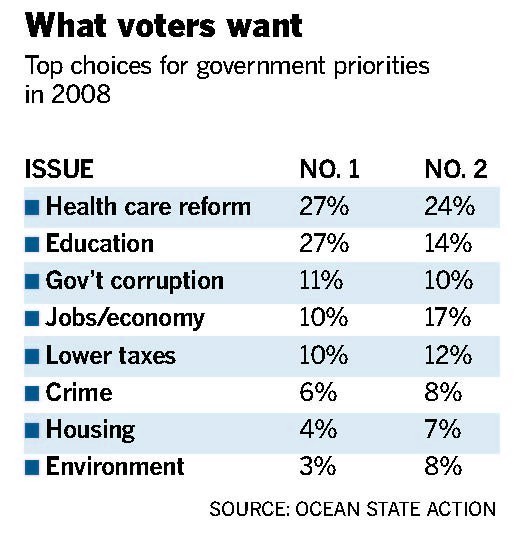
The poll, designed by a Northeastern University researcher and conducted in late October by Brown University’s Taubman Center for Public Policy, found health care was a major concern among the 410 registered voters polled, with 27 percent naming it as the top item they want government to focus on, and 24 percent naming it second.
The poll also found that while an overwhelming majority of the respondents had health insurance – 90 percent of those under 65 – one-third (32 percent) were either “very concerned” or “somewhat concerned” about losing it. In addition, 22 percent of respondents said their share of medical costs had increased “a lot” over the last year or two.
And respondents felt strongly that Rhode Island’s health care system is in trouble: 15 percent said it is “in a state of crisis,” and 55 percent said it has “major problems,” the poll found.
Cost and access both seem to be substantial concerns, with 87 percent of respondents saying they care about the latter. Even more, 96 percent, said they care about controlling health care costs.
Policymakers considering cuts to RIte Care, the state’s Medicaid program for children and families, to close the state budget gap, might want to take note: 67 percent of respondents said continued support for RIte Care is “very important,” while only 5 percent said it is “not too” important or “not at all” important.
The poll results were equally clear on the private sector’s ability to solve the system’s problems: Only 16 percent said insurers and providers could fix the system without government intervention, while 68 percent disagreed with that notion.
An overwhelming 84 percent of respondents agreed that health care “is a right that no one should be denied,” and 64 percent agreed health care reform is a “moral issue.”
But what shape the reforms should take wasn’t as clear. The poll found support for a wide range of measures, including expanded government programs and employer and individual mandates – all components of the Massachusetts health care reforms – as well as tighter regulation of insurers and financial rewards and penalties to encourage healthy lifestyles.
A full 75 percent of respondents said businesses “over a certain size” – the actual size wasn’t determined – should have to offer insurance or pay into a government fund, and 58 percent of respondents said all uninsured adults should be required to buy insurance if it’s affordable.
But asked whether they would pay more taxes to ensure all have health care coverage, 49 percent said yes, 41 percent no. And the Massachusetts plan itself still generates uncertainty: 28 percent of respondents said Rhode Island policymakers should use it as a model, 16 percent disagreed, and 56 percent were either neutral or didn’t know.
Health Insurance Commissioner Christopher F. Koller, who has been briefed on the poll, said it shows “broad support” for some kind of reform, “but the devil is in the details.”
Asked whether momentum for reform is building, Koller said to some extent it is, but it’s hard to decide whether cost, access or quality needs to be addressed first, or whether all three can be tackled at once. And in the current budget environment, he said, there’s little chance of an actual coverage expansion – not one that builds on government programs.
Koller said he expects the R.I. General Assembly to consider several reform measures this year, but “I don’t think you’re going to see a comprehensive proposal that would raise taxes to provide subsidies for low-income people.” His own focus this year, he said, will be on changes to the small-group market, but he’s not planning any major initiatives.
Lt. Gov. Elizabeth H. Roberts, meanwhile, does have an ambitious reform agenda, and she’s enlisted everyone from Koller to health care industry leaders to business and consumer advocates to help her put together a package. She said they are considering components of reforms in Massachusetts, Vermont, California and other places, plus local ideas.
Yet whatever happens in Rhode Island this year, Roberts said, it’s likely to be more of an incremental change than a dramatic overhaul.
“One of the things we need to do is build on the strengths of what we have now,” she said. “I don’t think people are ready for absolutely radical change. … [And] I’m fine with that, but we need to start moving because, as it says in this poll, inaction is not an option moving forward.” •