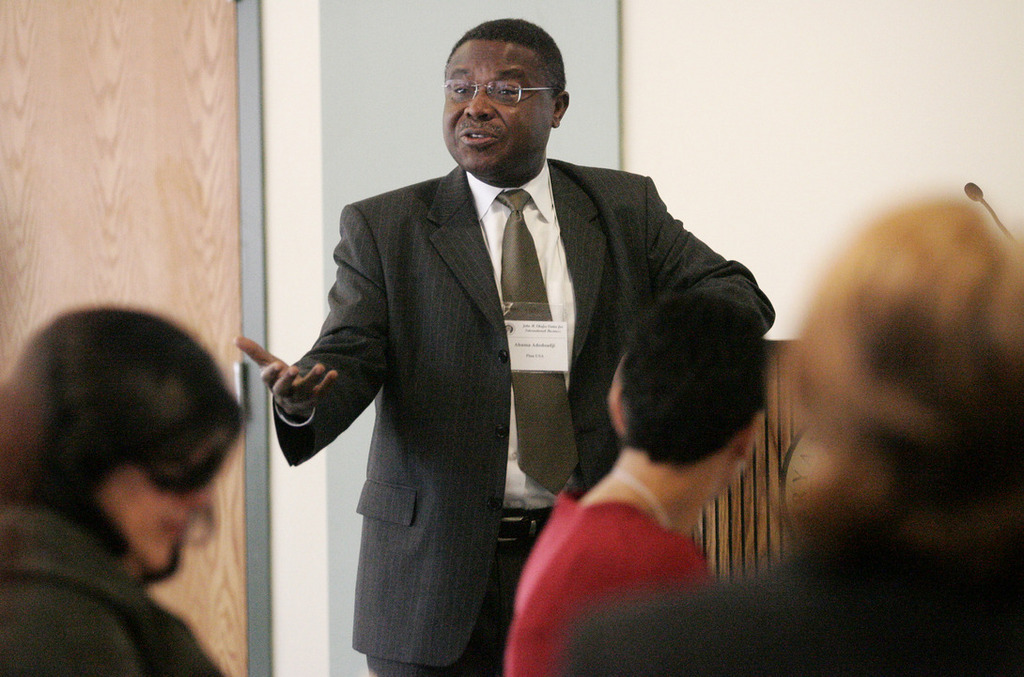
On his taxi trip through Warwick to a job interview with Plan USA, Ahuma Adodoadji, who has since started as CEO, got a rude awakening about the nonprofit’s Rhode Island presence.
He asked the taxi driver whether he knew about the nonprofit, which has been helping impoverished children internationally for 70 years.
No, the driver, a life-long Rhode Islander, hadn’t heard of it – although it’s been based in Warwick for 34 years and is the highest-revenue advocacy organization in the state.
So now Adodoadji, a Ghana native, is working to make local businesses aware of the plight of millions of children and how they can help Plan USA.
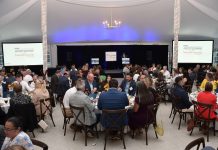
“Rhode Island, we belong to you, you belong to us, so we want you to reach out and put your arms around us,” he told a crowd of business leaders at a recent Bryant University luncheon in the John H. Chafee Center for International Business.
Globally, one in six children lives in poverty. One in seven receives no access to health care. Each year, four million infants die within a month of birth, he said.
At least one local company has found the case for supporting Plan USA compelling in the context of a broader corporate social responsibility initiative.
Hope Global Corp., a 125-year-old textile manufacturer based in Cumberland, has been working to reduce its environmental impact, and as part of that, it started a recycling program to reuse 60 percent of its waste – much of that accomplished through cooperation with other businesses.
“What was a surprise was when they went to the employees and asked what they wanted to do with the recycle money we raised?” said President and CEO Cheryl Merchant. “Their answer was, ‘We’d like to donate it to a charity.’ ”
The employees chose Plan USA.
Plan USA is “dedicated to children, and it’s a global operation that has ethics and values that we admired,” Merchant said.
Then the employees took another step. They each began to donate $1 out of their paychecks.
Ray Fogarty, director of the Chafee Center at Bryant, said a program like the one in place at Hope Global is a fine example of what Rhode Islander businesses might undertake. Leaders such as Merchant are what they need. “I couldn’t think of a better example than Cheryl.”
Plan USA, formerly Foster Plan USA, operates in 66 countries worldwide and helps 10 million children, 10 of whom are now sponsored by Hope Global.
“Our work, actually, if it didn’t exist, there would be some children who literally would just die without access” to health care, Adodoadji said. “Our work is so critical.”
For a Rhode Island business, Adodoadji said, it should be an easy decision when thinking about helping suffering children.
“Working to improve the lives of children around the world makes America look good,” he said. “And also it improves our security. We build friends around the world with some of our work, the work of similar organizations. It is good business for America to be proud of trying to change the world, make it a better place.”
Another business, California-based Princess Cruises, also asks employees to donate $1 from each paycheck. That’s not much, a barely noticeable amount, said Bruce Rutter, managing director for marketing and communications with Plan USA. But it was a small way to help. Now, after two years, those dollars have totaled $1.6 million for Plan USA.
With further help from businesses, Adodoadji said the nonprofit can continue to grow its $51.7 million annual revenue. Companies should give back, Merchant said.
“This is a way to show our passion and our caring,” Merchant said, adding “We all strive to be at that level of human kindness.” •