Rome wasn’t built in a day, and neither has the foundation for a thriving information technology sector in greater Providence been. But according to local IT experts, it is being built.
Several years into the Providence renaissance, the city and its environs are home to a handful of nationally recognized Internet entrepreneurs and an increasing number of smaller IT startups attracting venture capital.
“It’s a drumbeat, and it’s gotten better in my seven years here,” said Thorne Sparkman, managing director of the Slater Technology Fund, a state-funded venture capital source. “The deals are better, and they are more numerous.
Though mostly anecdotal, evidence that Providence’s IT community is building towards a critical mass can be seen in the fact that “tier-one entrepreneurs” such as Bill O’Farrell (co-founder and former CEO of SpeechWorks, who is now working to launch PublicDisplay) and Dan Lowe (founder of TAZZ Networks) have chosen the city to launch new Web startups here, Sparkman said.
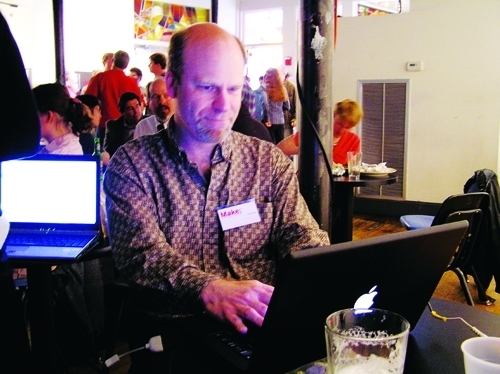
Another sign of the city’s burgeoning IT community is the success of the Providence Geeks, a loosely knit IT group that formed a little more than a year ago and now attracts more than 100 people to its monthly social events at AS220, he said.
An increasing number of IT entrepreneurs and industry professionals are being attracted to Providence and its surrounding towns for a variety of reasons, said Jack Templin, principal of the Internet consultancy Thought Cap and a founder of the Providence Geeks.
Providence is ideally situated, between Boston and New York City, has one of the highest per capita student populations of any city its size in the country, is affordable, and has a vibrant arts and music scene and city and state governments that understand the importance of the IT sector and are working to support it, Templin said.
“I think the community is really starting to gel, and that’s a very positive sign for the future, because when the community starts to gel like that, it becomes sort of a recognizable community that can be marketed outside the state,” he said.
Two marquee initiatives to further bolster the local IT community stalled recently when state lawmakers, facing a large budget deficit, chose not to fund RI-WINs – a project to make Rhode Island the first state with a border-to-border wireless broadband network – and the IT and Digital Media Center, which state economic development officials proposed to build as part of the redevelopment of the American Locomotive Works mill complex in Providence.
While both of those projects would undoubtedly help to spur the growth of Providence’s IT community, it is unrealistic to expect that government initiatives alone can turn the city into a regional hub for the sector, said Lee Hower, a senior associate at Point Judith Capital, a Providence-based venture capital firm.
“In a perfect world, I would be thrilled to see both of those programs get funding and support from the state, but the state has to balance the priorities of a whole bunch of areas,” he said. “Providence is not Silicon Valley, but Silicon Valley as it is today has taken 50 years to get there. It doesn’t happen overnight.” •