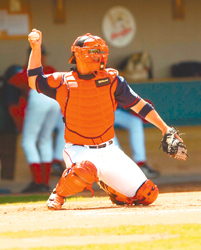
Snap history quiz: The Brown Stockings were…
A) Coal mine activists who fought brown lung disease
B) Minority suffragettes who picketed Woodrow Wilson
C) Worcester’s major league baseball team
The correct answer is C. In the late 19th century, during its industrial heyday
as a producer of iron, Worcester boasted its own National League baseball team,
the Worcester Brown Stockings.
ISO 9001:2026: A Practical Opportunity to Build for What’s Next
For Rhode Island manufacturers, ISO 9001 has been much more than a certificate on the…
Learn More
The team’s moment in the sun only lasted from 1880 to 1882.
Citing a recent study in support of professional baseball in the city, Worcester
is trying to regain its lost sports glory by getting a Triple-A team of its
own.
Problem is, the Pawtucket Red Sox stand in the way.
The Professional Baseball Agreement (PBA) that governs major and minor leagues
prohibits franchises from operating within each other’s territory. The PawSox’
territory is defined as including Worcester County.
“It’s like owning any franchise – like, say, a McDonald’s franchise,” explained
PawSox President Michael Tamburro. “When you own a minor league franchise, you
have territories that belong to you, and that territory is defined as a county.
Worcester County is one of the counties that’s controlled by our Pawtucket club.
It prevents two teams from operating in the same market.”
For Worcester to get a team, the PawSox would have to exercise its right to
waive the PBA rule – an occurrence that appears unlikely, for now.
“This is not the first time that Worcester has been trying to get its own
minor league team,” Tamburro said. “The city has been talking about this for
years. But we need to protect a major investment that was made by the state
of Rhode Island and the Pawtucket Red Sox.”
Worcester’s baseball adherents remain undeterred. A Harvard study released
last month by Worcester Mayor Timothy Murray and City Councilor Philip Palmieri
weighed the economic benefits of a club. It concluded: “Worcester is the right
place to bring a team and now is the right time.”
The study also noted that minor league baseball attendance is up 15 percent
compared to last year. City Manager Mike O’Brien will soon name a committee
to consider the idea of building a baseball stadium in Worcester.
Councilor Palmieri is considered the No. 1 booster of getting a ballclub and
he’s not reticent about his goals.
“The battle cry has always been that Pawtucket will stop anything Worcester
tries to do with a ballclub, but we have a new can-do attitude,” Palmieri said.
“There are many ways to approach this. Maybe we can put together a stadium package.
We’re going about this carefully, we’ve met with businesspeople and developers,
and we will prevail. This city is going through a rebirth and we need a ballclub
to reflect that. We’re changing our image.
“Hey, we could have a rivalry with Pawtucket like that between the Yankees
and the Red Sox.”
David Forsberg, president of the Worcester Business Development Corporation,
echoed Palmieri’s enthusiasm.
“The white paper that came out last month has reinvigorated discussion of
baseball in our city,” Forsberg said. “Worcester is looking at all sorts of
options. We’re not hung up on Triple-A. The new team could be Double-A, or Single-A,
or even affiliated with an independent league.”
The latter option would circumvent the PBA’s territorial restriction. Indeed,
two independent baseball franchises – the Northern and Atlantic leagues – already
operate several successful ballclubs in the Northeast.
The Worcester Business Development Corporation is a private, nonprofit entity
and a driving force behind getting baseball in Worcester. Forsberg acknowledged
that Worcester’s quixotic effort to get a team has waxed and waned for at least
a decade.
“The PBA’s territorial hurdle is significant,” Forsberg admits. “To use the
inevitable sports cliché, we’ve already taken a few swings at this pitch.”
In regards to building a new multimillion-dollar baseball stadium in Worcester,
Forsberg said proponents must be careful to avoid economic hyperbole.
“A typical Triple-A team plays about 70 games at home, so of course that would
be an economic plus,” he said. “But we should be careful to not overstate the
economic benefits of a team. In my mind, what’s more important is that a team
would provide low-cost family entertainment and contribute to the quality of
community life. A ballclub would greatly enhance the civic pride of this city.”
John Persinos is a contributing writer to PBN.