Group, politicians criticize president
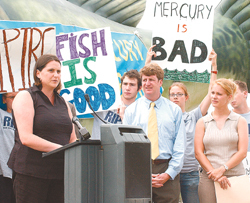
With a 20-foot inflatable fish serving as a backdrop, local representatives
from Clean Water Action joined with lawmakers on Aug. 20 at a press conference
on Water Street, Providence, as part of a campaign to reduce mercury pollution.
The event was held two days after Rhode Island improved its grade from a B- to a B on this year’s report card from the New England Zero Mercury Campaign. Eating mercury-contaminated fish is the primary way people are exposed to mercury, a toxic chemical released by power plants and garbage incinerators. Mercury has been linked to learning disabilities, developmental delays and problems with fine motor coordination in children.
Your Business Has Gone Global. Has Your Insurance?
A decade ago, “doing business internationally” was mostly a large-company concern. Today, a manufacturer in…
Learn More
In 1998, the New England governors recognized the severity of the mercury contamination problem and pledged to virtually eliminate emissions from the region by 2010. In 2005, the governors will evaluate their progress and timeline to achieve their interim goal of 75 percent reductions or greater. The Zero Mercury Campaign group is a coalition of environmental and public health organizations that grades the progress by each New England state annually. Democratic representatives U.S. Sen. Jack Reed and U.S. Rep. Patrick Kennedy were both on hand, as was state Attorney General Patrick Lynch. Reed and Kennedy stayed on message at the event, attacking the Bush administration’s Clear Skies Act, which aims to reduce mercury emissions 30 percent by 2010 and 70 percent by 2018.
“This is one of the most anti-environment administrations ever,” Kennedy said. “We’re not here today talking about the environment is some esoteric way. We’re talking about public health.”
Matt Auten, the clean air associate at the Rhode Island Public Interest Research Group, also spoke, saying the state should be looking to its neighbors in Connecticut and Massachusetts. Both states have set standards to drastically reduce mercury emissions. The Massachusetts Department of Environmental Protection released draft regulations calling for power plants to reduce emissions 85 percent by 2006 and 95 percent by 2012. Connecticut is requiring a 90 percent reduction by 2008.
Lynch said he continues to work with a group of other attorneys general from around the country to shore up the EPA’s national regulations, adding that the numbers and the science surrounding the issue of mercury contamination speak for themselves. He said the Bush administration is selling a “fish story” that the Clean Air and Clean Water acts are the best environmental policies the country can establish.
“They’re selling these things as great policy,” Lynch said. “And the lies will lead to environmental damage that can wreak havoc on the natural resources we rely on in the Ocean State.”
Sheila Dormody, Rhode Island director of Clean Water Action, said the state Department of Health is working to get the word out that it’s not all fish that pregnant women and young children need to worry about and the group is hopeful the state will pass a requirement that warnings about certain types of fish be posted in stores and restaurants.
“It’s bad for people’s health and it’s bad for the fishing industry when there’s confusion or a lack of education,” Dormody said.
Beyond that measure, Dormody said there have been some signs of positive progression in the Ocean State, chief among them a law requiring mercury to be taken out of consumer products. However, legislation introduced for the past three years to eliminate mercury in automobiles has stalled in the Assembly, due largely to lobbying efforts from the Alliance of Automobile Manufacturers, Dormody said.
The bill wouldn’t allow any cars to be bought or sold in Rhode Island that contained mercury.
“There’s 890 pounds of mercury driving around the state,” Dormody said. “The standard calculation is that all it takes is a single gram to contaminate all the fish in a 20-acre lake.”